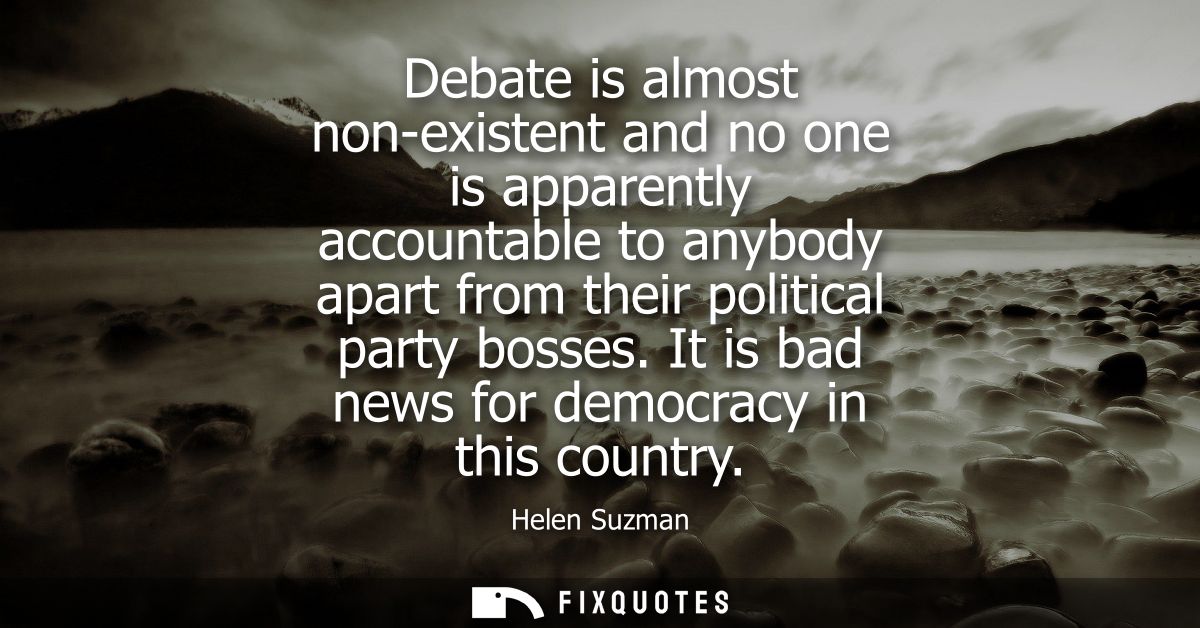
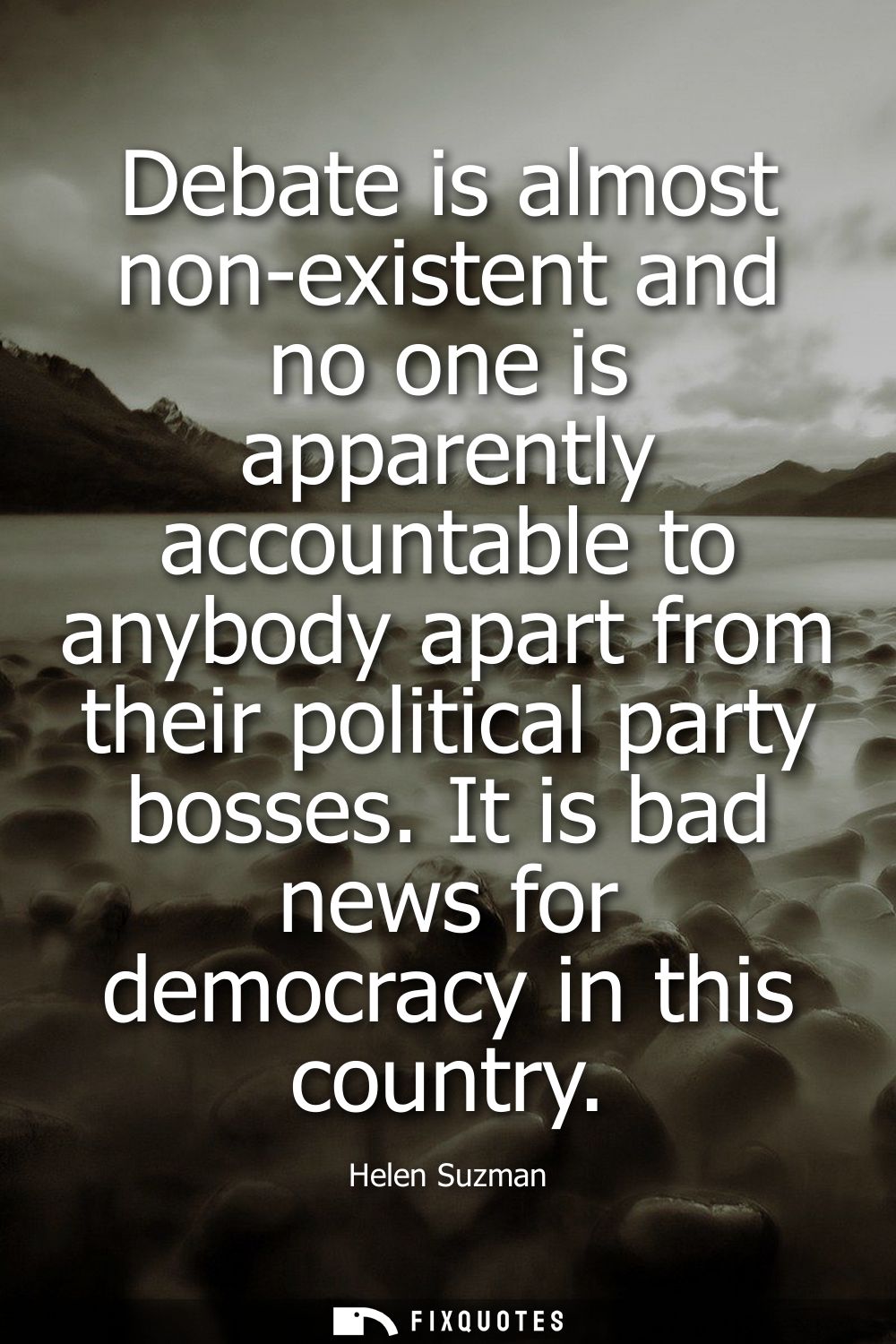
"Debate is almost non-existent and no one is apparently accountable to anybody apart from their political party bosses. It is bad news for democracy in this country"
About this Quote
The sting is in her target: “accountable to anybody apart from their political party bosses.” Suzman is diagnosing a legislature captured by internal hierarchies, where career survival depends less on citizens than on gatekeepers who control nominations, promotions, and access. That phrasing exposes the quiet mechanics of power: the real audience for many politicians isn’t the electorate, it’s the caucus room. Debate becomes “almost non-existent” not because everyone suddenly agrees, but because disagreement carries a professional penalty.
Context matters because Suzman wasn’t an armchair critic; she spent years as a near-solitary parliamentary opponent of apartheid, practicing the kind of adversarial politics she’s defending here. Coming from a South African politician who watched how institutions can be hollowed out while maintaining a facade of legality, her warning has a particular gravity. The subtext is blunt: majorities can become complacent, parties can become machines, and parliaments can become stages where outcomes are decided elsewhere.
“It is bad news for democracy” reads restrained, even clinical - which makes it sharper. Suzman doesn’t offer melodrama; she offers diagnosis. And diagnoses, unlike slogans, imply consequences.
Quote Details
| Topic | Freedom |
|---|---|
| Source | Help us find the source |
| Cite |
Citation Formats
APA Style (7th ed.)
Suzman, Helen. (2026, January 17). Debate is almost non-existent and no one is apparently accountable to anybody apart from their political party bosses. It is bad news for democracy in this country. FixQuotes. https://fixquotes.com/quotes/debate-is-almost-non-existent-and-no-one-is-53934/
Chicago Style
Suzman, Helen. "Debate is almost non-existent and no one is apparently accountable to anybody apart from their political party bosses. It is bad news for democracy in this country." FixQuotes. January 17, 2026. https://fixquotes.com/quotes/debate-is-almost-non-existent-and-no-one-is-53934/.
MLA Style (9th ed.)
"Debate is almost non-existent and no one is apparently accountable to anybody apart from their political party bosses. It is bad news for democracy in this country." FixQuotes, 17 Jan. 2026, https://fixquotes.com/quotes/debate-is-almost-non-existent-and-no-one-is-53934/. Accessed 6 Mar. 2026.