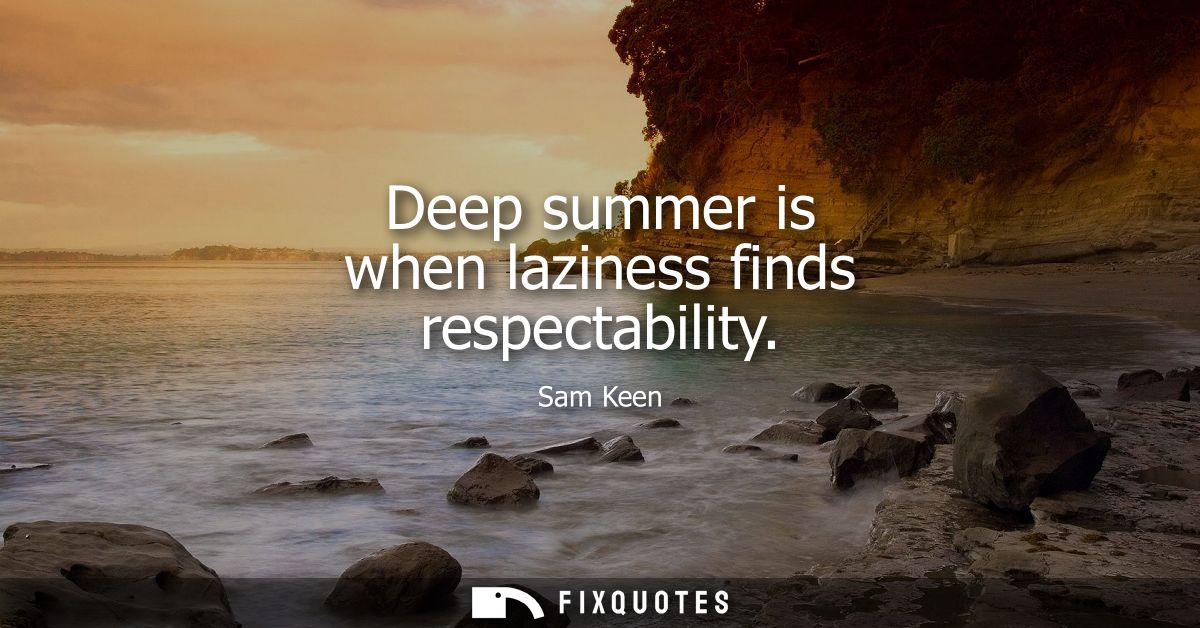
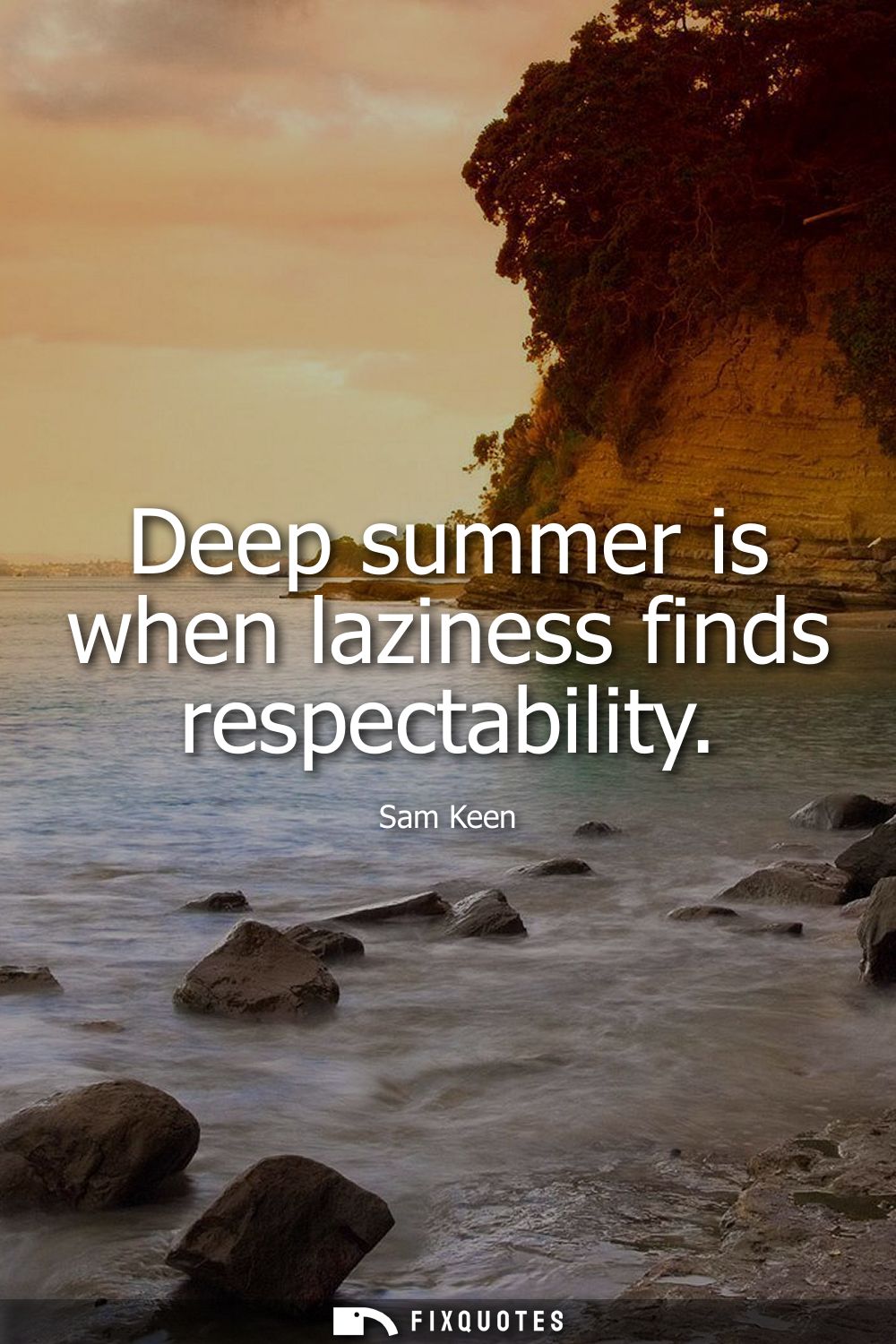
"Deep summer is when laziness finds respectability"
About this Quote
“Deep summer” isn’t just a date on the calendar; it’s a social permission slip. Sam Keen’s line hinges on a sly rebranding: laziness, normally policed as a moral failure, briefly passes as wisdom. The phrase “finds respectability” does the heavy lifting. Laziness isn’t redeemed by effort or productivity hacks; it’s legitimized by the season itself, as if heat and long light can confer dignity on doing less.
Keen, a self-styled philosopher of everyday life, often wrote about the stories we live inside - the myths of masculinity, the religion of busyness, the ways we confuse motion with meaning. Read in that context, the quote is a small rebellion against the Protestant work ethic that haunts modern selfhood. “Deep” suggests a tipping point: not early summer’s optimism or late summer’s melancholy, but the thick middle where time feels pooled rather than spent. In that middle, the culture’s usual surveillance softens. Vacations, slower offices, empty streets at noon: the world itself collaborates.
The subtext is less “take a break” than “notice how arbitrary our moral rankings are.” If idleness can become respectable in July, then maybe its disgrace in February is also a script, not a truth. Keen’s wit is gentle but pointed: we don’t suddenly become better people when we rest; we simply get a cultural alibi. The line invites a harder question - what would it mean to grant that respectability year-round, without needing the weather to excuse it?
Keen, a self-styled philosopher of everyday life, often wrote about the stories we live inside - the myths of masculinity, the religion of busyness, the ways we confuse motion with meaning. Read in that context, the quote is a small rebellion against the Protestant work ethic that haunts modern selfhood. “Deep” suggests a tipping point: not early summer’s optimism or late summer’s melancholy, but the thick middle where time feels pooled rather than spent. In that middle, the culture’s usual surveillance softens. Vacations, slower offices, empty streets at noon: the world itself collaborates.
The subtext is less “take a break” than “notice how arbitrary our moral rankings are.” If idleness can become respectable in July, then maybe its disgrace in February is also a script, not a truth. Keen’s wit is gentle but pointed: we don’t suddenly become better people when we rest; we simply get a cultural alibi. The line invites a harder question - what would it mean to grant that respectability year-round, without needing the weather to excuse it?
Quote Details
| Topic | Contentment |
|---|---|
| Source | Help us find the source |
| Cite |
Citation Formats
APA Style (7th ed.)
Keen, Sam. (2026, January 15). Deep summer is when laziness finds respectability. FixQuotes. https://fixquotes.com/quotes/deep-summer-is-when-laziness-finds-respectability-169695/
Chicago Style
Keen, Sam. "Deep summer is when laziness finds respectability." FixQuotes. January 15, 2026. https://fixquotes.com/quotes/deep-summer-is-when-laziness-finds-respectability-169695/.
MLA Style (9th ed.)
"Deep summer is when laziness finds respectability." FixQuotes, 15 Jan. 2026, https://fixquotes.com/quotes/deep-summer-is-when-laziness-finds-respectability-169695/. Accessed 27 Mar. 2026.
More Quotes by Sam
Add to List