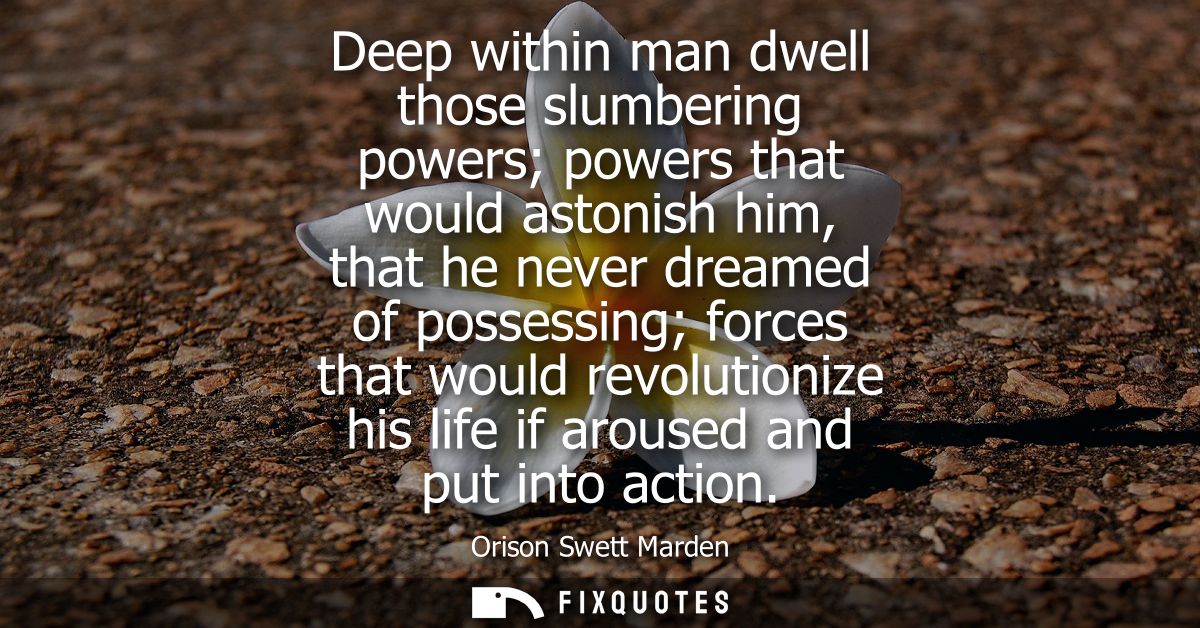
"Deep within man dwell those slumbering powers; powers that would astonish him, that he never dreamed of possessing; forces that would revolutionize his life if aroused and put into action"
About this Quote
The intent is motivational, but the subtext is moral and economic. “Powers” aren’t framed as communal or political capacities; they’re private assets waiting for the right mindset to liquidate them. The quote flatters the reader (“you have more in you than you know”) while quietly shifting responsibility onto the individual: if your life isn’t transformed, it’s because you haven’t “aroused” the right internal forces. That’s the classic early self-help bargain - empowerment with an invisible debt of self-blame.
Context matters. Marden is a foundational figure in turn-of-the-century American success literature, writing in a period of rapid industrialization, social mobility mythmaking, and anxious faith in “character” as a technology for advancement. His language borrows from the era’s quasi-spiritual psychology: the mind as a powerhouse, will as ignition, potential as destiny. Even the gendered “man” reads as a cultural baseline - the universalized citizen-worker who is expected to master himself the way the modern world is mastering machines.
Why it works: it makes change feel less like a slog and more like awakening, a sudden switch-flip. It offers hope without policy, transformation without institutions - a revolution staged entirely inside the skull.
Quote Details
| Topic | Motivational |
|---|---|
| Source | Help us find the source |
| Cite |
Citation Formats
APA Style (7th ed.)
Marden, Orison Swett. (2026, January 17). Deep within man dwell those slumbering powers; powers that would astonish him, that he never dreamed of possessing; forces that would revolutionize his life if aroused and put into action. FixQuotes. https://fixquotes.com/quotes/deep-within-man-dwell-those-slumbering-powers-35087/
Chicago Style
Marden, Orison Swett. "Deep within man dwell those slumbering powers; powers that would astonish him, that he never dreamed of possessing; forces that would revolutionize his life if aroused and put into action." FixQuotes. January 17, 2026. https://fixquotes.com/quotes/deep-within-man-dwell-those-slumbering-powers-35087/.
MLA Style (9th ed.)
"Deep within man dwell those slumbering powers; powers that would astonish him, that he never dreamed of possessing; forces that would revolutionize his life if aroused and put into action." FixQuotes, 17 Jan. 2026, https://fixquotes.com/quotes/deep-within-man-dwell-those-slumbering-powers-35087/. Accessed 24 Mar. 2026.