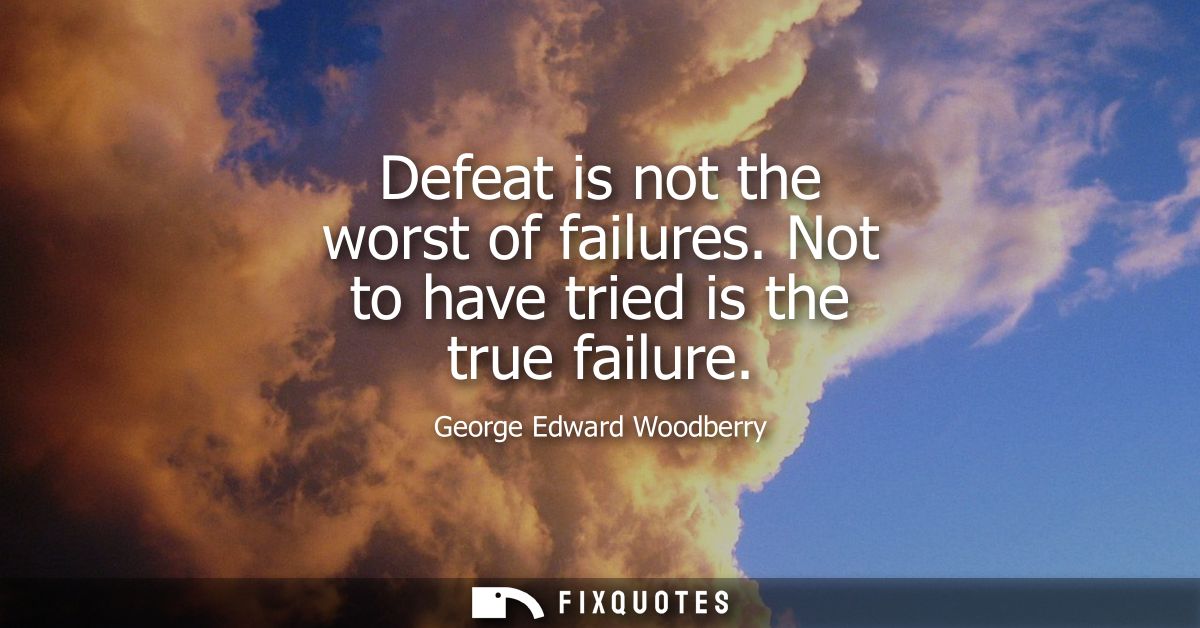
"Defeat is not the worst of failures. Not to have tried is the true failure"
About this Quote
The subtext is sharpened by Woodberry’s era. As a late-19th-century American man of letters, he’s writing in a culture intoxicated by progress and anxious about softness: industrial expansion, professionalization, and the rising authority of “merit” all put pressure on individuals to perform and to be seen performing. “Not to have tried” is cowardice, yes, but also a kind of social selfishness - hoarding your potential from the public record.
Rhetorically, the sentence works because it’s a corrective to shame. It doesn’t deny loss; it reassigns disgrace. Defeat becomes an acceptable cost of seriousness, while inaction is cast as the only outcome with no redeeming narrative. In a critic’s mouth, that’s also a plea: make the work, make the attempt, give us something worth judging.
Quote Details
| Topic | Failure |
|---|---|
| Source | Help us find the source |
| Cite |
Citation Formats
APA Style (7th ed.)
Woodberry, George Edward. (2026, January 16). Defeat is not the worst of failures. Not to have tried is the true failure. FixQuotes. https://fixquotes.com/quotes/defeat-is-not-the-worst-of-failures-not-to-have-126990/
Chicago Style
Woodberry, George Edward. "Defeat is not the worst of failures. Not to have tried is the true failure." FixQuotes. January 16, 2026. https://fixquotes.com/quotes/defeat-is-not-the-worst-of-failures-not-to-have-126990/.
MLA Style (9th ed.)
"Defeat is not the worst of failures. Not to have tried is the true failure." FixQuotes, 16 Jan. 2026, https://fixquotes.com/quotes/defeat-is-not-the-worst-of-failures-not-to-have-126990/. Accessed 12 Feb. 2026.