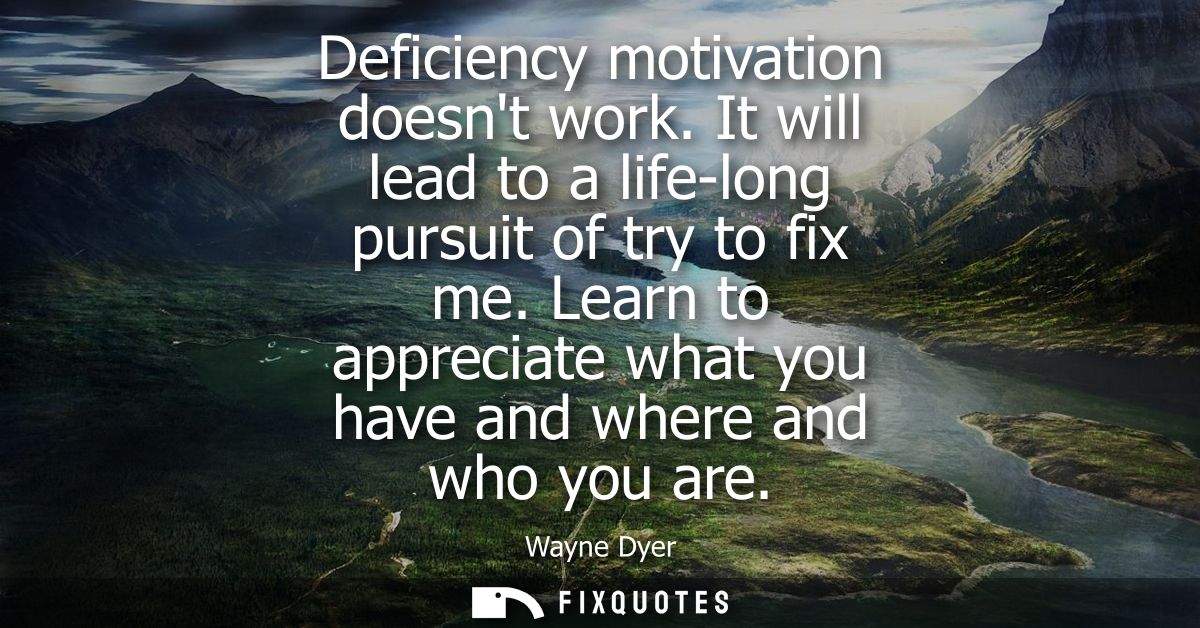
"Deficiency motivation doesn't work. It will lead to a life-long pursuit of try to fix me. Learn to appreciate what you have and where and who you are"
About this Quote
The subtext is about identity. If your motivation is built on deficiency, then your self-concept is built on deficiency too. Every achievement becomes a temporary patch, every setback evidence of the original flaw. That’s why he predicts “a life-long pursuit” of “try to fix me”: the goalpost moves because the real product isn’t progress, it’s self-surveillance. Dyer’s warning lands as cultural critique as much as personal advice, aimed at a modern economy of dissatisfaction that keeps people buying, optimizing, and diagnosing.
Context matters: Dyer emerged from a late-20th-century therapeutic culture where psychological language migrated into everyday life, and where self-improvement became both liberation and marketplace. His pivot - “Learn to appreciate what you have and where and who you are” - isn’t a call to complacency. It’s a reframe: growth that starts from sufficiency rather than shame. The power of the line is its quiet insistence that motivation doesn’t have to be a referendum on your worth.
Quote Details
| Topic | Gratitude |
|---|---|
| Source | Help us find the source |
| Cite |
Citation Formats
APA Style (7th ed.)
Dyer, Wayne. (2026, January 18). Deficiency motivation doesn't work. It will lead to a life-long pursuit of try to fix me. Learn to appreciate what you have and where and who you are. FixQuotes. https://fixquotes.com/quotes/deficiency-motivation-doesnt-work-it-will-lead-to-2302/
Chicago Style
Dyer, Wayne. "Deficiency motivation doesn't work. It will lead to a life-long pursuit of try to fix me. Learn to appreciate what you have and where and who you are." FixQuotes. January 18, 2026. https://fixquotes.com/quotes/deficiency-motivation-doesnt-work-it-will-lead-to-2302/.
MLA Style (9th ed.)
"Deficiency motivation doesn't work. It will lead to a life-long pursuit of try to fix me. Learn to appreciate what you have and where and who you are." FixQuotes, 18 Jan. 2026, https://fixquotes.com/quotes/deficiency-motivation-doesnt-work-it-will-lead-to-2302/. Accessed 6 Mar. 2026.