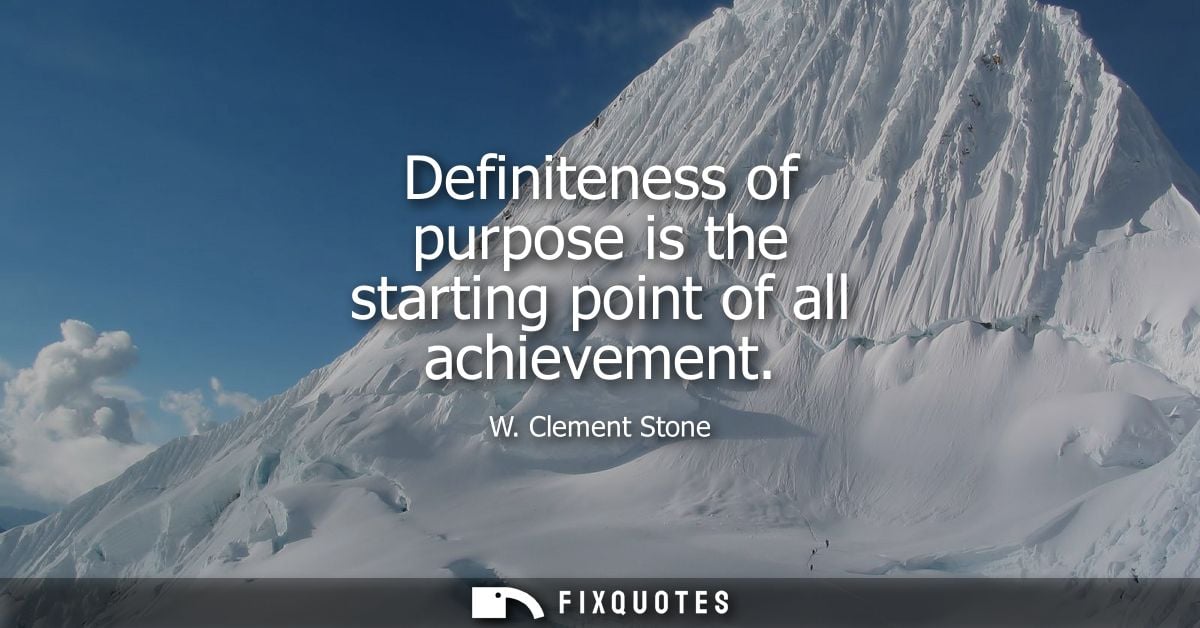
"Definiteness of purpose is the starting point of all achievement"
About this Quote
“Definiteness of purpose” is business-gospel phrasing with a blade inside it: it sounds uplifting, but it’s also a filter. Stone isn’t praising vague ambition or raw talent; he’s elevating a managerial quality - clarity that can be measured, repeated, and turned into results. The subtext is that achievement isn’t a mystery or a gift from the muses. It’s an output, and the input is a decision.
That’s why the line works rhetorically. “Starting point” makes purpose feel less like an abstract virtue and more like a practical lever you can pull today. “All achievement” is the classic sales-era totalizing claim - not strictly true, but psychologically effective. It collapses messy realities (luck, privilege, timing, networks) into a single controllable variable. For an audience trying to climb, that simplification is a feature, not a bug.
The context matters: Stone was a 20th-century businessman shaped by the rise of self-help optimism and corporate performance culture, including the “think-and-grow” tradition where mindset is treated as capital. In that world, definiteness is both motivation and strategy: a way to align effort, justify sacrifice, and avoid the costly drift that kills projects and careers.
There’s also a quiet moral edge. If purpose is the beginning of achievement, then lack of achievement can be framed as lack of purpose - a comforting narrative for systems that prefer personal responsibility over structural critique. The line sells agency, and it also sells a worldview where success is, above all, a matter of choosing to be exact.
That’s why the line works rhetorically. “Starting point” makes purpose feel less like an abstract virtue and more like a practical lever you can pull today. “All achievement” is the classic sales-era totalizing claim - not strictly true, but psychologically effective. It collapses messy realities (luck, privilege, timing, networks) into a single controllable variable. For an audience trying to climb, that simplification is a feature, not a bug.
The context matters: Stone was a 20th-century businessman shaped by the rise of self-help optimism and corporate performance culture, including the “think-and-grow” tradition where mindset is treated as capital. In that world, definiteness is both motivation and strategy: a way to align effort, justify sacrifice, and avoid the costly drift that kills projects and careers.
There’s also a quiet moral edge. If purpose is the beginning of achievement, then lack of achievement can be framed as lack of purpose - a comforting narrative for systems that prefer personal responsibility over structural critique. The line sells agency, and it also sells a worldview where success is, above all, a matter of choosing to be exact.
Quote Details
| Topic | Goal Setting |
|---|---|
| Source | Help us find the source |
| Cite |
Citation Formats
APA Style (7th ed.)
Stone, W. Clement. (2026, January 18). Definiteness of purpose is the starting point of all achievement. FixQuotes. https://fixquotes.com/quotes/definiteness-of-purpose-is-the-starting-point-of-22005/
Chicago Style
Stone, W. Clement. "Definiteness of purpose is the starting point of all achievement." FixQuotes. January 18, 2026. https://fixquotes.com/quotes/definiteness-of-purpose-is-the-starting-point-of-22005/.
MLA Style (9th ed.)
"Definiteness of purpose is the starting point of all achievement." FixQuotes, 18 Jan. 2026, https://fixquotes.com/quotes/definiteness-of-purpose-is-the-starting-point-of-22005/. Accessed 4 Apr. 2026.
More Quotes by Clement Stone
Add to List