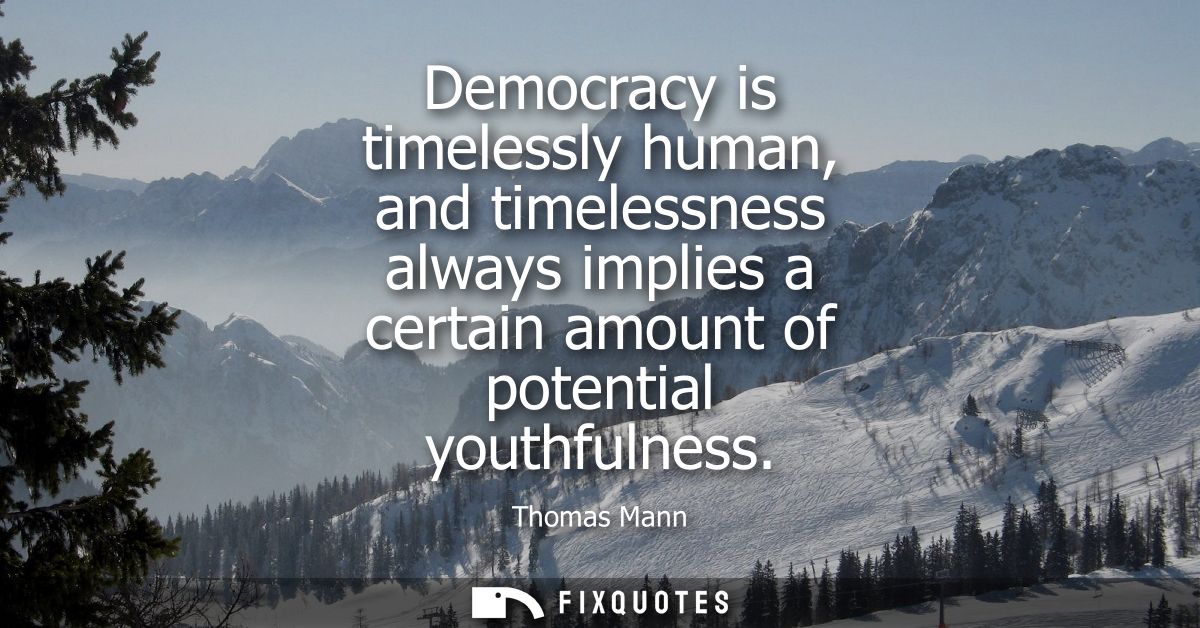
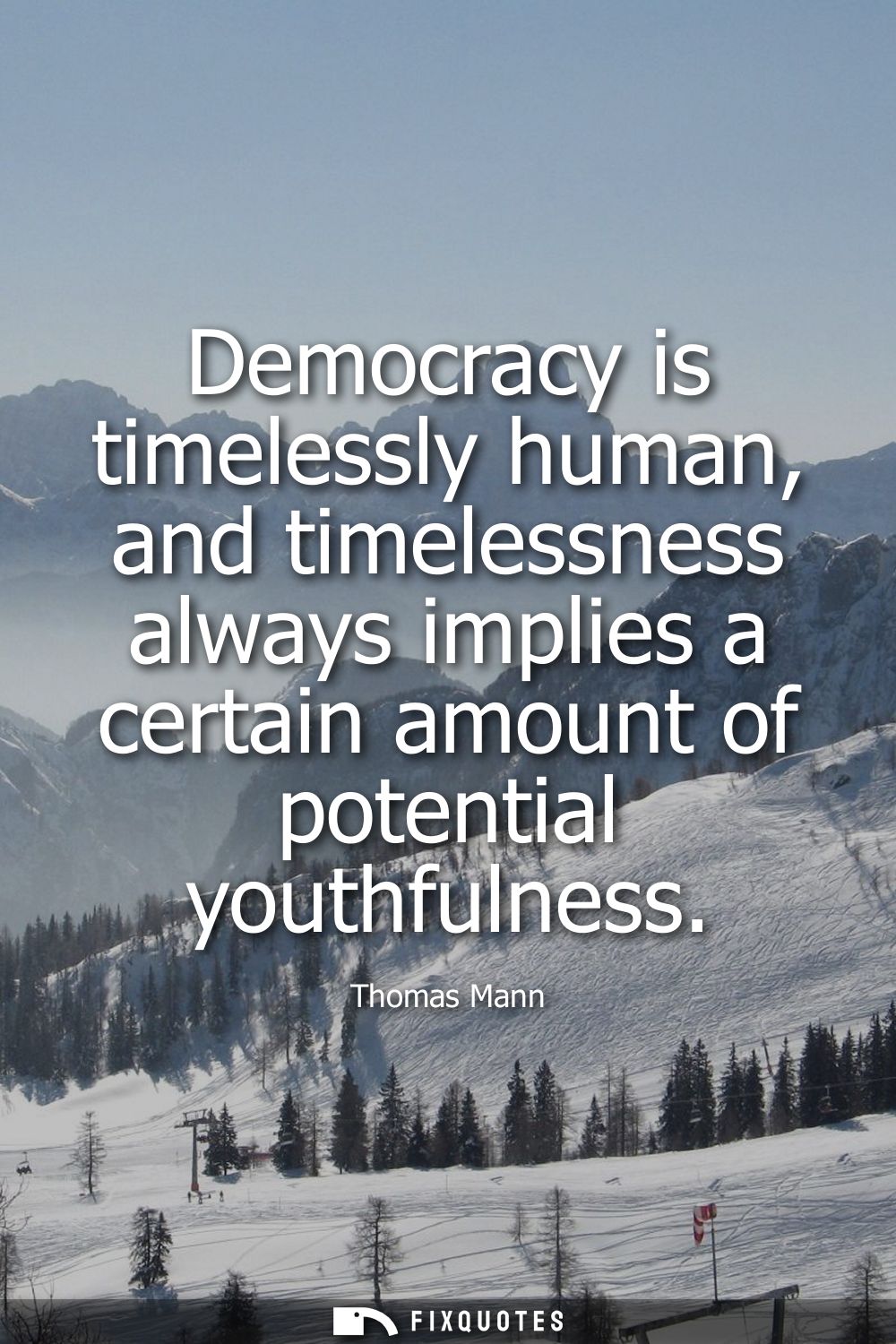
"Democracy is timelessly human, and timelessness always implies a certain amount of potential youthfulness"
About this Quote
The second clause is where Mann’s modernism shows. “Timelessness” usually reads as old, settled, museum-like. He flips it: what lasts can stay young. Youth here isn’t naive optimism; it’s the capacity for renewal, revision, self-correction. Mann is hinting at democracy’s most underrated feature: its legitimacy comes not from claiming perfection, but from building change into the system. A dictatorship sells itself as destiny; a democracy survives by staying unfinished.
Subtext: democracy’s “youthfulness” is only “potential.” It doesn’t automatically refresh itself; citizens have to do the work of keeping it alive, alert, and skeptical of grandeur. In Mann’s 20th-century context - liberalism under siege, mass politics weaponized - that conditional is a warning dressed as reassurance. Democracy can be perpetually young, but only if people resist the seductive comfort of surrendering responsibility.
Quote Details
| Topic | Time |
|---|---|
| Source | Help us find the source |
| Cite |
Citation Formats
APA Style (7th ed.)
Mann, Thomas. (2026, January 18). Democracy is timelessly human, and timelessness always implies a certain amount of potential youthfulness. FixQuotes. https://fixquotes.com/quotes/democracy-is-timelessly-human-and-timelessness-3934/
Chicago Style
Mann, Thomas. "Democracy is timelessly human, and timelessness always implies a certain amount of potential youthfulness." FixQuotes. January 18, 2026. https://fixquotes.com/quotes/democracy-is-timelessly-human-and-timelessness-3934/.
MLA Style (9th ed.)
"Democracy is timelessly human, and timelessness always implies a certain amount of potential youthfulness." FixQuotes, 18 Jan. 2026, https://fixquotes.com/quotes/democracy-is-timelessly-human-and-timelessness-3934/. Accessed 26 Mar. 2026.