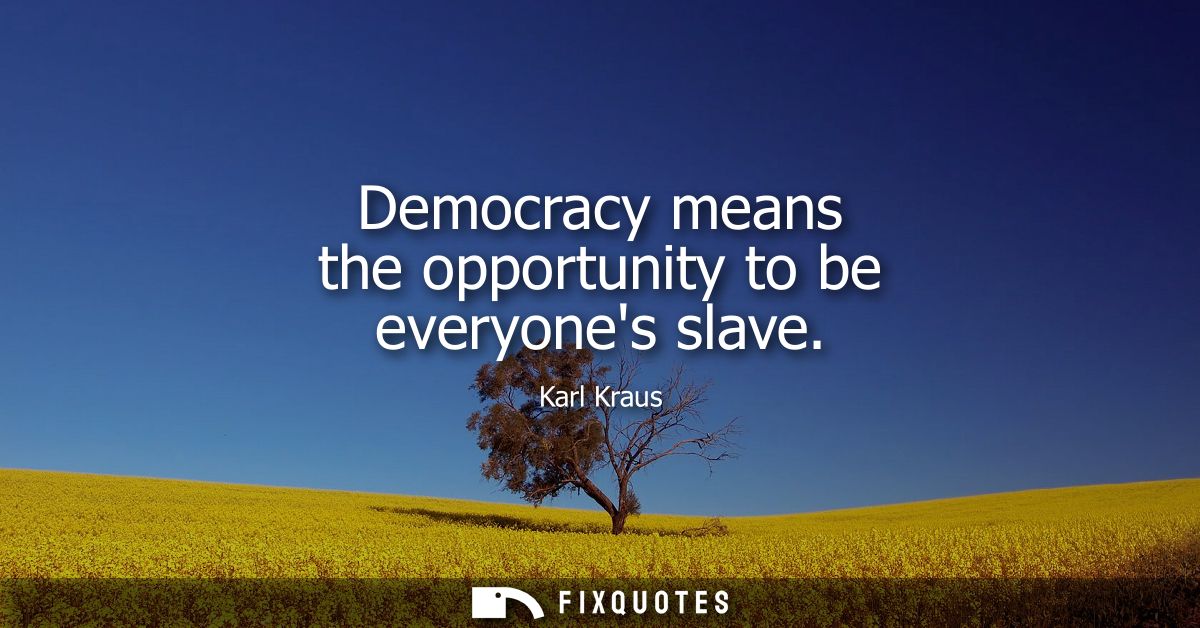
"Democracy means the opportunity to be everyone's slave"
About this Quote
Kraus twists democracy into a punchline that lands like an accusation. By redefining it as “the opportunity to be everyone’s slave,” he’s not attacking the idea of popular rule so much as the moral bargain it can force on the individual: in a mass society, you don’t answer to a monarch, you answer to the crowd. The word “opportunity” is the knife. It mimics the sunny language of liberal progress while suggesting that what’s being offered is a new kind of servitude dressed as empowerment.
The subtext is less “democracy is bad” than “democracy is easily corrupted into a marketplace of approval.” Kraus, a Viennese satirist with a lifelong allergy to cant, is wary of how public opinion becomes a coercive force, especially when amplified by media. If everyone gets a vote, everyone also gets a claim on you: your speech must be palatable, your politics performative, your conscience negotiable. Slavery here isn’t chains; it’s social dependency - the constant calibration to what “people” want, fear, or demand.
Context matters. Kraus wrote in the volatile Austria of the late empire and early republic, watching journalism, propaganda, and nationalist hysteria turn “the public” into an instrument. After World War I, democratic forms proliferated even as demagogic moods intensified. His line anticipates a modern anxiety: that participation can slide into submission, and that a culture obsessed with consensus can punish anyone who refuses to be liked.
The subtext is less “democracy is bad” than “democracy is easily corrupted into a marketplace of approval.” Kraus, a Viennese satirist with a lifelong allergy to cant, is wary of how public opinion becomes a coercive force, especially when amplified by media. If everyone gets a vote, everyone also gets a claim on you: your speech must be palatable, your politics performative, your conscience negotiable. Slavery here isn’t chains; it’s social dependency - the constant calibration to what “people” want, fear, or demand.
Context matters. Kraus wrote in the volatile Austria of the late empire and early republic, watching journalism, propaganda, and nationalist hysteria turn “the public” into an instrument. After World War I, democratic forms proliferated even as demagogic moods intensified. His line anticipates a modern anxiety: that participation can slide into submission, and that a culture obsessed with consensus can punish anyone who refuses to be liked.
Quote Details
| Topic | Freedom |
|---|---|
| Source | Later attribution: 1001 Quotations to inspire you before you die (Robert Arp, 2018) modern compilationISBN: 9781788400510 · ID: FGNADwAAQBAJ
Evidence:
... the doors are open to everyone.” Milk was memorably played by Sean Penn in Gus Van Sant's movie Milk (2008).JE See all Quotations for Politics and Society “Democracy means the opportunity to be everyone's slave.” Karl Kraus. |
| Cite |
Citation Formats
APA Style (7th ed.)
Kraus, Karl. (2026, February 23). Democracy means the opportunity to be everyone's slave. FixQuotes. https://fixquotes.com/quotes/democracy-means-the-opportunity-to-be-everyones-78388/
Chicago Style
Kraus, Karl. "Democracy means the opportunity to be everyone's slave." FixQuotes. February 23, 2026. https://fixquotes.com/quotes/democracy-means-the-opportunity-to-be-everyones-78388/.
MLA Style (9th ed.)
"Democracy means the opportunity to be everyone's slave." FixQuotes, 23 Feb. 2026, https://fixquotes.com/quotes/democracy-means-the-opportunity-to-be-everyones-78388/. Accessed 27 Mar. 2026.
More Quotes by Karl
Add to List