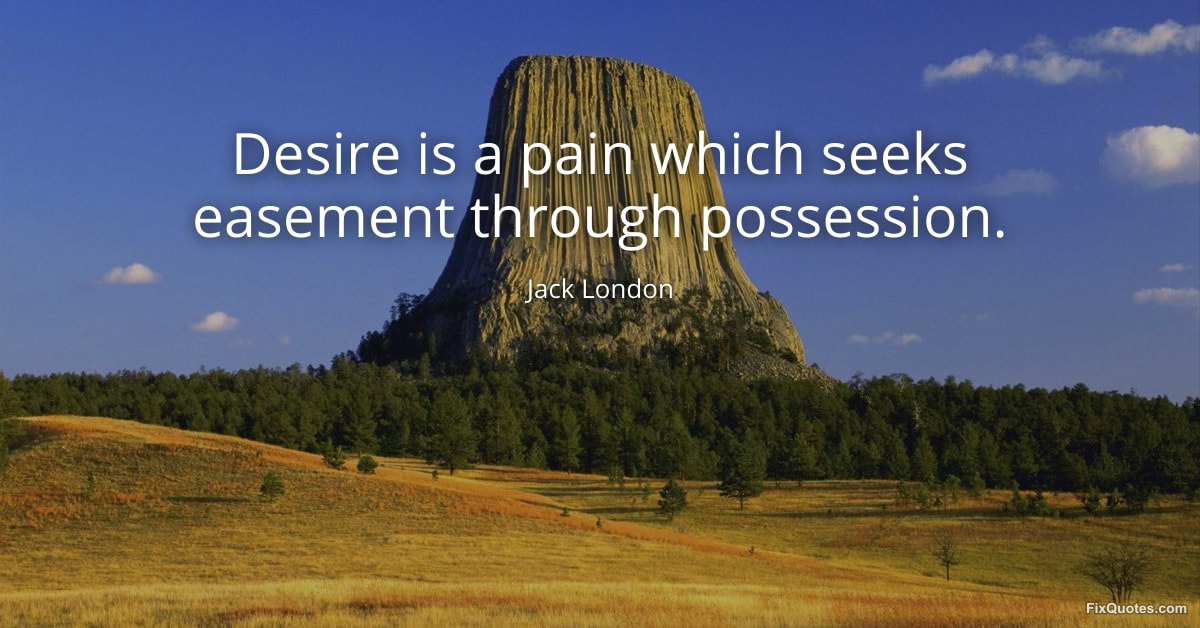
"Desire is a pain which seeks easement through possession"
About this Quote
London frames desire not as sparkle but as inflammation: an ache that invents its own medicine and then mistakes the medicine for meaning. Calling desire a "pain" strips it of romance and casts it as a bodily condition, something that nags, distracts, and drives action less like choice than like compulsion. The phrasing is diagnostic. "Seeks easement" sounds clinical, almost legalistic, as if the self is filing paperwork against its own restlessness. That diction matters: it suggests desire is not a noble calling but a symptom looking for relief.
Then comes the trapdoor: "through possession". London is unsentimental about what modern culture sells as fulfillment. Possession isn’t intimacy, understanding, or even pleasure; it’s ownership. The line implies that desire collapses into acquisition because acquisition is measurable. You can point to it, hold it, display it, defend it. That’s why it "works" rhetorically: it exposes how quickly longing is translated into a transaction, and how easily the self confuses having with healing.
In context, this feels born from London’s broader preoccupations: survival, appetite, class hunger, and the brutal mechanics of capitalism. His characters often live close to scarcity, where wanting is physically dangerous and fantasies are expensive. Read that way, the quote doubles as social critique. A society organized around possession trains people to treat pain as a shopping list, then wonders why the relief never lasts.
Then comes the trapdoor: "through possession". London is unsentimental about what modern culture sells as fulfillment. Possession isn’t intimacy, understanding, or even pleasure; it’s ownership. The line implies that desire collapses into acquisition because acquisition is measurable. You can point to it, hold it, display it, defend it. That’s why it "works" rhetorically: it exposes how quickly longing is translated into a transaction, and how easily the self confuses having with healing.
In context, this feels born from London’s broader preoccupations: survival, appetite, class hunger, and the brutal mechanics of capitalism. His characters often live close to scarcity, where wanting is physically dangerous and fantasies are expensive. Read that way, the quote doubles as social critique. A society organized around possession trains people to treat pain as a shopping list, then wonders why the relief never lasts.
Quote Details
| Topic | Wisdom |
|---|---|
| Source | Help us find the source |
| Cite |
Citation Formats
APA Style (7th ed.)
London, Jack. (2026, January 15). Desire is a pain which seeks easement through possession. FixQuotes. https://fixquotes.com/quotes/desire-is-a-pain-which-seeks-easement-through-173111/
Chicago Style
London, Jack. "Desire is a pain which seeks easement through possession." FixQuotes. January 15, 2026. https://fixquotes.com/quotes/desire-is-a-pain-which-seeks-easement-through-173111/.
MLA Style (9th ed.)
"Desire is a pain which seeks easement through possession." FixQuotes, 15 Jan. 2026, https://fixquotes.com/quotes/desire-is-a-pain-which-seeks-easement-through-173111/. Accessed 29 Mar. 2026.
More Quotes by Jack
Add to List