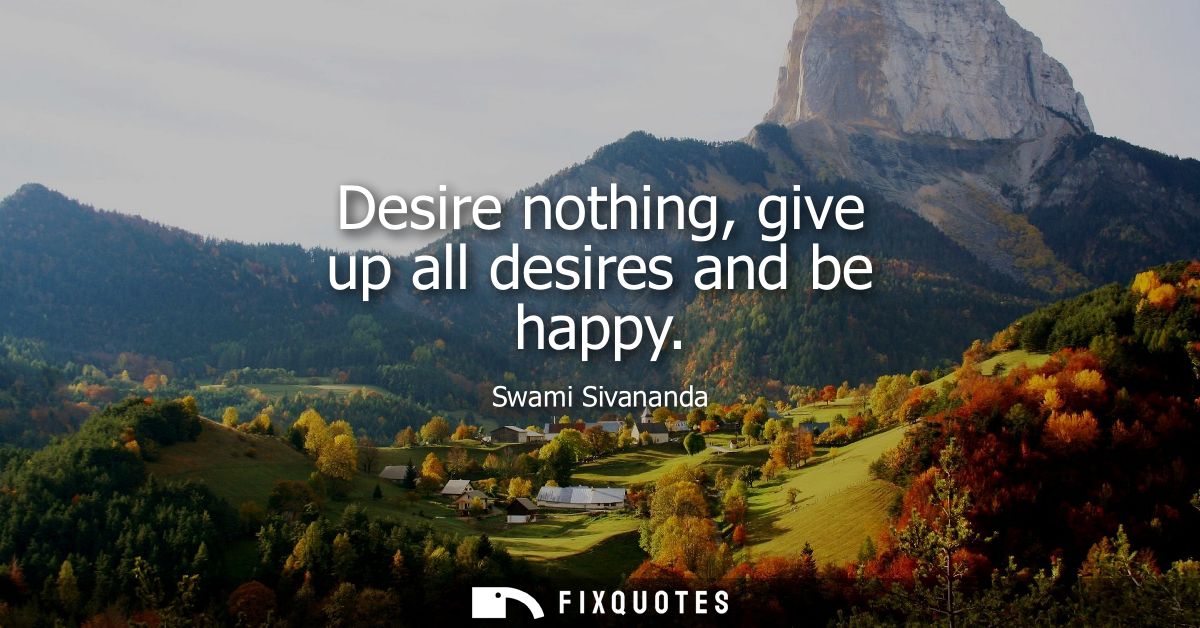
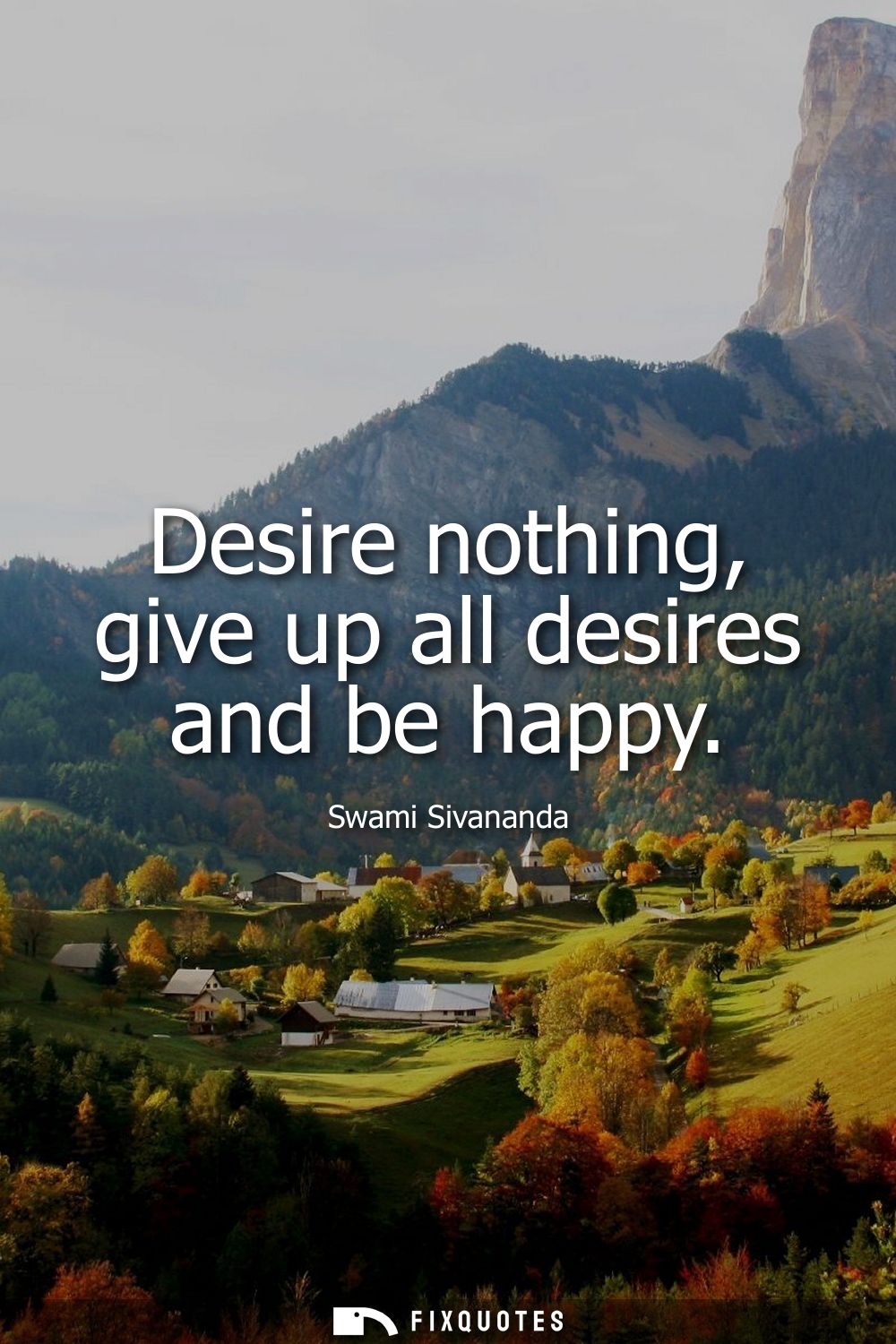
"Desire nothing, give up all desires and be happy"
About this Quote
Austerely simple, Swami Sivananda's line lands like a dare: stop negotiating with your own cravings. The phrasing is deliberately paradoxical - "desire nothing" is itself an instruction you might want to want. That tension is the point. In the yogic and Vedantic world Sivananda inhabited, desire is less a spice of life than a mechanism of bondage: a loop that keeps the mind projecting happiness into the next object, the next achievement, the next person. By asking you to drop the whole apparatus, he isn't offering a minimalist lifestyle tip; he's proposing a different engine for wellbeing.
The intent is surgical: cut the root, not the branch. "Give up all desires" isn't anti-pleasure so much as anti-dependence. The subtext is that most of what we call desire is really anxiety dressed up as ambition - the need to secure identity, control outcomes, and keep discomfort at bay. Happiness, in this frame, isn't a prize at the end of successful wanting; it's what surfaces when the mind stops insisting that reality be edited.
Context matters. Sivananda taught in a colonial and early postcolonial India where modern consumer aspiration and Western models of progress were accelerating. His counsel reads as both spiritual instruction and cultural resistance: refusing to let the self be organized by acquisition. It's also a practical monastic psychology. Renunciation isn't romantic; it's a method for reducing mental turbulence, making attention steadier, compassion less conditional, and contentment less hostage to circumstance.
The intent is surgical: cut the root, not the branch. "Give up all desires" isn't anti-pleasure so much as anti-dependence. The subtext is that most of what we call desire is really anxiety dressed up as ambition - the need to secure identity, control outcomes, and keep discomfort at bay. Happiness, in this frame, isn't a prize at the end of successful wanting; it's what surfaces when the mind stops insisting that reality be edited.
Context matters. Sivananda taught in a colonial and early postcolonial India where modern consumer aspiration and Western models of progress were accelerating. His counsel reads as both spiritual instruction and cultural resistance: refusing to let the self be organized by acquisition. It's also a practical monastic psychology. Renunciation isn't romantic; it's a method for reducing mental turbulence, making attention steadier, compassion less conditional, and contentment less hostage to circumstance.
Quote Details
| Topic | Letting Go |
|---|---|
| Source | Help us find the source |
| Cite |
Citation Formats
APA Style (7th ed.)
Sivananda, Swami. (2026, January 18). Desire nothing, give up all desires and be happy. FixQuotes. https://fixquotes.com/quotes/desire-nothing-give-up-all-desires-and-be-happy-7696/
Chicago Style
Sivananda, Swami. "Desire nothing, give up all desires and be happy." FixQuotes. January 18, 2026. https://fixquotes.com/quotes/desire-nothing-give-up-all-desires-and-be-happy-7696/.
MLA Style (9th ed.)
"Desire nothing, give up all desires and be happy." FixQuotes, 18 Jan. 2026, https://fixquotes.com/quotes/desire-nothing-give-up-all-desires-and-be-happy-7696/. Accessed 31 Mar. 2026.
More Quotes by Swami
Add to List