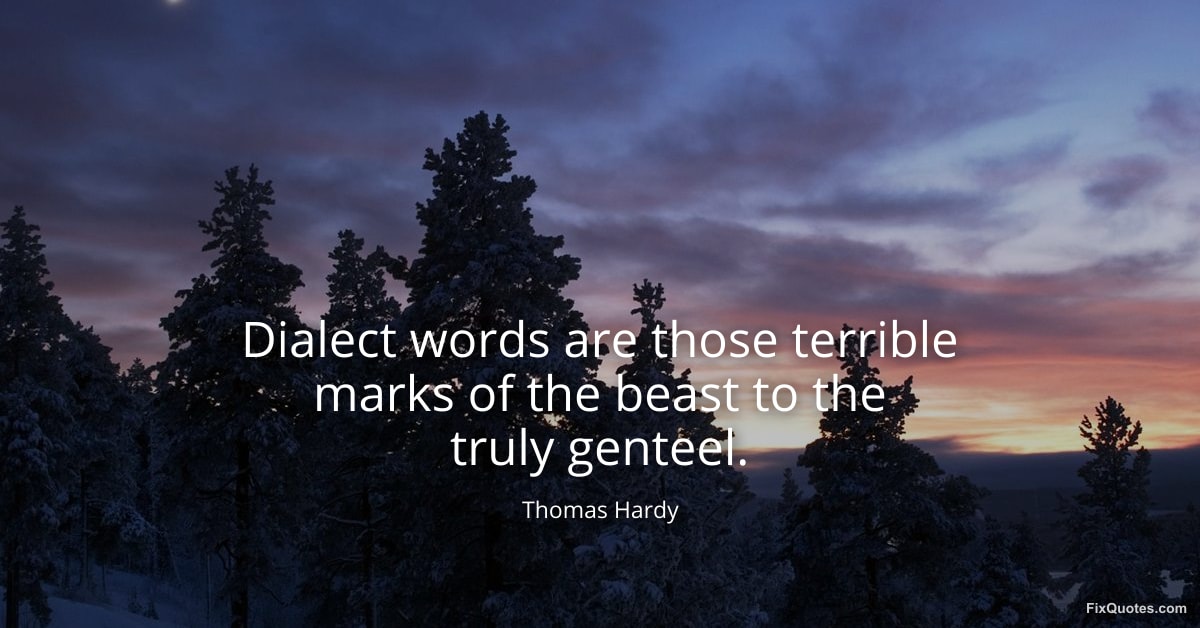
"Dialect words are those terrible marks of the beast to the truly genteel"
About this Quote
Hardy lands the knife with the kind of polite cruelty the English class system perfected: “dialect words” aren’t just unfashionable, they’re “terrible marks of the beast,” a stigma that clings to the speaker like a brand. The phrase “truly genteel” is doing double duty. On its face it names the social arbiters of taste; underneath, it mocks them. Anyone who needs to be “truly” genteel is already insecure, forever scanning for impurities that might expose the fraud.
Hardy wrote from a life split between rural Dorset and the metropolitan literary world, and his fiction repeatedly stages the same conflict: local speech as living culture versus “proper” English as social passport control. In Victorian England, accent and vocabulary were less personal quirks than readable paperwork. They announced where you were born, what work your parents did, whether you belonged in the parlor or the kitchen. Calling dialect “marks of the beast” borrows biblical language of damnation, but Hardy’s bite is that the damnation is administered by drawing rooms, not churches.
The subtext is radical for how quietly it’s delivered: the genteel don’t merely prefer standard language, they weaponize it. “Terrible” suggests not aesthetic displeasure but moral panic, as if a dropped “h” or a regional verb threatens the whole architecture of hierarchy. Hardy’s sympathy is with the branded, not the branders; he shows how “refinement” can function as a laundering system, scrubbing away locality to manufacture respectability. In that sense, the line reads like an early diagnosis of linguistic prejudice: the snob’s fear is never the word itself, but what the word reveals.
Hardy wrote from a life split between rural Dorset and the metropolitan literary world, and his fiction repeatedly stages the same conflict: local speech as living culture versus “proper” English as social passport control. In Victorian England, accent and vocabulary were less personal quirks than readable paperwork. They announced where you were born, what work your parents did, whether you belonged in the parlor or the kitchen. Calling dialect “marks of the beast” borrows biblical language of damnation, but Hardy’s bite is that the damnation is administered by drawing rooms, not churches.
The subtext is radical for how quietly it’s delivered: the genteel don’t merely prefer standard language, they weaponize it. “Terrible” suggests not aesthetic displeasure but moral panic, as if a dropped “h” or a regional verb threatens the whole architecture of hierarchy. Hardy’s sympathy is with the branded, not the branders; he shows how “refinement” can function as a laundering system, scrubbing away locality to manufacture respectability. In that sense, the line reads like an early diagnosis of linguistic prejudice: the snob’s fear is never the word itself, but what the word reveals.
Quote Details
| Topic | Witty One-Liners |
|---|---|
| Source | Unverified source: The Mayor of Casterbridge (Thomas Hardy, 1886)
Evidence: One grievous failing of Elizabeth's was her occasional pretty and picturesque use of dialect words, those terrible marks of the beast to the truly genteel. (Chapter XX (p. 245 in the 1886 Volume 1 PDF on Wikisource)). This line appears in Chapter XX of Thomas Hardy’s novel The Mayor of Casterbrid... Other candidates (1) Pearls of Wisdom (Mamutty Chola, 2019) compilation95.0% Mamutty Chola. Thomas Hardy Thomas Hardy , OM ( 2 June 1840 11 January 1928 ) was an English novelist and poet ... Di... |
| Cite |
Citation Formats
APA Style (7th ed.)
Hardy, Thomas. (2026, March 2). Dialect words are those terrible marks of the beast to the truly genteel. FixQuotes. https://fixquotes.com/quotes/dialect-words-are-those-terrible-marks-of-the-3170/
Chicago Style
Hardy, Thomas. "Dialect words are those terrible marks of the beast to the truly genteel." FixQuotes. March 2, 2026. https://fixquotes.com/quotes/dialect-words-are-those-terrible-marks-of-the-3170/.
MLA Style (9th ed.)
"Dialect words are those terrible marks of the beast to the truly genteel." FixQuotes, 2 Mar. 2026, https://fixquotes.com/quotes/dialect-words-are-those-terrible-marks-of-the-3170/. Accessed 31 Mar. 2026.
More Quotes by Thomas
Add to List