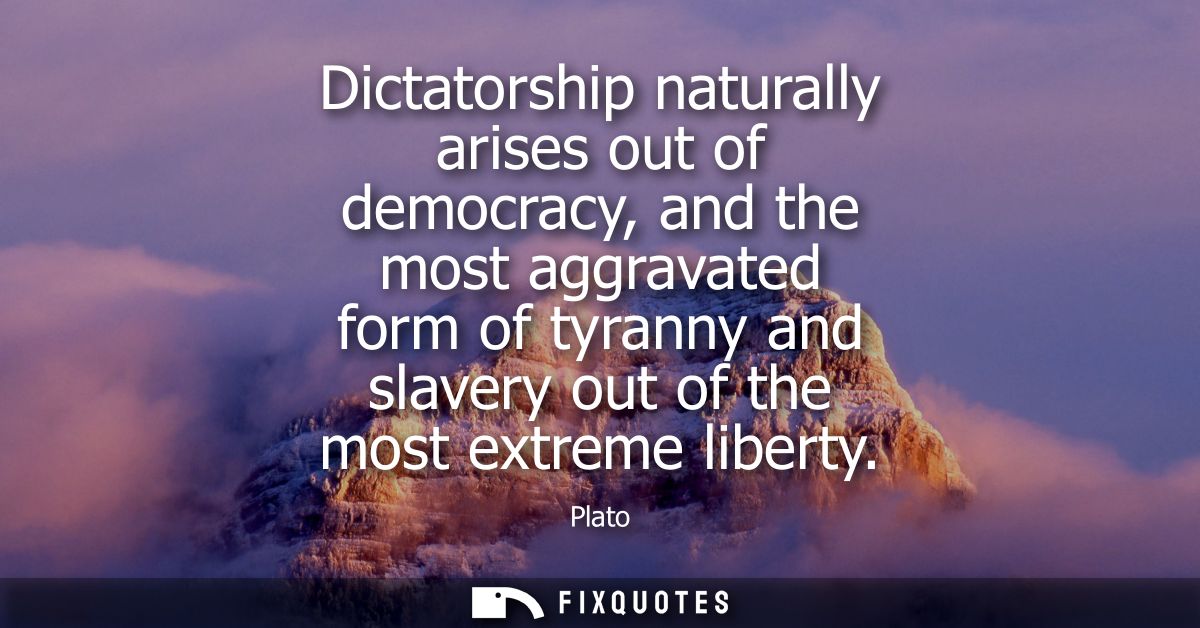
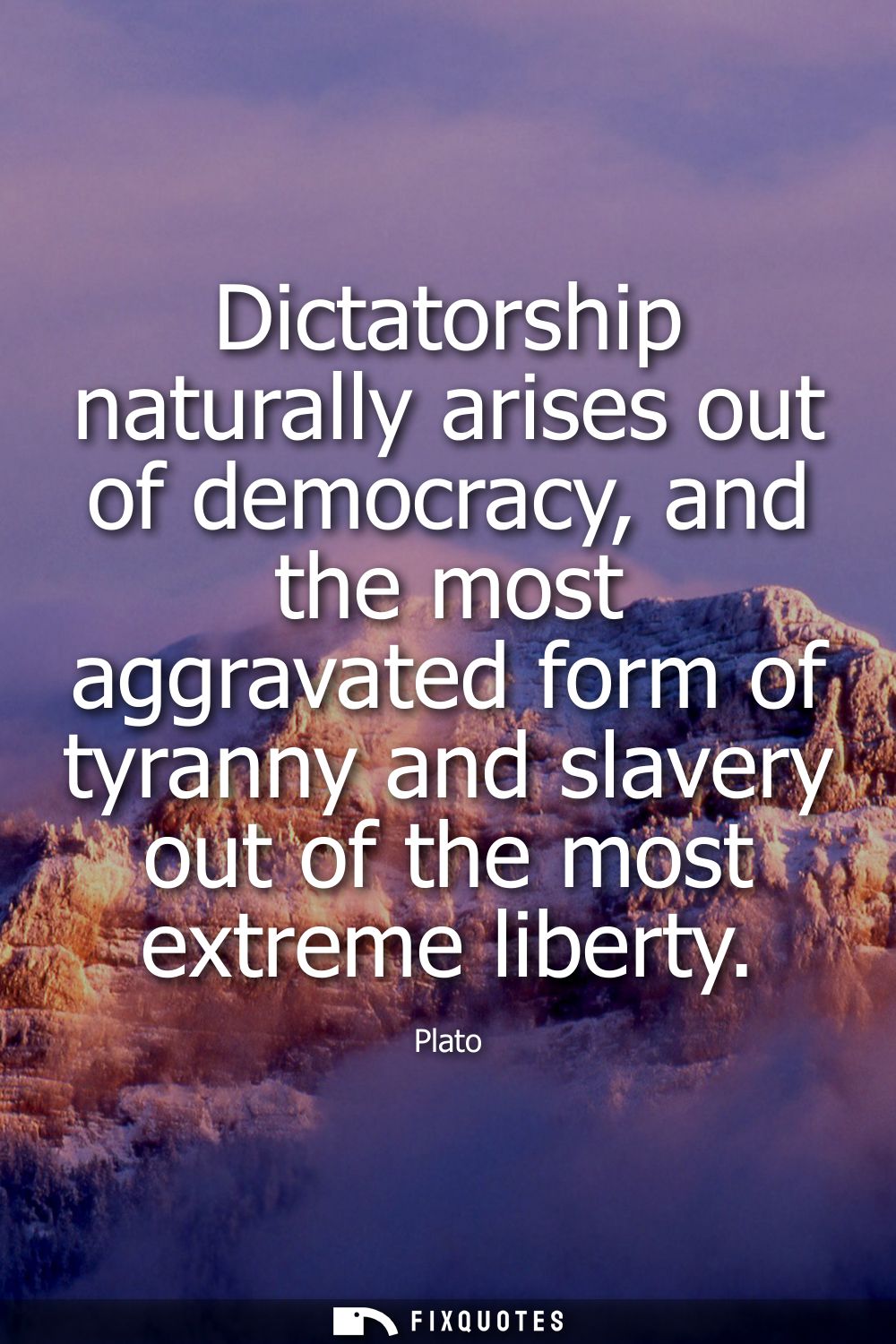
"Dictatorship naturally arises out of democracy, and the most aggravated form of tyranny and slavery out of the most extreme liberty"
About this Quote
Democracy, for Plato, is not the happy endpoint of political evolution; it is the soft soil where authoritarianism can sprout. The line is engineered as a provocation: the thing we praise as freedom contains the seeds of its opposite. Its bite comes from the way it flips civic self-congratulation into self-indictment, insisting that liberty is not automatically self-stabilizing. If anything, the more intoxicated a society becomes with the romance of “doing whatever you want,” the more it trains itself to tolerate chaos, impulsiveness, and the erosion of shared standards.
The subtext is psychological as much as institutional. Plato is arguing that unbounded freedom doesn’t just loosen laws; it reshapes character. Citizens stop wanting restraint, then start resenting anyone who asks for it. In that environment, a “savior” figure becomes culturally legible: someone who promises order, clarity, and protection from the very volatility people helped unleash. Extreme liberty, in this telling, manufactures a craving for domination - because constant choice without discipline becomes exhausting, even frightening.
Context matters: Plato is writing in the long shadow of Athens’ democratic turbulence, the Peloponnesian War, and the execution of Socrates by a popular court. His suspicion of mass rule isn’t abstract snobbery; it’s a diagnosis drawn from a city he saw lurch between hubris and panic. The quote works because it treats politics as a feedback loop between desires and systems: when freedom becomes pure appetite, tyranny arrives not as a coup from outside, but as a demand from within.
The subtext is psychological as much as institutional. Plato is arguing that unbounded freedom doesn’t just loosen laws; it reshapes character. Citizens stop wanting restraint, then start resenting anyone who asks for it. In that environment, a “savior” figure becomes culturally legible: someone who promises order, clarity, and protection from the very volatility people helped unleash. Extreme liberty, in this telling, manufactures a craving for domination - because constant choice without discipline becomes exhausting, even frightening.
Context matters: Plato is writing in the long shadow of Athens’ democratic turbulence, the Peloponnesian War, and the execution of Socrates by a popular court. His suspicion of mass rule isn’t abstract snobbery; it’s a diagnosis drawn from a city he saw lurch between hubris and panic. The quote works because it treats politics as a feedback loop between desires and systems: when freedom becomes pure appetite, tyranny arrives not as a coup from outside, but as a demand from within.
Quote Details
| Topic | Freedom |
|---|---|
| Source | Plato, The Republic, Book VIII — passage on the transition from democracy to tyranny (commonly cited source for this quotation). |
More Quotes by Plato
Add to List