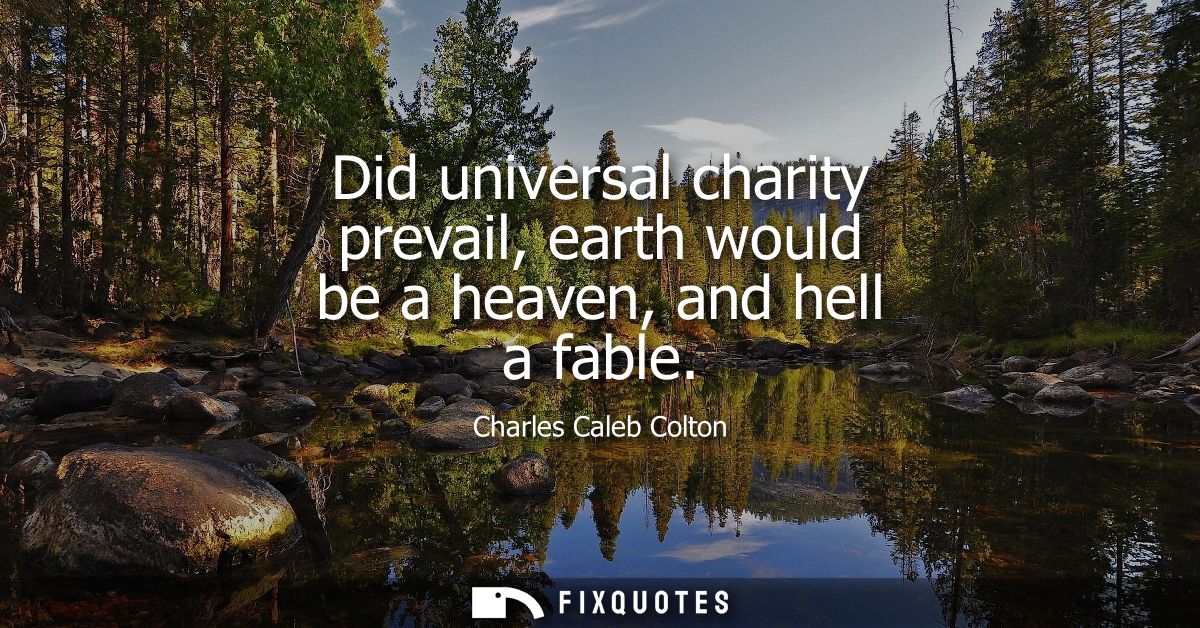
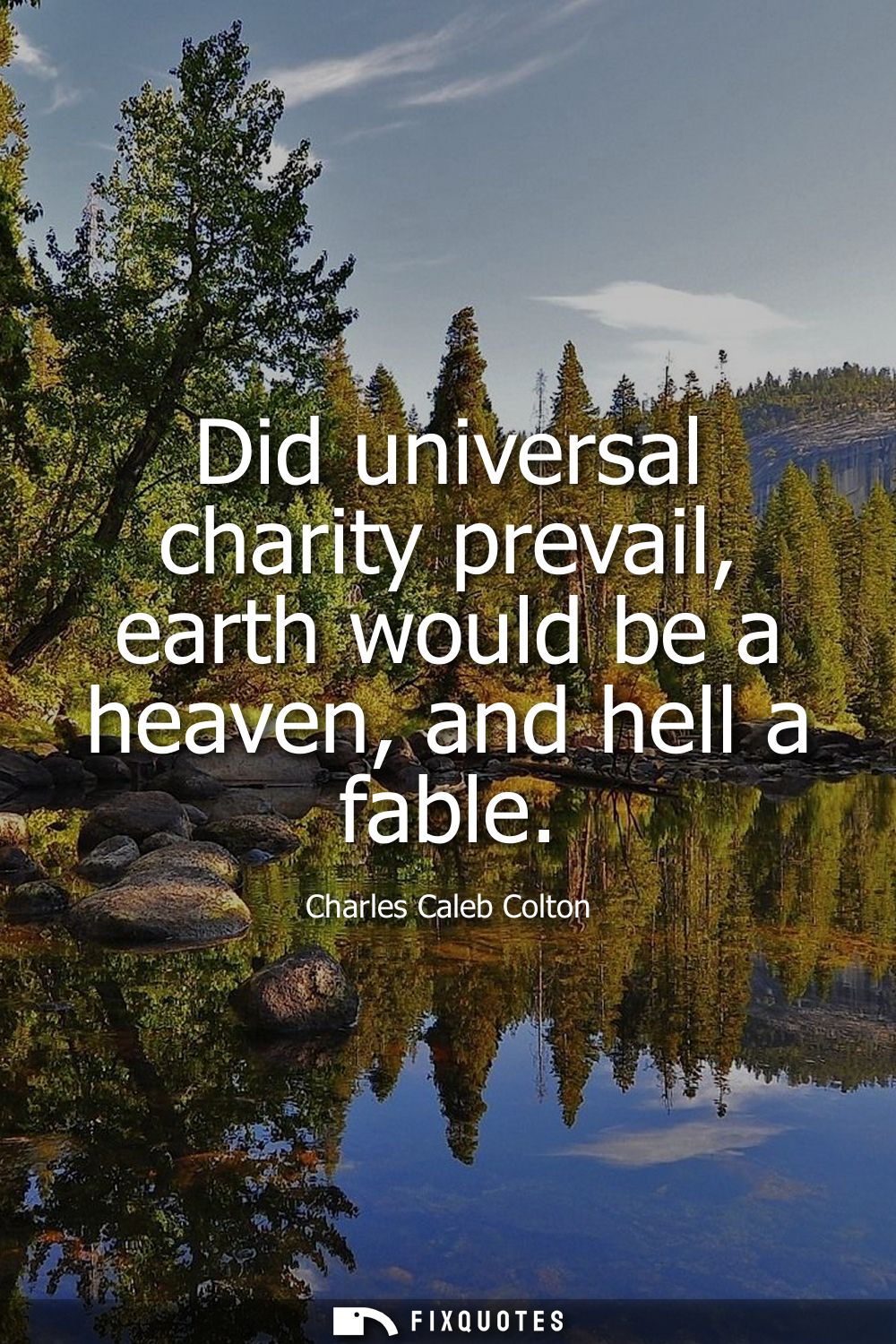
"Did universal charity prevail, earth would be a heaven, and hell a fable"
About this Quote
The intent is both devotional and satirically practical. Colton isn’t offering theology so much as a stress test for it: if people actually behaved as their faith instructs, the metaphysical architecture of reward and punishment would look embarrassingly unnecessary. That’s the subtextual jab. Hell isn’t challenged on doctrinal grounds; it’s demoted on logistical ones. It exists because we don’t.
Context matters here. Writing in a Britain marked by widening inequality, religious revivalism, and moralizing reform, Colton is speaking to a culture fluent in Christian language and haunted by industrial-era suffering. His rhetorical move is to collapse the distance between private virtue and public conditions: “earth would be a heaven” dares the reader to see misery not as fate or divine mystery, but as a human manufacturing problem. The sentence works because it holds out a breathtaking promise while quietly accusing us of choosing, every day, to keep hell plausible.
Quote Details
| Topic | Kindness |
|---|---|
| Source | Help us find the source |
| Cite |
Citation Formats
APA Style (7th ed.)
Colton, Charles Caleb. (2026, January 16). Did universal charity prevail, earth would be a heaven, and hell a fable. FixQuotes. https://fixquotes.com/quotes/did-universal-charity-prevail-earth-would-be-a-87422/
Chicago Style
Colton, Charles Caleb. "Did universal charity prevail, earth would be a heaven, and hell a fable." FixQuotes. January 16, 2026. https://fixquotes.com/quotes/did-universal-charity-prevail-earth-would-be-a-87422/.
MLA Style (9th ed.)
"Did universal charity prevail, earth would be a heaven, and hell a fable." FixQuotes, 16 Jan. 2026, https://fixquotes.com/quotes/did-universal-charity-prevail-earth-would-be-a-87422/. Accessed 17 Mar. 2026.