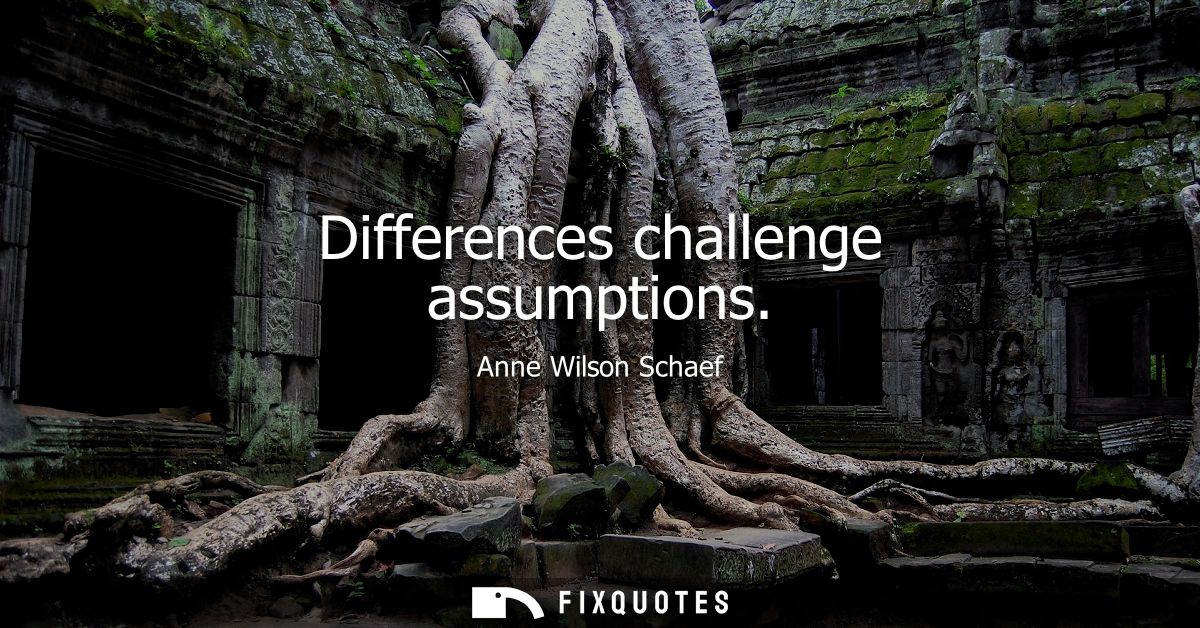
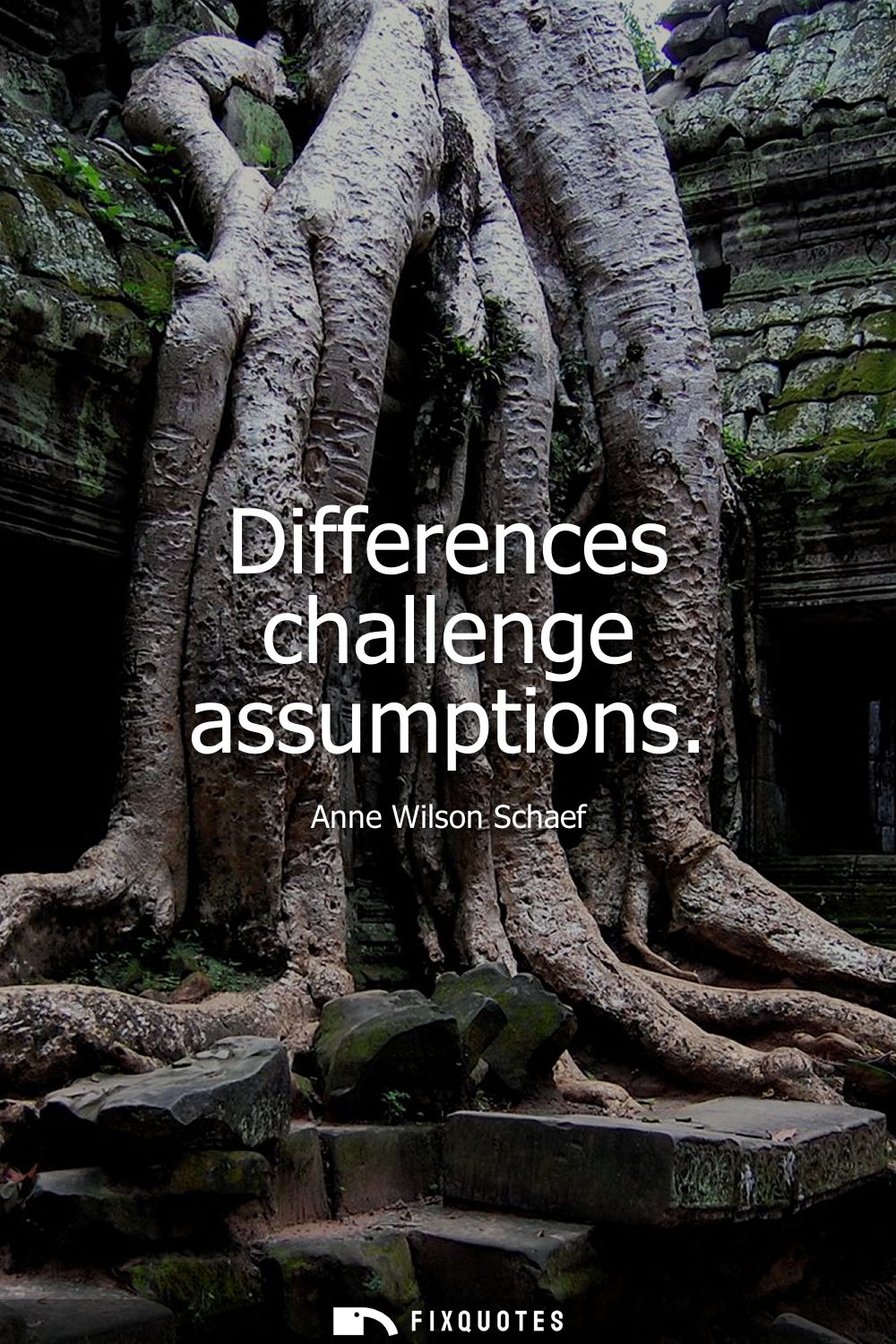
"Differences challenge assumptions"
About this Quote
“Differences challenge assumptions” is deceptively compact: a self-help-era aphorism that smuggles a sharp critique of how people and institutions protect their comfort. Anne Wilson Schaef wrote from inside the late-20th-century ecosystem of recovery culture and systems thinking, where “awareness” isn’t a vibe but a mechanism. In that context, difference isn’t decorative diversity; it’s a stress test. It pushes on the unseen beams holding up our stories about normal, right, safe, competent.
The line works because it flips the usual power dynamic. We tend to treat assumptions as neutral defaults and differences as disruptions to be managed. Schaef reverses that: the disruption is the point, and the “default” is revealed as an unexamined choice. Subtext: if your beliefs can’t survive contact with someone else’s reality, they weren’t beliefs so much as habits.
There’s also a quiet moral claim embedded in the grammar. “Differences” is plural and impersonal; it avoids assigning blame to the “different” person. The challenge is structural, not interpersonal. You don’t get to file the problem under “they’re difficult.” The friction is information.
Read politically, it’s a warning against monocultures, the kind that mistake consensus for truth. Read personally, it’s a recovery principle: growth happens when denial meets evidence. Schaef isn’t asking for tolerance as etiquette; she’s arguing for difference as a tool of epistemic humility, the thing that keeps us honest when our assumptions want to stay undefeated.
The line works because it flips the usual power dynamic. We tend to treat assumptions as neutral defaults and differences as disruptions to be managed. Schaef reverses that: the disruption is the point, and the “default” is revealed as an unexamined choice. Subtext: if your beliefs can’t survive contact with someone else’s reality, they weren’t beliefs so much as habits.
There’s also a quiet moral claim embedded in the grammar. “Differences” is plural and impersonal; it avoids assigning blame to the “different” person. The challenge is structural, not interpersonal. You don’t get to file the problem under “they’re difficult.” The friction is information.
Read politically, it’s a warning against monocultures, the kind that mistake consensus for truth. Read personally, it’s a recovery principle: growth happens when denial meets evidence. Schaef isn’t asking for tolerance as etiquette; she’s arguing for difference as a tool of epistemic humility, the thing that keeps us honest when our assumptions want to stay undefeated.
Quote Details
| Topic | Wisdom |
|---|---|
| Source | Help us find the source |
| Cite |
Citation Formats
APA Style (7th ed.)
Schaef, Anne Wilson. (2026, January 16). Differences challenge assumptions. FixQuotes. https://fixquotes.com/quotes/differences-challenge-assumptions-138482/
Chicago Style
Schaef, Anne Wilson. "Differences challenge assumptions." FixQuotes. January 16, 2026. https://fixquotes.com/quotes/differences-challenge-assumptions-138482/.
MLA Style (9th ed.)
"Differences challenge assumptions." FixQuotes, 16 Jan. 2026, https://fixquotes.com/quotes/differences-challenge-assumptions-138482/. Accessed 2 Apr. 2026.
More Quotes by Anne
Add to List