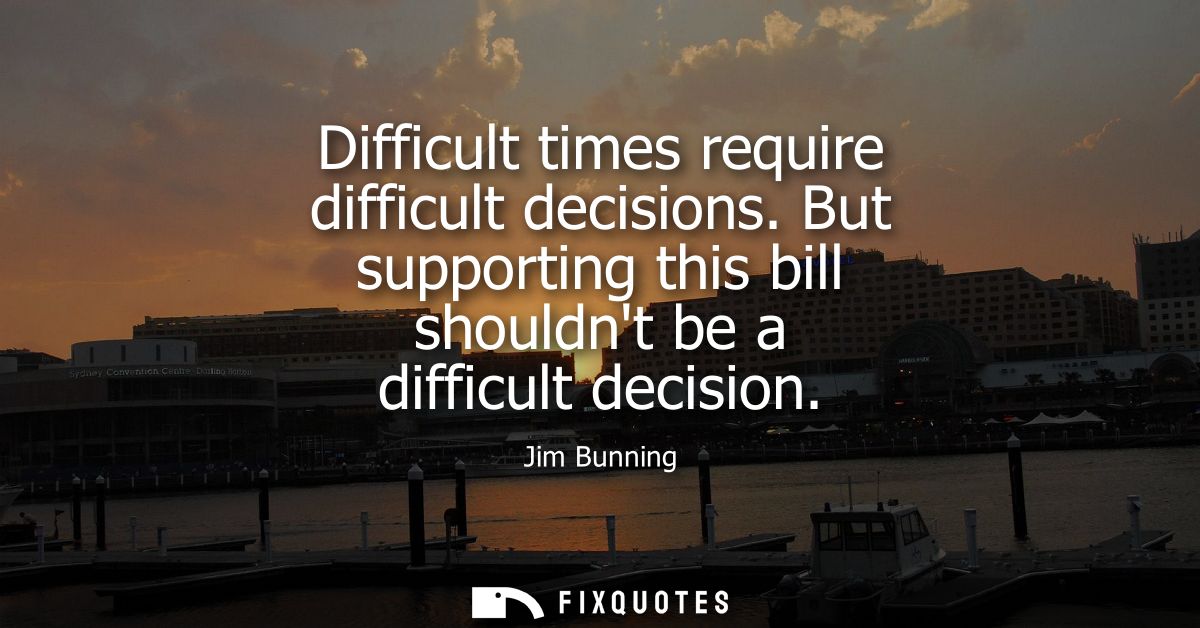
"Difficult times require difficult decisions. But supporting this bill shouldn't be a difficult decision"
About this Quote
The intent is coercively calming. If you're a wavering colleague, the sentence offers an exit ramp from uncertainty: you can look courageous without doing the hard work of weighing tradeoffs. If you're the public, it pre-emptively delegitimizes skepticism. In hard times, citizens expect sacrifice and complexity; Bunning counters by implying the bill is so obviously right that only politics, not principle, could complicate it.
The subtext is a gentle accusation: if you find this decision difficult, the problem is you. It's a rhetorical move that polices the boundaries of reasonable debate, especially common in moments like recessions, wars, or emergency financial votes, when legislators try to compress messy policy into a binary test of character.
What makes the line effective is its asymmetry. It acknowledges hardship to sound honest, then denies hardship to foreclose argument. It's persuasion by emotional bookkeeping: he spends the currency of "difficult times" to buy consensus on a specific bill, hoping no one checks the receipt.
Quote Details
| Topic | Decision-Making |
|---|---|
| Source | Help us find the source |
| Cite |
Citation Formats
APA Style (7th ed.)
Bunning, Jim. (2026, January 17). Difficult times require difficult decisions. But supporting this bill shouldn't be a difficult decision. FixQuotes. https://fixquotes.com/quotes/difficult-times-require-difficult-decisions-but-69814/
Chicago Style
Bunning, Jim. "Difficult times require difficult decisions. But supporting this bill shouldn't be a difficult decision." FixQuotes. January 17, 2026. https://fixquotes.com/quotes/difficult-times-require-difficult-decisions-but-69814/.
MLA Style (9th ed.)
"Difficult times require difficult decisions. But supporting this bill shouldn't be a difficult decision." FixQuotes, 17 Jan. 2026, https://fixquotes.com/quotes/difficult-times-require-difficult-decisions-but-69814/. Accessed 25 Mar. 2026.