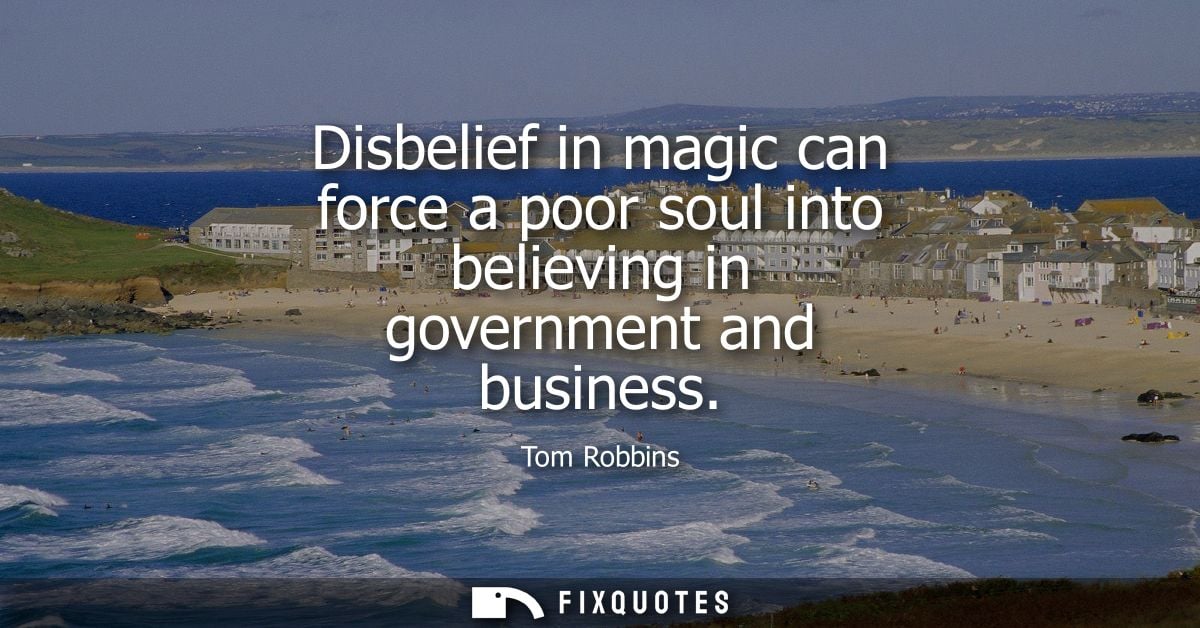
"Disbelief in magic can force a poor soul into believing in government and business"
About this Quote
The phrase “force a poor soul” carries the real sneer. The “poor soul” is the dutiful citizen-consumer, convinced they’ve outgrown superstition while quietly practicing a new one: faith in bureaucracy’s benevolence and commerce’s logic. Government and business become the replacement gods - omnipresent, opaque, demanding rituals (forms, metrics, quarterly results), offering a thin promise of salvation (security, growth) that always recedes. Robbins isn’t arguing for literal magic so much as for the psychological necessity of wonder and the cost of misplacing it.
Context matters: Robbins comes out of postwar American abundance and its hangover - the era when corporate life, advertising, and technocratic governance claimed they could manage the human condition. His countercultural fiction treats imagination as an insurgent force. The line works because it flips the smug hierarchy: the “rational” person isn’t liberated from belief; they’ve simply chosen a more socially acceptable fantasy, one that can write laws, move money, and call itself reality.
Quote Details
| Topic | Witty One-Liners |
|---|---|
| Source | Help us find the source |
| Cite |
Citation Formats
APA Style (7th ed.)
Robbins, Tom. (2026, January 17). Disbelief in magic can force a poor soul into believing in government and business. FixQuotes. https://fixquotes.com/quotes/disbelief-in-magic-can-force-a-poor-soul-into-58957/
Chicago Style
Robbins, Tom. "Disbelief in magic can force a poor soul into believing in government and business." FixQuotes. January 17, 2026. https://fixquotes.com/quotes/disbelief-in-magic-can-force-a-poor-soul-into-58957/.
MLA Style (9th ed.)
"Disbelief in magic can force a poor soul into believing in government and business." FixQuotes, 17 Jan. 2026, https://fixquotes.com/quotes/disbelief-in-magic-can-force-a-poor-soul-into-58957/. Accessed 11 Mar. 2026.