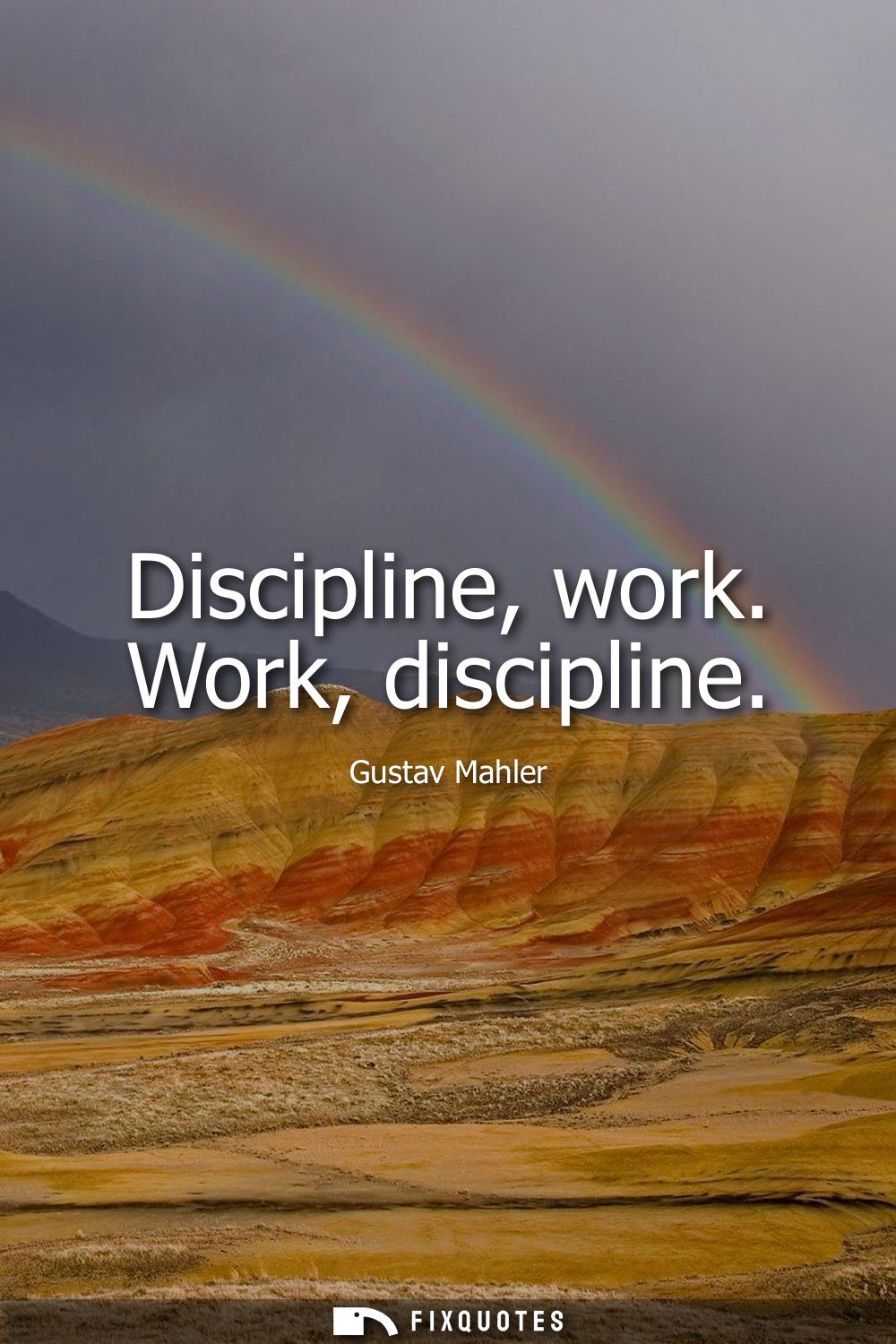
"Discipline, work. Work, discipline"
About this Quote
Two blunt nouns, flipped like a musical inversion, and suddenly Mahler’s whole ethic is on the table: no mysticism, no “inspiration,” just a treadmill you choose every day. “Discipline, work. Work, discipline” reads less like advice than a self-issued command, the kind you mutter when your nerves are fraying and the deadline doesn’t care. The repetition matters. It’s not poetic flourish; it’s an anti-flourish, a refusal of the romantic myth that the great composer is simply struck by lightning.
Mahler lived at the exact collision point between artistic grandeur and modern exhaustion. As a conductor, he was notorious for exacting rehearsals and near-tyrannical standards; as a composer, he built sprawling symphonies that sound like whole civilizations arguing with themselves. That scale doesn’t come from a single ecstatic burst. It comes from turning up, again and again, and insisting the notes obey. The quote’s chiasmus (A-B, B-A) suggests a closed system: discipline generates work, and work reinforces discipline. One feeds the other until it becomes identity.
There’s subtext, too: an anxiety that the only defense against chaos is routine. Mahler’s music is haunted by fragility - tenderness collapsing into marches, folk innocence curdling into dread. This maxim is the counterweight to that inner volatility, a way to domesticate the turbulent mind into usable sound. It’s also a quiet rebuke to audiences who want genius without the cost. Mahler is saying the cost out loud.
Mahler lived at the exact collision point between artistic grandeur and modern exhaustion. As a conductor, he was notorious for exacting rehearsals and near-tyrannical standards; as a composer, he built sprawling symphonies that sound like whole civilizations arguing with themselves. That scale doesn’t come from a single ecstatic burst. It comes from turning up, again and again, and insisting the notes obey. The quote’s chiasmus (A-B, B-A) suggests a closed system: discipline generates work, and work reinforces discipline. One feeds the other until it becomes identity.
There’s subtext, too: an anxiety that the only defense against chaos is routine. Mahler’s music is haunted by fragility - tenderness collapsing into marches, folk innocence curdling into dread. This maxim is the counterweight to that inner volatility, a way to domesticate the turbulent mind into usable sound. It’s also a quiet rebuke to audiences who want genius without the cost. Mahler is saying the cost out loud.
Quote Details
| Topic | Work Ethic |
|---|---|
| Source | Help us find the source |
| Cite |
Citation Formats
APA Style (7th ed.)
Mahler, Gustav. (2026, January 17). Discipline, work. Work, discipline. FixQuotes. https://fixquotes.com/quotes/discipline-work-work-discipline-53860/
Chicago Style
Mahler, Gustav. "Discipline, work. Work, discipline." FixQuotes. January 17, 2026. https://fixquotes.com/quotes/discipline-work-work-discipline-53860/.
MLA Style (9th ed.)
"Discipline, work. Work, discipline." FixQuotes, 17 Jan. 2026, https://fixquotes.com/quotes/discipline-work-work-discipline-53860/. Accessed 27 Mar. 2026.
More Quotes by Gustav
Add to List