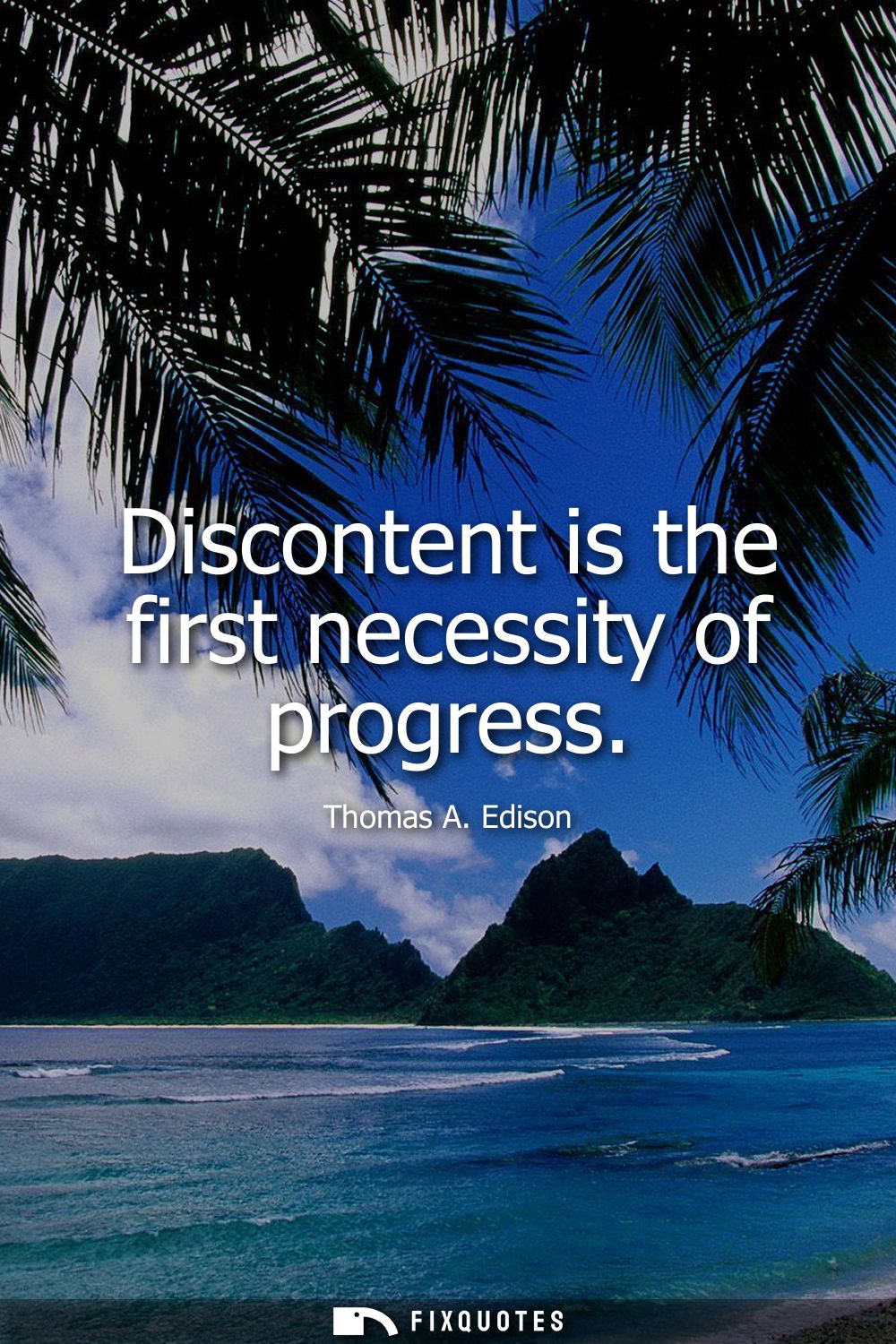
"Discontent is the first necessity of progress"
About this Quote
Progress, Edison implies, begins as an irritation: a refusal to accept the current state of things as good enough. “Discontent” is doing double duty here. It’s an emotional condition, but also a work ethic - the itch that keeps you in the lab after everyone else has gone home. Calling it a “necessity” strips it of glamour and turns it into a tool, like copper wire or a filament. You don’t have to be noble; you just have to be dissatisfied.
The subtext is pure Edison: innovation as disciplined impatience, not romantic inspiration. This is the inventor’s rebuttal to the myth of the lightning-bolt genius. Discontent, in this framing, isn’t whining or cynicism. It’s a specific kind of friction with reality that demands iteration. His career was built on incremental refinement, aggressive testing, and relentless optimization; he industrialized invention. The quote flatters that worldview by recasting restlessness as virtue and comfort as a trap.
Context matters, too. Edison operated in a late-19th- and early-20th-century America intoxicated with machines, patents, and “modernity,” where technological change promised social ascent and national power. “Progress” wasn’t an abstract ideal; it was electrification, communication at scale, factories running longer, cities glowing at night. In that environment, discontent becomes almost civic-minded: the personal annoyance that fuels a public transformation.
There’s a harder edge hiding inside the uplift. If discontent is necessary, then contentment looks like failure, and the treadmill never ends. Edison’s line captures the exhilaration of improvement - and the possibility that we might come to need dissatisfaction just to feel alive.
The subtext is pure Edison: innovation as disciplined impatience, not romantic inspiration. This is the inventor’s rebuttal to the myth of the lightning-bolt genius. Discontent, in this framing, isn’t whining or cynicism. It’s a specific kind of friction with reality that demands iteration. His career was built on incremental refinement, aggressive testing, and relentless optimization; he industrialized invention. The quote flatters that worldview by recasting restlessness as virtue and comfort as a trap.
Context matters, too. Edison operated in a late-19th- and early-20th-century America intoxicated with machines, patents, and “modernity,” where technological change promised social ascent and national power. “Progress” wasn’t an abstract ideal; it was electrification, communication at scale, factories running longer, cities glowing at night. In that environment, discontent becomes almost civic-minded: the personal annoyance that fuels a public transformation.
There’s a harder edge hiding inside the uplift. If discontent is necessary, then contentment looks like failure, and the treadmill never ends. Edison’s line captures the exhilaration of improvement - and the possibility that we might come to need dissatisfaction just to feel alive.
Quote Details
| Topic | Motivational |
|---|---|
| Source | Attributed to Thomas A. Edison; cited on Wikiquote 'Thomas Edison' entry (contains "Discontent is the first necessity of progress"). |
More Quotes by Thomas
Add to List