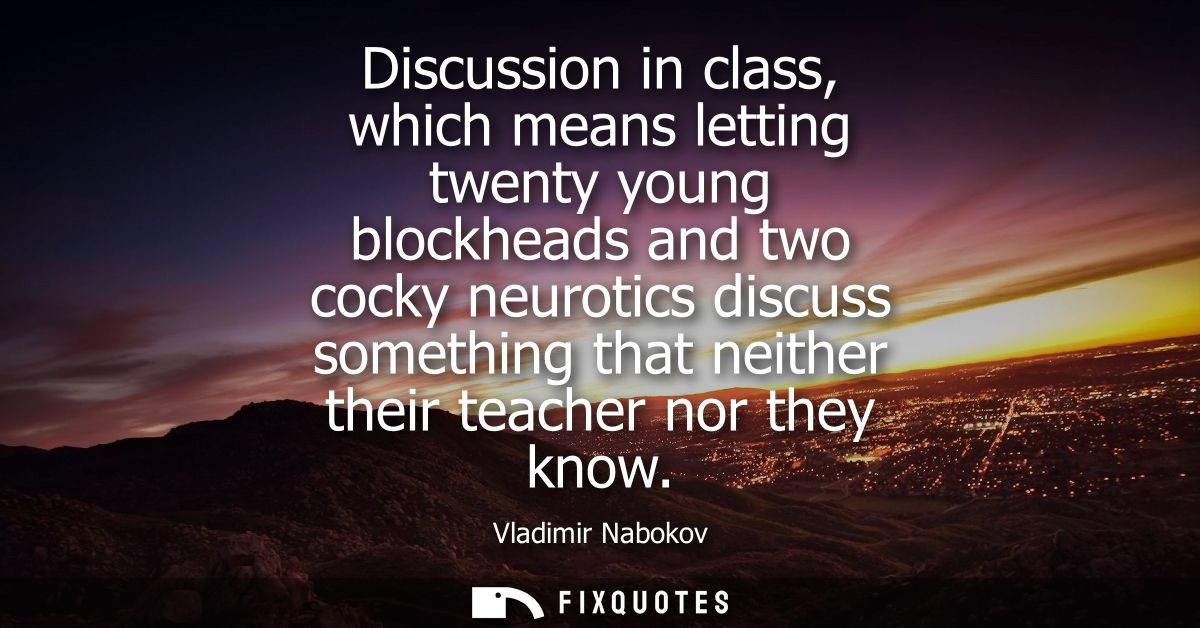
"Discussion in class, which means letting twenty young blockheads and two cocky neurotics discuss something that neither their teacher nor they know"
About this Quote
The phrasing is engineered to sting. “Which means” snaps the romantic veil off the term, translating institutional jargon into blunt reality. “Twenty young blockheads and two cocky neurotics” is Nabokov at his most socially precise: the majority cast as complacently dull, the minority as performatively clever and anxious. That “two” matters. It hints at the typical seminar dynamic where a couple of overeager voices dominate, not because they understand more, but because they can’t tolerate silence. The teacher isn’t spared either. Nabokov collapses the usual hierarchy by admitting the adult’s ignorance alongside the students’, turning the whole exercise into a kind of improvisational bluff.
Contextually, the jab fits Nabokov’s well-known suspicion of trendy educational methods and his reverence for exactitude: close reading, hard attention, the private labor of understanding. The subtext is less “students are stupid” than “institutions mistake noise for thought.” He’s diagnosing a culture that confuses participation with comprehension, and then congratulates itself for the confusion. The cruelty is deliberate; it’s also a warning about how easily “discussion” becomes a performance of intelligence rather than its acquisition.
Quote Details
| Topic | Teaching |
|---|---|
| Source | Help us find the source |
| Cite |
Citation Formats
APA Style (7th ed.)
Nabokov, Vladimir. (2026, January 18). Discussion in class, which means letting twenty young blockheads and two cocky neurotics discuss something that neither their teacher nor they know. FixQuotes. https://fixquotes.com/quotes/discussion-in-class-which-means-letting-twenty-16297/
Chicago Style
Nabokov, Vladimir. "Discussion in class, which means letting twenty young blockheads and two cocky neurotics discuss something that neither their teacher nor they know." FixQuotes. January 18, 2026. https://fixquotes.com/quotes/discussion-in-class-which-means-letting-twenty-16297/.
MLA Style (9th ed.)
"Discussion in class, which means letting twenty young blockheads and two cocky neurotics discuss something that neither their teacher nor they know." FixQuotes, 18 Jan. 2026, https://fixquotes.com/quotes/discussion-in-class-which-means-letting-twenty-16297/. Accessed 1 Apr. 2026.