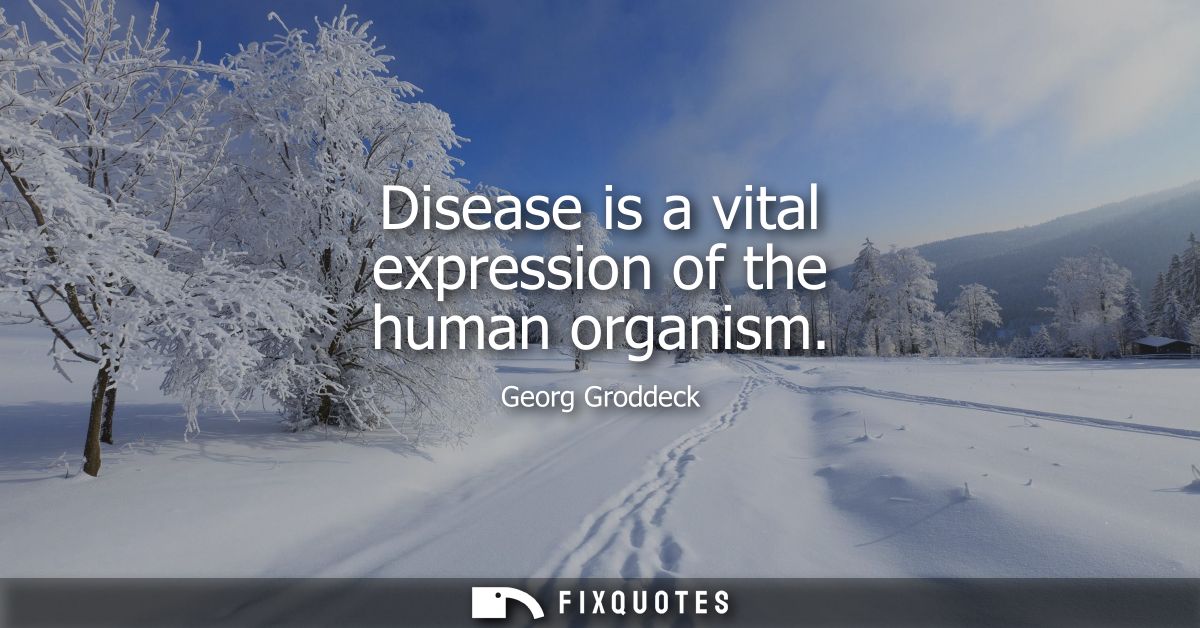
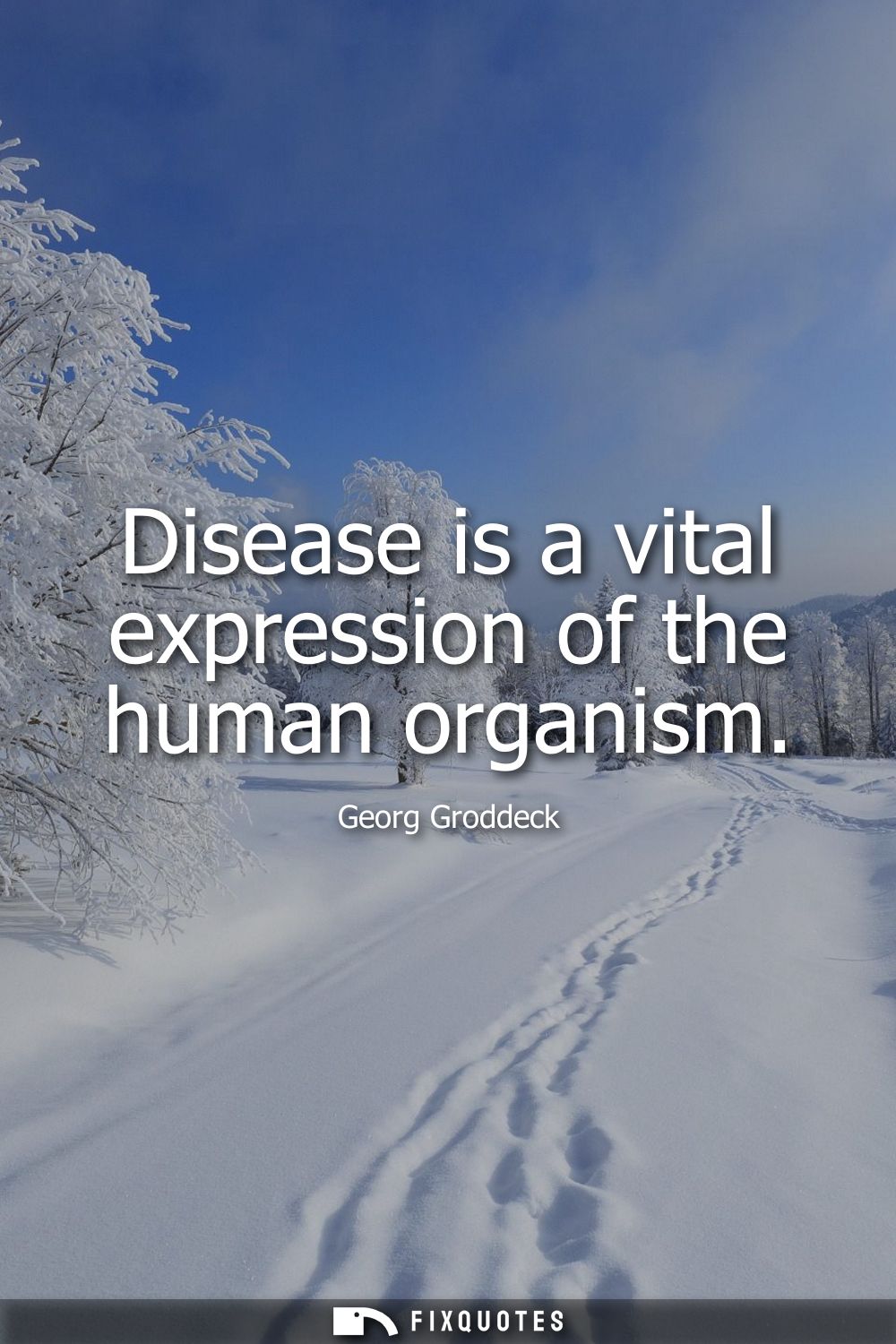
"Disease is a vital expression of the human organism"
About this Quote
“Disease is a vital expression of the human organism” is a provocation dressed up as a diagnosis. Georg Groddeck, an early 20th-century physician and psychoanalytic oddball, is pushing against the era’s rising faith in medicine as pure mechanics: find the broken part, fix it, move on. His word choice matters. “Vital” doesn’t mean pleasant; it means alive, purposeful, animated. He’s framing illness less as an enemy invasion than as the body speaking in its own dialect when ordinary speech fails.
The subtext is psychological and slightly heretical: symptoms aren’t just malfunctions, they’re messages. Groddeck’s worldview (often summarized as “the It” running us more than our conscious “I”) treats the organism as an author, not a victim. Disease becomes a kind of involuntary autobiography, written in pain, fatigue, skin eruptions, stomach knots. That’s why the sentence lands with such unsettling confidence: it relocates agency from germs and genes to the messy interior life we’d rather keep politely separate from physiology.
Context sharpens the edge. In the shadow of industrial modernity and postwar trauma, bodies were absorbing pressures that culture didn’t have language for. Groddeck’s intent isn’t to deny biology; it’s to widen the frame, to argue that health is never only physical. The line works because it refuses the comfort of a clean split between mind and body, and it dares you to treat sickness as meaning-bearing, not merely meaning-less.
The subtext is psychological and slightly heretical: symptoms aren’t just malfunctions, they’re messages. Groddeck’s worldview (often summarized as “the It” running us more than our conscious “I”) treats the organism as an author, not a victim. Disease becomes a kind of involuntary autobiography, written in pain, fatigue, skin eruptions, stomach knots. That’s why the sentence lands with such unsettling confidence: it relocates agency from germs and genes to the messy interior life we’d rather keep politely separate from physiology.
Context sharpens the edge. In the shadow of industrial modernity and postwar trauma, bodies were absorbing pressures that culture didn’t have language for. Groddeck’s intent isn’t to deny biology; it’s to widen the frame, to argue that health is never only physical. The line works because it refuses the comfort of a clean split between mind and body, and it dares you to treat sickness as meaning-bearing, not merely meaning-less.
Quote Details
| Topic | Health |
|---|---|
| Source | Help us find the source |
| Cite |
Citation Formats
APA Style (7th ed.)
Groddeck, Georg. (2026, January 17). Disease is a vital expression of the human organism. FixQuotes. https://fixquotes.com/quotes/disease-is-a-vital-expression-of-the-human-62201/
Chicago Style
Groddeck, Georg. "Disease is a vital expression of the human organism." FixQuotes. January 17, 2026. https://fixquotes.com/quotes/disease-is-a-vital-expression-of-the-human-62201/.
MLA Style (9th ed.)
"Disease is a vital expression of the human organism." FixQuotes, 17 Jan. 2026, https://fixquotes.com/quotes/disease-is-a-vital-expression-of-the-human-62201/. Accessed 5 Apr. 2026.
More Quotes by Georg
Add to List