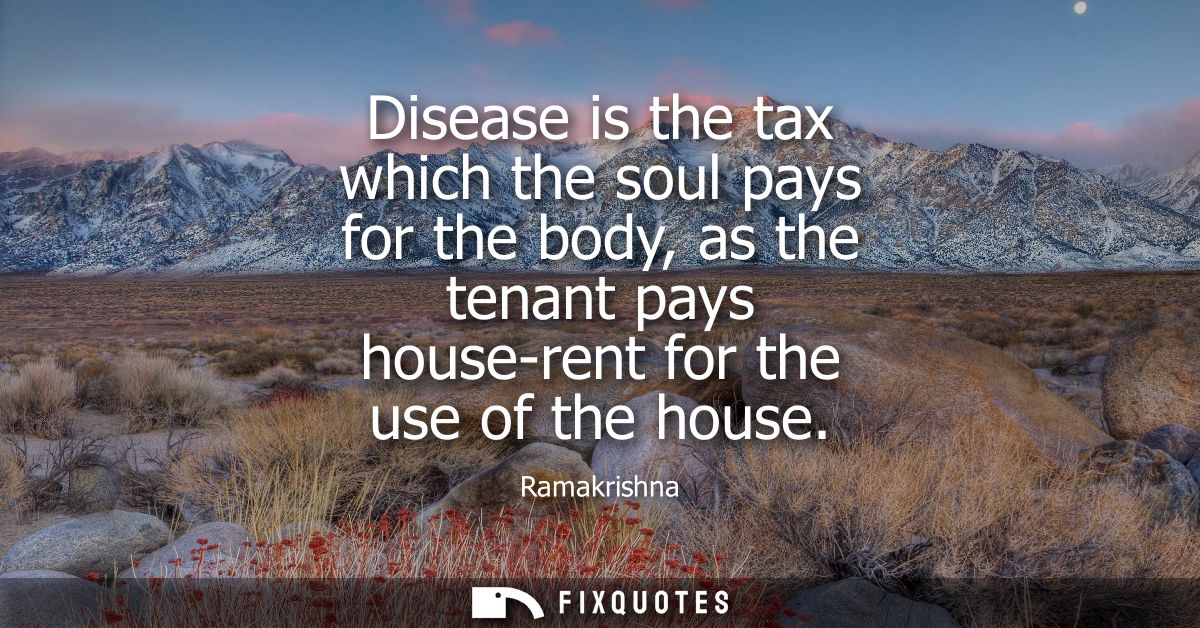
"Disease is the tax which the soul pays for the body, as the tenant pays house-rent for the use of the house"
About this Quote
The subtext is unmistakably Vedantic: the soul is not the body, the body is temporary property, and pain is one of the lease terms. Ramakrishna isn’t glorifying disease; he’s quarantining it, relocating it from the core self to the conditions of embodiment. For devotees, that separation can be psychologically liberating: if the soul is the tenant, then sickness can’t be evidence of spiritual failure. It’s maintenance fees on a fragile structure.
Context matters because Ramakrishna’s authority wasn’t abstract philosophy; it was lived religious charisma in 19th-century Bengal, amid poverty, colonial upheaval, and limited medical care. When disease was common and treatment scarce, meaning-making became its own form of survival. The line offers a disciplined spirituality for bodily vulnerability: accept the rent, but don’t confuse the house with home.
Quote Details
| Topic | Wisdom |
|---|---|
| Source | Help us find the source |
| Cite |
Citation Formats
APA Style (7th ed.)
Ramakrishna. (2026, January 17). Disease is the tax which the soul pays for the body, as the tenant pays house-rent for the use of the house. FixQuotes. https://fixquotes.com/quotes/disease-is-the-tax-which-the-soul-pays-for-the-26169/
Chicago Style
Ramakrishna. "Disease is the tax which the soul pays for the body, as the tenant pays house-rent for the use of the house." FixQuotes. January 17, 2026. https://fixquotes.com/quotes/disease-is-the-tax-which-the-soul-pays-for-the-26169/.
MLA Style (9th ed.)
"Disease is the tax which the soul pays for the body, as the tenant pays house-rent for the use of the house." FixQuotes, 17 Jan. 2026, https://fixquotes.com/quotes/disease-is-the-tax-which-the-soul-pays-for-the-26169/. Accessed 7 Apr. 2026.