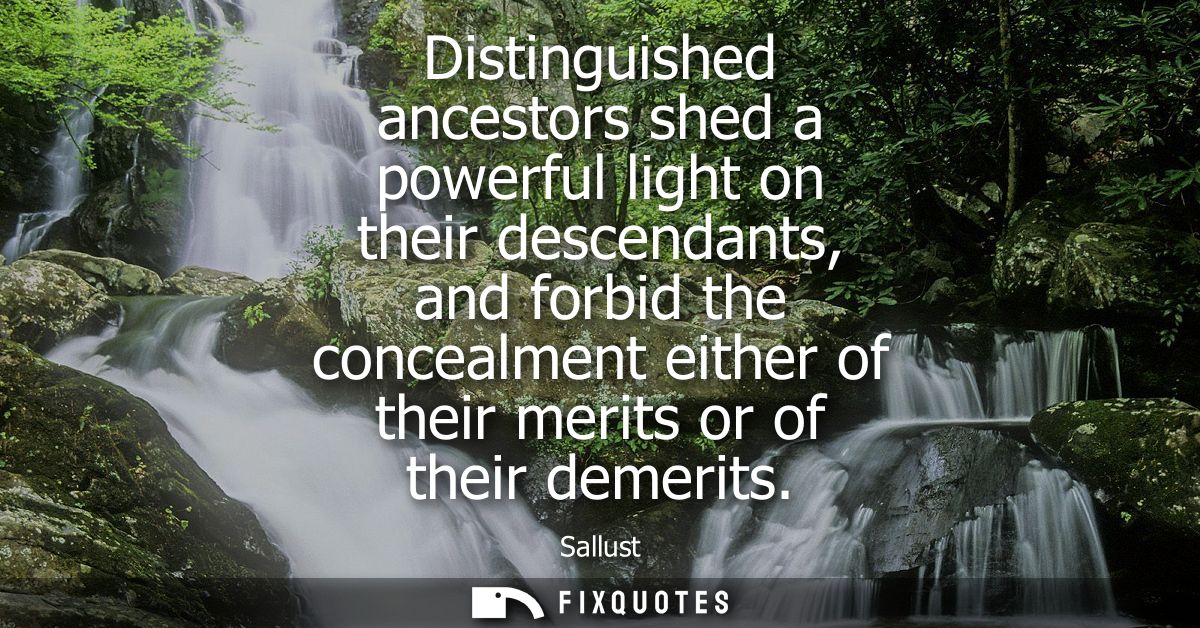
"Distinguished ancestors shed a powerful light on their descendants, and forbid the concealment either of their merits or of their demerits"
About this Quote
The line works because it flips the usual aristocratic fantasy. Noble lineage is supposed to “cover” you, to smooth over flaws with inherited prestige. Sallust insists it does the opposite: it “forbids concealment” of both virtue and vice. Merit becomes comparative, not absolute. Your good deeds are measured against a gallery of forebears; your failures look like betrayal, not mere human error. Even your successes can read as borrowed light.
Sallust’s subtext is moral and political at once. As a historian writing in the late Republic, he’s documenting a society where old names dominated offices while corruption metastasized. The quote needles the Roman nobility’s habit of treating ancestry as entitlement rather than obligation. It also hints at the historian’s own mandate: to keep the record so bright that reputation can’t launder wrongdoing. In that sense, the “powerful light” is historiography itself: memory weaponized against convenient forgetting, especially by the well-born.
Quote Details
| Topic | Legacy & Remembrance |
|---|---|
| Source | Help us find the source |
| Cite |
Citation Formats
APA Style (7th ed.)
Sallust. (2026, January 15). Distinguished ancestors shed a powerful light on their descendants, and forbid the concealment either of their merits or of their demerits. FixQuotes. https://fixquotes.com/quotes/distinguished-ancestors-shed-a-powerful-light-on-159415/
Chicago Style
Sallust. "Distinguished ancestors shed a powerful light on their descendants, and forbid the concealment either of their merits or of their demerits." FixQuotes. January 15, 2026. https://fixquotes.com/quotes/distinguished-ancestors-shed-a-powerful-light-on-159415/.
MLA Style (9th ed.)
"Distinguished ancestors shed a powerful light on their descendants, and forbid the concealment either of their merits or of their demerits." FixQuotes, 15 Jan. 2026, https://fixquotes.com/quotes/distinguished-ancestors-shed-a-powerful-light-on-159415/. Accessed 14 Mar. 2026.