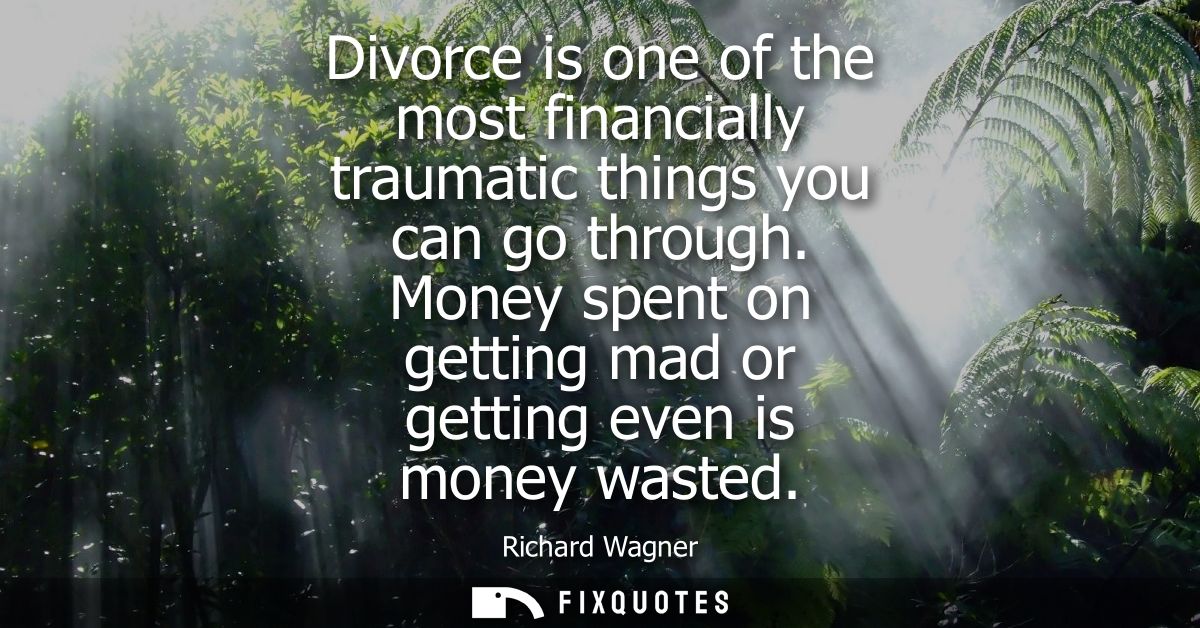
"Divorce is one of the most financially traumatic things you can go through. Money spent on getting mad or getting even is money wasted"
About this Quote
The specific intent is pragmatic moralism dressed as fiscal counsel: treat divorce less like a battlefield and more like triage. By framing “getting mad” and “getting even” as expenditures, he recasts emotion as consumption - not noble suffering, but a budget line item. The subtext is almost puritanical: indignation feels righteous, revenge feels clarifying, but both are just ways of extending the relationship by other means. The marriage ends; the conflict becomes the new intimacy.
Context matters. Nineteenth-century Europe wasn’t kind to women’s financial independence, and divorce (where it existed) carried social penalties alongside legal complexity. “Financial trauma” isn’t metaphor; it’s structure. In that world, money could decide custody, housing, reputation, even whether separation was livable. Wagner, perpetually entangled in patronage, debts, and scandal, understood how quickly personal drama turns into solvency math.
It works because it punctures self-importance. The line doesn’t ask you to be forgiving; it asks you to be efficient. In a culture that romanticizes “closure” through confrontation, Wagner offers a harsher wisdom: the only satisfying revenge is not paying for it.
Quote Details
| Topic | Divorce |
|---|---|
| Source | Help us find the source |
| Cite |
Citation Formats
APA Style (7th ed.)
Wagner, Richard. (2026, January 16). Divorce is one of the most financially traumatic things you can go through. Money spent on getting mad or getting even is money wasted. FixQuotes. https://fixquotes.com/quotes/divorce-is-one-of-the-most-financially-traumatic-107541/
Chicago Style
Wagner, Richard. "Divorce is one of the most financially traumatic things you can go through. Money spent on getting mad or getting even is money wasted." FixQuotes. January 16, 2026. https://fixquotes.com/quotes/divorce-is-one-of-the-most-financially-traumatic-107541/.
MLA Style (9th ed.)
"Divorce is one of the most financially traumatic things you can go through. Money spent on getting mad or getting even is money wasted." FixQuotes, 16 Jan. 2026, https://fixquotes.com/quotes/divorce-is-one-of-the-most-financially-traumatic-107541/. Accessed 3 Apr. 2026.