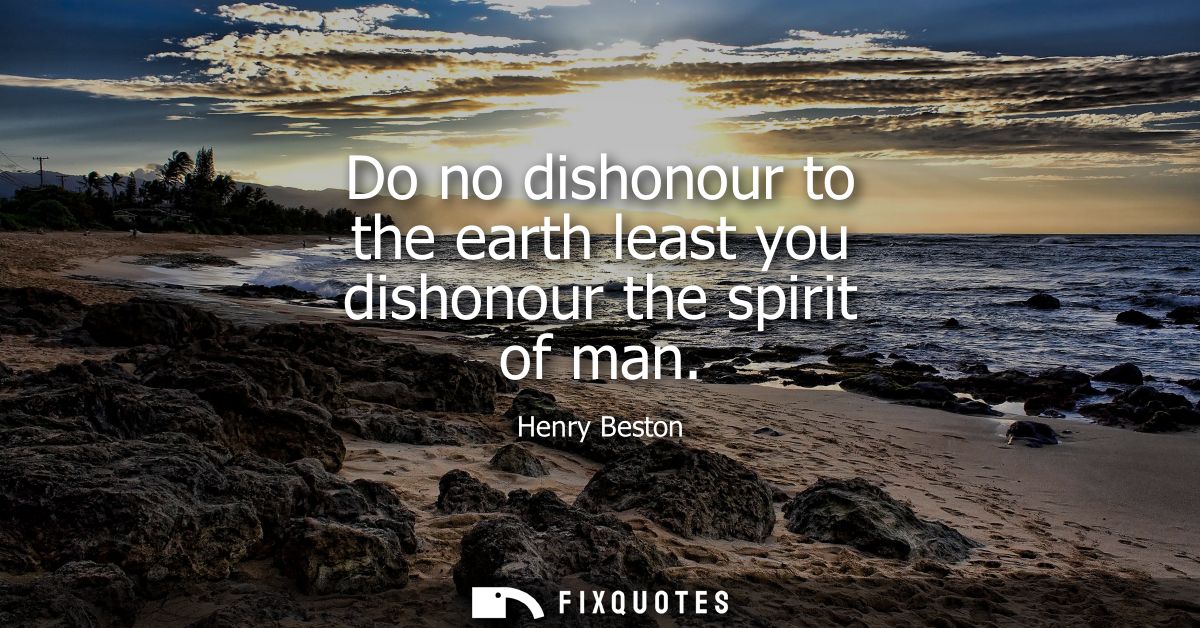
"Do no dishonour to the earth, least you dishonour the spirit of man"
About this Quote
Beston’s line lands like a moral rebuke dressed in plain clothes: harm the earth and you don’t just damage “nature,” you cheapen yourself. The verb choice matters. “Dishonour” isn’t the language of policy or even ecology; it’s the language of vows, ancestry, and shame. He’s not asking for better recycling habits. He’s arguing that environmental abuse is a species-level humiliation.
The subtext is a deliberate collapse of the boundary between the natural world and human meaning. “Least” (an older spelling of “lest”) gives the sentence the cadence of a warning from scripture or folklore, implying consequences that are spiritual before they’re material. Beston makes the earth a mirror: what you do to it reveals what you think you are. If you treat land, water, and animals as disposable, you’re quietly endorsing a view of humanity as disposable too: a creature without obligations, without reverence, without limits.
Context sharpens the intent. Beston wrote in an era when industrial expansion was still sold as uncomplicated progress, when “conservation” often meant resource management for human benefit. His broader work, especially The Outermost House, insists on the wild as a corrective to modern arrogance, not a backdrop for it. This sentence is a compact manifesto against the flattening logic of extraction: the earth is not merely scenery or inventory; it’s a moral relationship. Treat it like a quarry, and you train the human spirit to live like one.
The subtext is a deliberate collapse of the boundary between the natural world and human meaning. “Least” (an older spelling of “lest”) gives the sentence the cadence of a warning from scripture or folklore, implying consequences that are spiritual before they’re material. Beston makes the earth a mirror: what you do to it reveals what you think you are. If you treat land, water, and animals as disposable, you’re quietly endorsing a view of humanity as disposable too: a creature without obligations, without reverence, without limits.
Context sharpens the intent. Beston wrote in an era when industrial expansion was still sold as uncomplicated progress, when “conservation” often meant resource management for human benefit. His broader work, especially The Outermost House, insists on the wild as a corrective to modern arrogance, not a backdrop for it. This sentence is a compact manifesto against the flattening logic of extraction: the earth is not merely scenery or inventory; it’s a moral relationship. Treat it like a quarry, and you train the human spirit to live like one.
Quote Details
| Topic | Nature |
|---|---|
| Source | Help us find the source |
| Cite |
Citation Formats
APA Style (7th ed.)
Beston, Henry. (2026, February 17). Do no dishonour to the earth, least you dishonour the spirit of man. FixQuotes. https://fixquotes.com/quotes/do-no-dishonour-to-the-earth-least-you-dishonour-125391/
Chicago Style
Beston, Henry. "Do no dishonour to the earth, least you dishonour the spirit of man." FixQuotes. February 17, 2026. https://fixquotes.com/quotes/do-no-dishonour-to-the-earth-least-you-dishonour-125391/.
MLA Style (9th ed.)
"Do no dishonour to the earth, least you dishonour the spirit of man." FixQuotes, 17 Feb. 2026, https://fixquotes.com/quotes/do-no-dishonour-to-the-earth-least-you-dishonour-125391/. Accessed 30 Mar. 2026.
More Quotes by Henry
Add to List