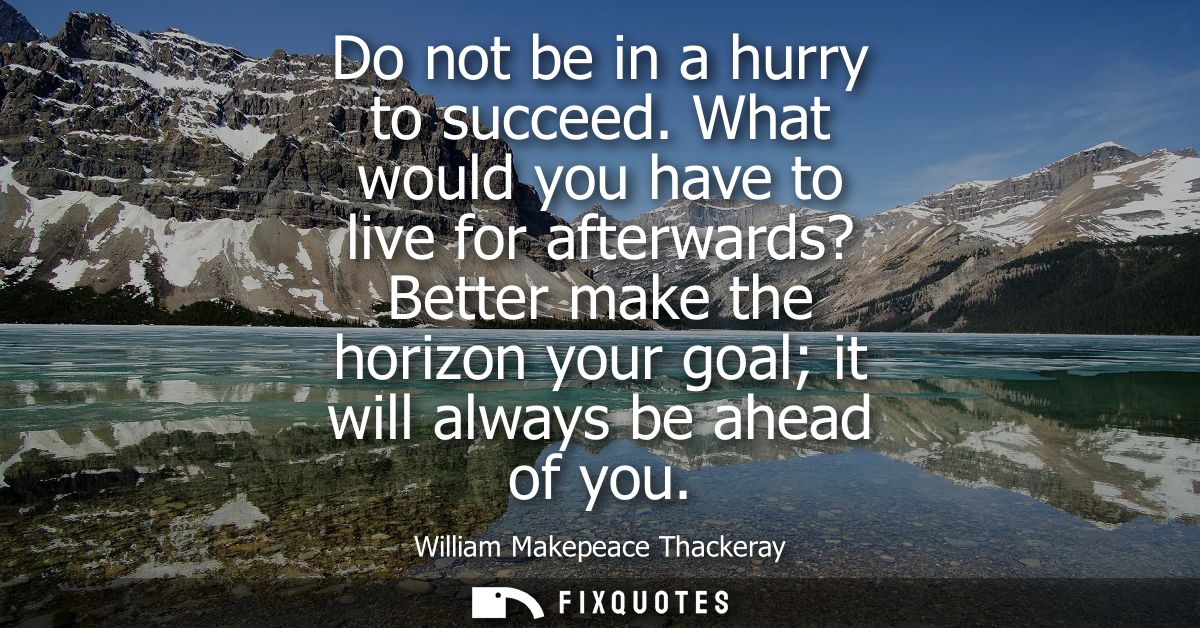
"Do not be in a hurry to succeed. What would you have to live for afterwards? Better make the horizon your goal; it will always be ahead of you"
About this Quote
The craft here is in how he redefines the goal without preaching. “Better make the horizon your goal” swaps a measurable endpoint for a moving one, an image that refuses closure. The horizon is seductive precisely because it can’t be cashed in. It keeps the self in motion, not trapped in the anxieties of social ranking. Thackeray is also quietly satirizing the Victorian fixation on advancement - the idea that life is a ladder and the point is to stop climbing as high as possible. He’s telling you the ladder ends in stagnation.
Context matters: Thackeray made a career dissecting status hunger and self-deception in a culture intoxicated by upward mobility. This quote is a novelist’s version of plot wisdom: don’t rush the ending. Stay in the chapter where you’re still becoming.
Quote Details
| Topic | Goal Setting |
|---|---|
| Source | Help us find the source |
| Cite |
Citation Formats
APA Style (7th ed.)
Thackeray, William Makepeace. (2026, January 18). Do not be in a hurry to succeed. What would you have to live for afterwards? Better make the horizon your goal; it will always be ahead of you. FixQuotes. https://fixquotes.com/quotes/do-not-be-in-a-hurry-to-succeed-what-would-you-15101/
Chicago Style
Thackeray, William Makepeace. "Do not be in a hurry to succeed. What would you have to live for afterwards? Better make the horizon your goal; it will always be ahead of you." FixQuotes. January 18, 2026. https://fixquotes.com/quotes/do-not-be-in-a-hurry-to-succeed-what-would-you-15101/.
MLA Style (9th ed.)
"Do not be in a hurry to succeed. What would you have to live for afterwards? Better make the horizon your goal; it will always be ahead of you." FixQuotes, 18 Jan. 2026, https://fixquotes.com/quotes/do-not-be-in-a-hurry-to-succeed-what-would-you-15101/. Accessed 12 Feb. 2026.