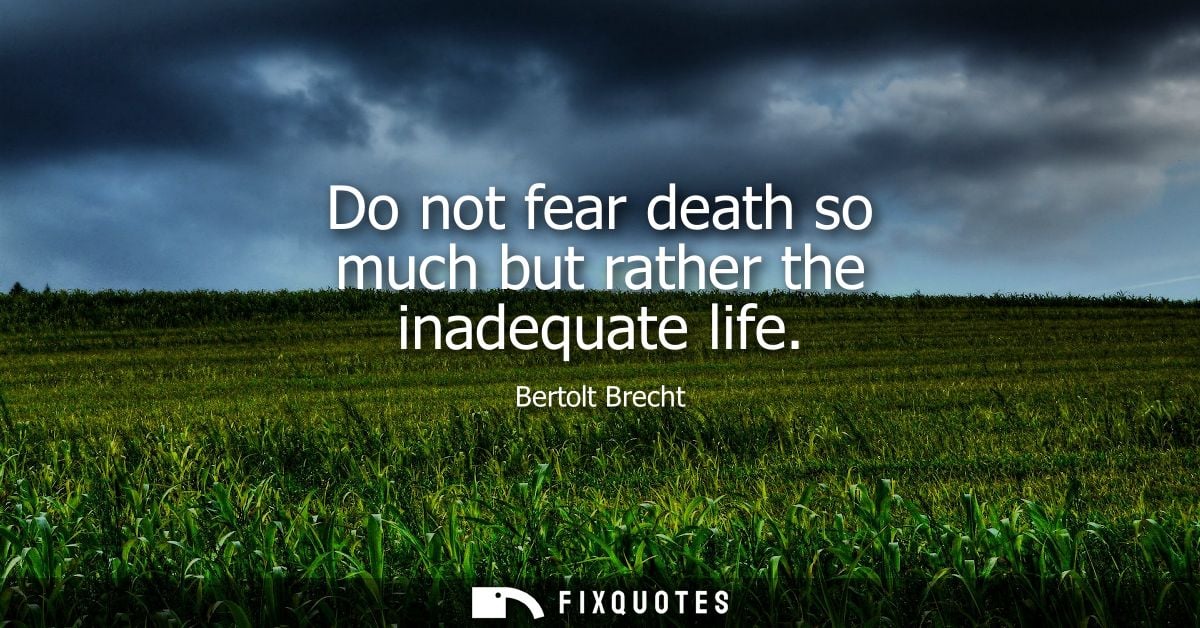
"Do not fear death so much, but rather the inadequate life"
About this Quote
Brecht doesn’t soothe you about dying; he indicts you for how you’re living. “Do not fear death so much” reads like classic moral counsel until the pivot lands: the real terror is “the inadequate life,” a phrase that sounds almost bureaucratic, as if life could fail an inspection. That’s the sting. Brecht turns an existential anxiety into a political and ethical audit: What have you accepted as normal? What have you called “necessary” because resistance felt inconvenient?
The line carries Brecht’s signature suspicion of passive emotion. Fear of death can be a private drama that keeps the public world untouched; fear of an inadequate life forces a reckoning with choices, complicity, and wasted agency. It’s a reframing that undermines the comforting heroism of “braving death” and replaces it with the harder, less cinematic challenge of refusing small, compliant living. Brecht isn’t romanticizing risk for its own sake; he’s warning that survival at any cost can become a quiet form of surrender.
Context matters: Brecht wrote in a century where states industrialized death and demanded loyalty, where exile and censorship weren’t abstractions. Under those conditions, “inadequate” isn’t merely personal underachievement; it’s a life trimmed to fit authoritarian expectations, a life where one’s speech, work, and conscience are negotiated down. The quote works because it weaponizes understatement. Death is the obvious threat. Brecht points to the subtler one: a life spent bargaining away your own full participation in the world.
The line carries Brecht’s signature suspicion of passive emotion. Fear of death can be a private drama that keeps the public world untouched; fear of an inadequate life forces a reckoning with choices, complicity, and wasted agency. It’s a reframing that undermines the comforting heroism of “braving death” and replaces it with the harder, less cinematic challenge of refusing small, compliant living. Brecht isn’t romanticizing risk for its own sake; he’s warning that survival at any cost can become a quiet form of surrender.
Context matters: Brecht wrote in a century where states industrialized death and demanded loyalty, where exile and censorship weren’t abstractions. Under those conditions, “inadequate” isn’t merely personal underachievement; it’s a life trimmed to fit authoritarian expectations, a life where one’s speech, work, and conscience are negotiated down. The quote works because it weaponizes understatement. Death is the obvious threat. Brecht points to the subtler one: a life spent bargaining away your own full participation in the world.
Quote Details
| Topic | Meaning of Life |
|---|---|
| Source | Help us find the source |
| Cite |
Citation Formats
APA Style (7th ed.)
Brecht, Bertolt. (2026, February 20). Do not fear death so much, but rather the inadequate life. FixQuotes. https://fixquotes.com/quotes/do-not-fear-death-so-much-but-rather-the-7975/
Chicago Style
Brecht, Bertolt. "Do not fear death so much, but rather the inadequate life." FixQuotes. February 20, 2026. https://fixquotes.com/quotes/do-not-fear-death-so-much-but-rather-the-7975/.
MLA Style (9th ed.)
"Do not fear death so much, but rather the inadequate life." FixQuotes, 20 Feb. 2026, https://fixquotes.com/quotes/do-not-fear-death-so-much-but-rather-the-7975/. Accessed 25 Mar. 2026.
More Quotes by Bertolt
Add to List