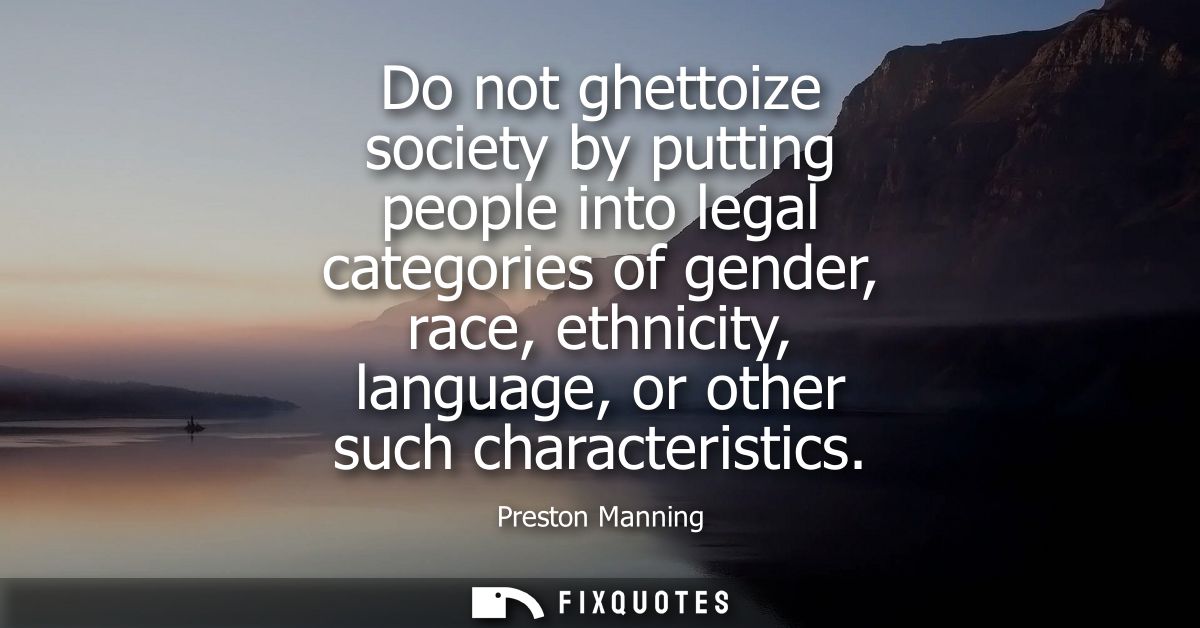
"Do not ghettoize society by putting people into legal categories of gender, race, ethnicity, language, or other such characteristics"
About this Quote
The intent tracks a classic small-c conservative instinct: protect social cohesion by keeping government “blind” to identity. In Canadian context, that lands directly in the long argument over multiculturalism, bilingualism, and Charter-era rights protections. Manning’s Reform Party emerged in the 1990s amid backlash to constitutional bargaining and perceived special deals. So the quote reads less like a neutral plea for unity and more like a preemptive critique of policies that recognize groups in law - employment equity, language rights, Indigenous-specific frameworks, human rights categories.
The subtext is a wager about power: that legal recognition of difference doesn’t merely protect the vulnerable; it incentivizes political entrepreneurs to mobilize grievance and turn citizenship into a competition for exemptions. By bundling gender and race with language and ethnicity, he collapses distinct histories into one cautionary tale about “categories,” making the administrative act itself the villain.
What makes the line effective is its simplicity and its anxiety. It offers an appealing picture of fairness - one law for all - while sidestepping the uncomfortable counterpoint: ignoring categories doesn’t erase inequality; it can just freeze it into the “neutral” baseline. The rhetoric asks you to fear the label more than the conditions that made the label necessary.
Quote Details
| Topic | Equality |
|---|---|
| Source | Help us find the source |
| Cite |
Citation Formats
APA Style (7th ed.)
Manning, Preston. (2026, January 17). Do not ghettoize society by putting people into legal categories of gender, race, ethnicity, language, or other such characteristics. FixQuotes. https://fixquotes.com/quotes/do-not-ghettoize-society-by-putting-people-into-65087/
Chicago Style
Manning, Preston. "Do not ghettoize society by putting people into legal categories of gender, race, ethnicity, language, or other such characteristics." FixQuotes. January 17, 2026. https://fixquotes.com/quotes/do-not-ghettoize-society-by-putting-people-into-65087/.
MLA Style (9th ed.)
"Do not ghettoize society by putting people into legal categories of gender, race, ethnicity, language, or other such characteristics." FixQuotes, 17 Jan. 2026, https://fixquotes.com/quotes/do-not-ghettoize-society-by-putting-people-into-65087/. Accessed 15 Mar. 2026.