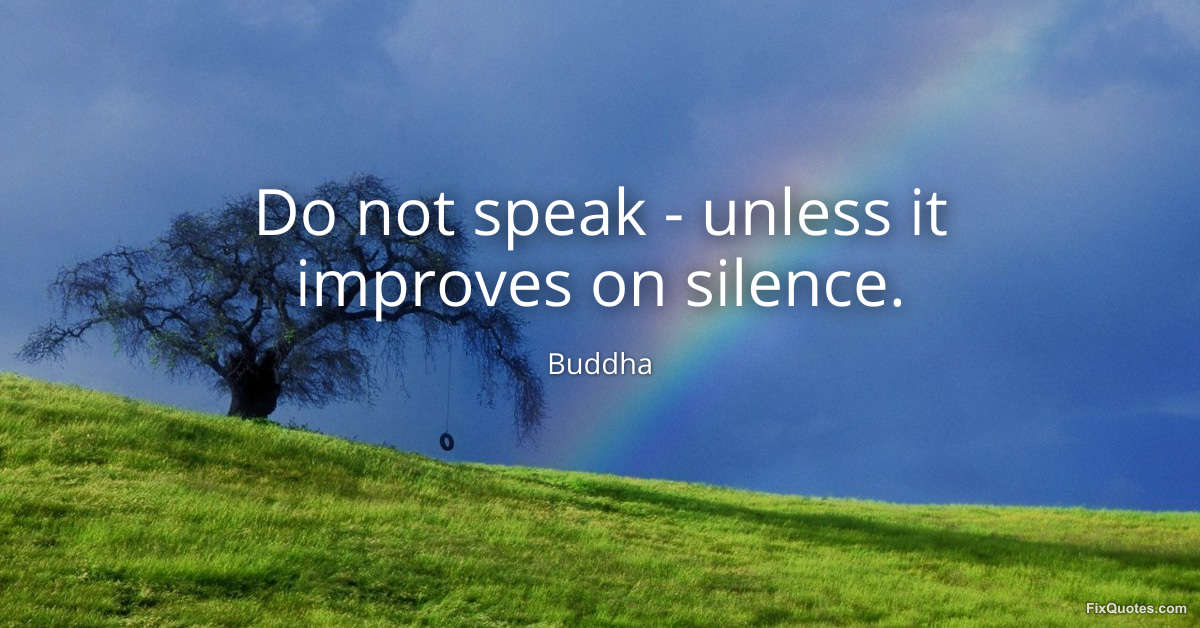
"Do not speak - unless it improves on silence"
About this Quote
Silence, in this formulation, is not emptiness; it is the standard speech has to beat. That reversal gives the line its force. Most cultures treat speech as the default and quiet as absence, awkwardness, even failure. Buddha flips the hierarchy. Words are suddenly on probation. If they cannot clarify, heal, teach, or calm, they are not neutral; they are a degradation of something cleaner.
The intent is ethical as much as spiritual. In Buddhist thought, speech is action. It can generate attachment, vanity, conflict, self-deception. So the line is not a genteel endorsement of introversion or good manners. It is a demand for discipline. Before speaking, one must ask: Is this true? Is it necessary? Is it compassionate? The subtext is that much of ordinary talk fails that test. Gossip, boasting, reactive argument, the compulsive need to fill dead air; these are not harmless social habits but symptoms of an untrained mind.
That is why the saying still lands with unusual sharpness in a hyperverbal age. Social media has made expression feel like a civic reflex, as if every thought improves by being posted. Buddha's sentence offers a harder metric: not whether you have a right to speak, but whether your speech outperforms restraint. It is severe, but not anti-human. The goal is not muteness; it is precision. When words do arrive under that standard, they carry weight. They are less likely to be self-display and more likely to be instruments of attention. Silence is not the opposite of communication here. It is its measure.
The intent is ethical as much as spiritual. In Buddhist thought, speech is action. It can generate attachment, vanity, conflict, self-deception. So the line is not a genteel endorsement of introversion or good manners. It is a demand for discipline. Before speaking, one must ask: Is this true? Is it necessary? Is it compassionate? The subtext is that much of ordinary talk fails that test. Gossip, boasting, reactive argument, the compulsive need to fill dead air; these are not harmless social habits but symptoms of an untrained mind.
That is why the saying still lands with unusual sharpness in a hyperverbal age. Social media has made expression feel like a civic reflex, as if every thought improves by being posted. Buddha's sentence offers a harder metric: not whether you have a right to speak, but whether your speech outperforms restraint. It is severe, but not anti-human. The goal is not muteness; it is precision. When words do arrive under that standard, they carry weight. They are less likely to be self-display and more likely to be instruments of attention. Silence is not the opposite of communication here. It is its measure.
Quote Details
| Topic | Wisdom |
|---|---|
| Source | Later attribution: The Art of Deliberate Success (David Keane, 2013) modern compilationISBN: 9781118487648 · ID: mnq8N_xXeH0C
Evidence:
... Do not speak - unless it improves on silence . -BUDDHIST SAYING. Your. our language defines you . From the moment you accept this truth , your life changes . You become acutely conscious of your language , deliberate about the thoughts ... |
| Cite |
Citation Formats
APA Style (7th ed.)
Buddha. (2026, March 15). Do not speak - unless it improves on silence. FixQuotes. https://fixquotes.com/quotes/do-not-speak-unless-it-improves-on-silence-185828/
Chicago Style
Buddha. "Do not speak - unless it improves on silence." FixQuotes. March 15, 2026. https://fixquotes.com/quotes/do-not-speak-unless-it-improves-on-silence-185828/.
MLA Style (9th ed.)
"Do not speak - unless it improves on silence." FixQuotes, 15 Mar. 2026, https://fixquotes.com/quotes/do-not-speak-unless-it-improves-on-silence-185828/. Accessed 2 Apr. 2026.
More Quotes by Buddha
Add to List