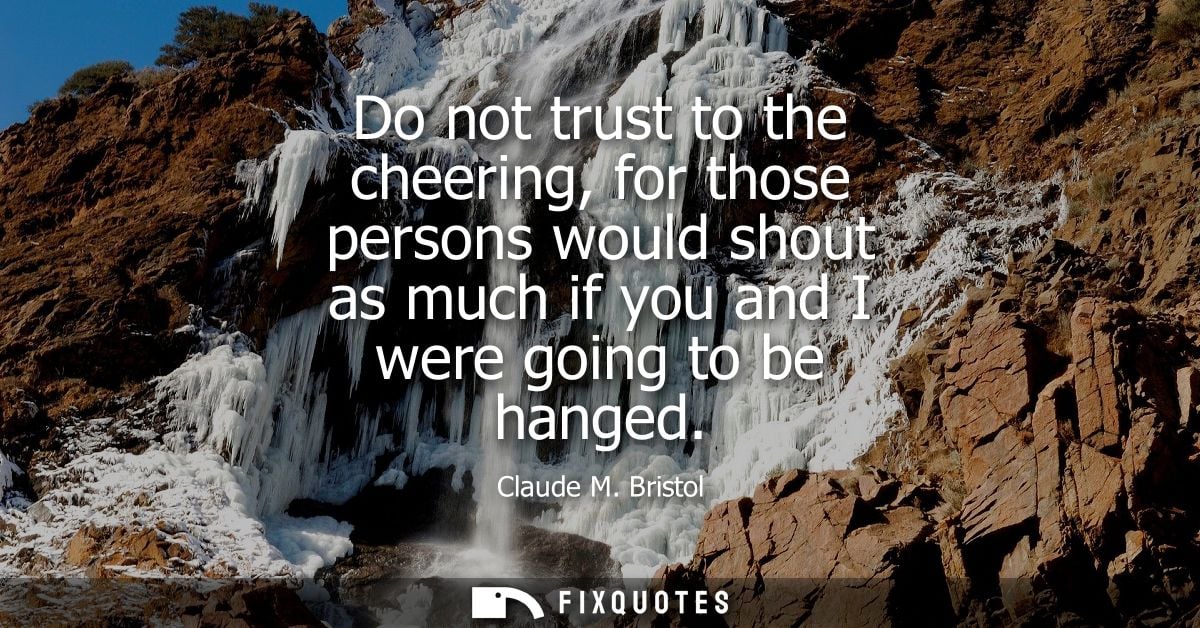
"Do not trust to the cheering, for those persons would shout as much if you and I were going to be hanged"
About this Quote
The intent is prophylactic: inoculate the listener against the seduction of applause. He casts the audience not as a community but as weather - shifting, impersonal, sometimes violent. The subtext is about power. When leaders, performers, or would-be strivers start treating cheers as a scoreboard for truth, they become governable by whoever can produce the loudest room. Bristol's hangman's image is a blunt reminder that spectacle can turn punitive without changing its tone.
Contextually, Bristol wrote in an early-20th-century culture obsessed with public persuasion, mass media, and the mechanics of influence. In that world, "the crowd" becomes both market and jury. His sentence is a small piece of psychological self-defense: measure your work by substance, not reaction; keep your center when the room loves you, because it's the same room that might love your downfall.
Quote Details
| Topic | Fake Friends |
|---|---|
| Source | Help us find the source |
| Cite |
Citation Formats
APA Style (7th ed.)
Bristol, Claude M. (2026, January 16). Do not trust to the cheering, for those persons would shout as much if you and I were going to be hanged. FixQuotes. https://fixquotes.com/quotes/do-not-trust-to-the-cheering-for-those-persons-110089/
Chicago Style
Bristol, Claude M. "Do not trust to the cheering, for those persons would shout as much if you and I were going to be hanged." FixQuotes. January 16, 2026. https://fixquotes.com/quotes/do-not-trust-to-the-cheering-for-those-persons-110089/.
MLA Style (9th ed.)
"Do not trust to the cheering, for those persons would shout as much if you and I were going to be hanged." FixQuotes, 16 Jan. 2026, https://fixquotes.com/quotes/do-not-trust-to-the-cheering-for-those-persons-110089/. Accessed 2 Apr. 2026.