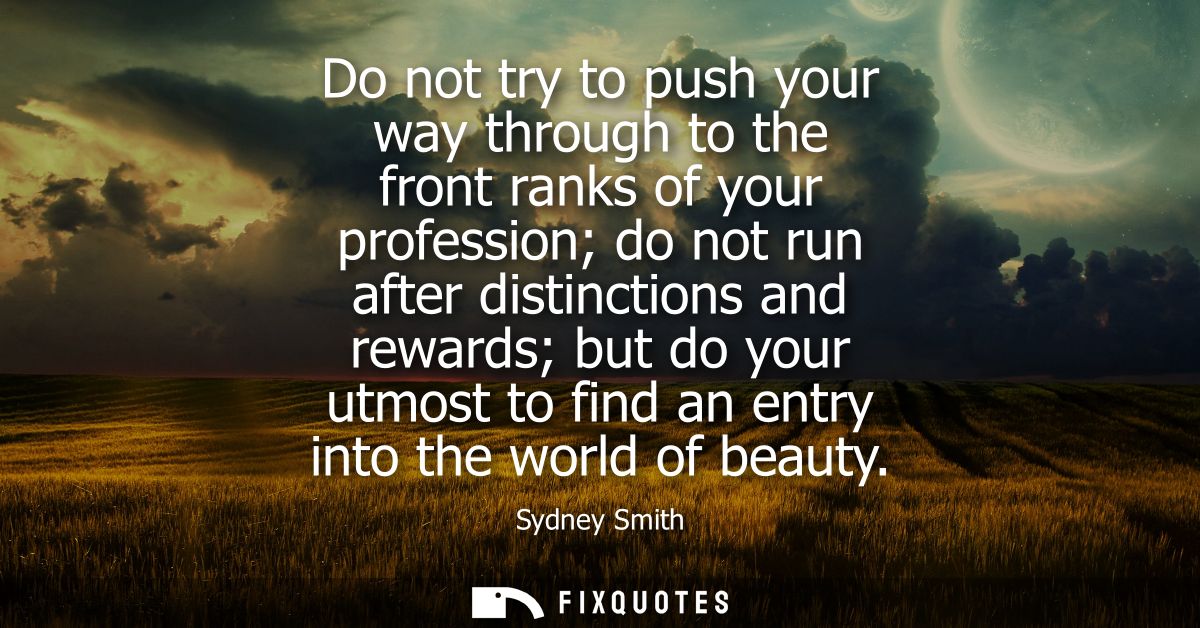
"Do not try to push your way through to the front ranks of your profession; do not run after distinctions and rewards; but do your utmost to find an entry into the world of beauty"
About this Quote
A clergyman telling you to stop chasing the “front ranks” sounds like pious restraint until you notice the bait-and-switch: Sydney Smith isn’t arguing for passivity, he’s rerouting ambition. The sentence is built on two prohibitions - don’t shove, don’t run - verbs that make professional striving look not just exhausting but faintly vulgar. “Push your way” implies elbows and opportunism; “run after” turns honors into something you pantingly pursue like a dog after a carriage. Smith’s moral point lands through social satire: status-seeking deforms the seeker.
Then comes the pivot: “but do your utmost.” This isn’t monkish renunciation. It’s effort, redirected. “Find an entry” is a wonderfully non-triumphal phrase, suggesting beauty isn’t a podium you conquer but a room you’re lucky - and disciplined - enough to enter. Beauty here isn’t decoration; in Smith’s Anglican, early-19th-century world it’s a proxy for the formative powers of art, nature, taste, and humane attention. The subtext is pastoral and practical: the rewards you can’t control (rank, distinctions) make you anxious and petty; the realm you can practice daily (beauty) makes you steadier, more generous, more fully alive.
Context matters. Smith lived amid the churn of modern professional life - expanding institutions, reputations built in print, competitive clerical and literary circles. His advice reads like an early warning about careerism: if your identity is stapled to advancement, you become easy to manipulate. Beauty, by contrast, is offered as an alternative economy, one where the currency is perception rather than applause.
Then comes the pivot: “but do your utmost.” This isn’t monkish renunciation. It’s effort, redirected. “Find an entry” is a wonderfully non-triumphal phrase, suggesting beauty isn’t a podium you conquer but a room you’re lucky - and disciplined - enough to enter. Beauty here isn’t decoration; in Smith’s Anglican, early-19th-century world it’s a proxy for the formative powers of art, nature, taste, and humane attention. The subtext is pastoral and practical: the rewards you can’t control (rank, distinctions) make you anxious and petty; the realm you can practice daily (beauty) makes you steadier, more generous, more fully alive.
Context matters. Smith lived amid the churn of modern professional life - expanding institutions, reputations built in print, competitive clerical and literary circles. His advice reads like an early warning about careerism: if your identity is stapled to advancement, you become easy to manipulate. Beauty, by contrast, is offered as an alternative economy, one where the currency is perception rather than applause.
Quote Details
| Topic | Humility |
|---|
More Quotes by Sydney
Add to List