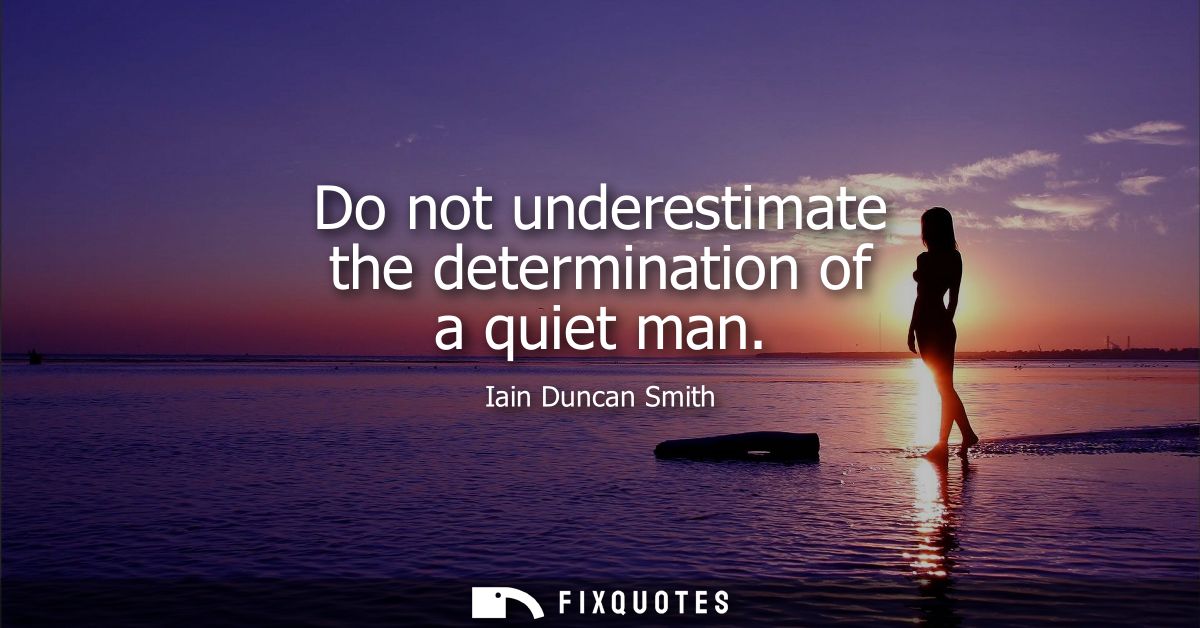
"Do not underestimate the determination of a quiet man"
About this Quote
“Do not underestimate the determination of a quiet man” is a warning disguised as a compliment: it flatters restraint while quietly rebuking the people who mistake volume for power. Coming from Iain Duncan Smith, a politician whose public persona has often leaned more dogged than charismatic, the line reads like self-mythmaking with a tactical edge. It’s the underdog’s rallying cry, but also a shot across the bows at Westminster’s performative talkers.
The genius of the wording is its asymmetry. “Quiet” is framed as a misread signal, inviting the listener to confess a bias: we tend to equate confidence with dominance, airtime with influence. “Determination,” meanwhile, is deliberately vague. It can mean moral conviction, stubbornness, survival instinct, ideological hardness. That ambiguity lets the speaker claim the admirable version while keeping the harder one in reserve. In political terms, it’s a way to justify persistence even when the room isn’t applauding.
The subtext is also about discipline. Quietness implies message control: fewer gaffes, fewer tells, less fodder for opponents. Determination implies a long game, the kind of incremental grinding that outlasts media cycles. It’s a line built for a political culture addicted to spectacle, reminding you that real leverage often sits with the person who isn’t auditioning for the cameras.
It lands because it taps a modern suspicion: the loudest figure in the debate may be the least serious, while the “quiet man” is counting votes, building alliances, and waiting for the moment when noise runs out.
The genius of the wording is its asymmetry. “Quiet” is framed as a misread signal, inviting the listener to confess a bias: we tend to equate confidence with dominance, airtime with influence. “Determination,” meanwhile, is deliberately vague. It can mean moral conviction, stubbornness, survival instinct, ideological hardness. That ambiguity lets the speaker claim the admirable version while keeping the harder one in reserve. In political terms, it’s a way to justify persistence even when the room isn’t applauding.
The subtext is also about discipline. Quietness implies message control: fewer gaffes, fewer tells, less fodder for opponents. Determination implies a long game, the kind of incremental grinding that outlasts media cycles. It’s a line built for a political culture addicted to spectacle, reminding you that real leverage often sits with the person who isn’t auditioning for the cameras.
It lands because it taps a modern suspicion: the loudest figure in the debate may be the least serious, while the “quiet man” is counting votes, building alliances, and waiting for the moment when noise runs out.
Quote Details
| Topic | Perseverance |
|---|---|
| Source | Unverified source: Iain Duncan Smith: Conservative Party Conference Speech (Iain Duncan Smith, 2002)
Evidence: Primary-origin context: Iain Duncan Smith (then Conservative Party leader) delivered the line "Do not underestimate the determination of a quiet man" in his closing/leader's speech to the Conservative Party Conference in Bournemouth on Thursday, 10 October 2002. The Guardian published the full sp... Other candidates (2) Reflections on Leadership and Career Development (Manfred F. R. Kets de Vries, 2010) compilation95.0% ... Do not underestimate the determination of a quiet man , ' said Iain Duncan Smith , the ' quiet man ' of British C... Iain Duncan Smith (Iain Duncan Smith) compilation33.8% ng divide between people who benefit from the immigration of cheap nannies and b |
| Cite |
Citation Formats
APA Style (7th ed.)
Smith, Iain Duncan. (2026, January 13). Do not underestimate the determination of a quiet man. FixQuotes. https://fixquotes.com/quotes/do-not-underestimate-the-determination-of-a-quiet-164801/
Chicago Style
Smith, Iain Duncan. "Do not underestimate the determination of a quiet man." FixQuotes. January 13, 2026. https://fixquotes.com/quotes/do-not-underestimate-the-determination-of-a-quiet-164801/.
MLA Style (9th ed.)
"Do not underestimate the determination of a quiet man." FixQuotes, 13 Jan. 2026, https://fixquotes.com/quotes/do-not-underestimate-the-determination-of-a-quiet-164801/. Accessed 31 Mar. 2026.
More Quotes by Iain
Add to List