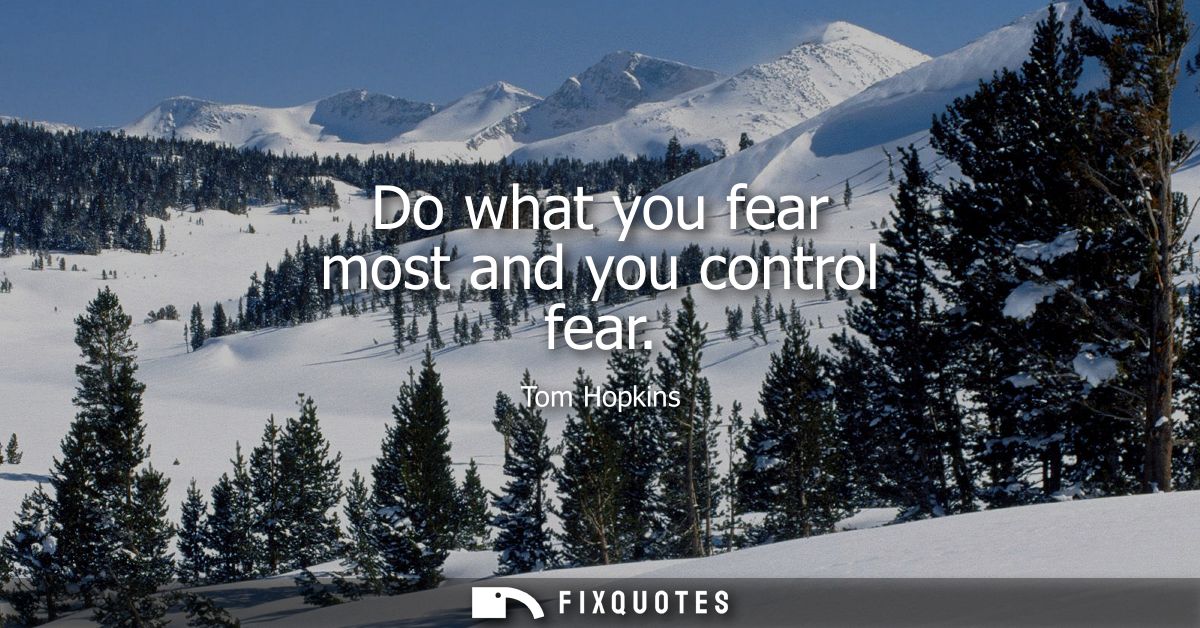
"Do what you fear most and you control fear"
About this Quote
Fear doesn’t disappear when you “think positive”; it shrinks when you stop treating it like a stop sign. Tom Hopkins, a sales-world evangelist of practice and repetition, distills that logic into a line that reads like a dare but functions like a method: pick the scenario that spikes your adrenaline, do it on purpose, and you convert fear from a master into a metric.
The intent is pragmatic, almost industrial. Hopkins isn’t offering therapy; he’s offering a lever for performance. In sales, fear is rarely abstract. It’s the fear of rejection, awkwardness, sounding stupid, being ignored, losing status. His sentence targets the exact point where most people stall: the moment before action, when imagination runs amok and the body interprets possibility as danger. “Do what you fear most” is exposure training without the clinical packaging. The implied promise - “and you control fear” - is about reclaiming agency by collecting evidence. Each completed action becomes a receipt that the catastrophe didn’t happen, or if it did, you survived it.
The subtext is also culturally American and business-coded: control is the prize. Not peace, not understanding, not acceptance - control. That’s why it lands in corporate contexts where anxiety is treated as a productivity bug. It’s bracing, even a little ruthless, because it reframes fear as something you can manage through behavior, not something that deserves endless interpretation.
It works because it swaps the usual hierarchy. Fear isn’t the precondition for action; action is the tool that reorganizes fear.
The intent is pragmatic, almost industrial. Hopkins isn’t offering therapy; he’s offering a lever for performance. In sales, fear is rarely abstract. It’s the fear of rejection, awkwardness, sounding stupid, being ignored, losing status. His sentence targets the exact point where most people stall: the moment before action, when imagination runs amok and the body interprets possibility as danger. “Do what you fear most” is exposure training without the clinical packaging. The implied promise - “and you control fear” - is about reclaiming agency by collecting evidence. Each completed action becomes a receipt that the catastrophe didn’t happen, or if it did, you survived it.
The subtext is also culturally American and business-coded: control is the prize. Not peace, not understanding, not acceptance - control. That’s why it lands in corporate contexts where anxiety is treated as a productivity bug. It’s bracing, even a little ruthless, because it reframes fear as something you can manage through behavior, not something that deserves endless interpretation.
It works because it swaps the usual hierarchy. Fear isn’t the precondition for action; action is the tool that reorganizes fear.
Quote Details
| Topic | Fear |
|---|
More Quotes by Tom
Add to List