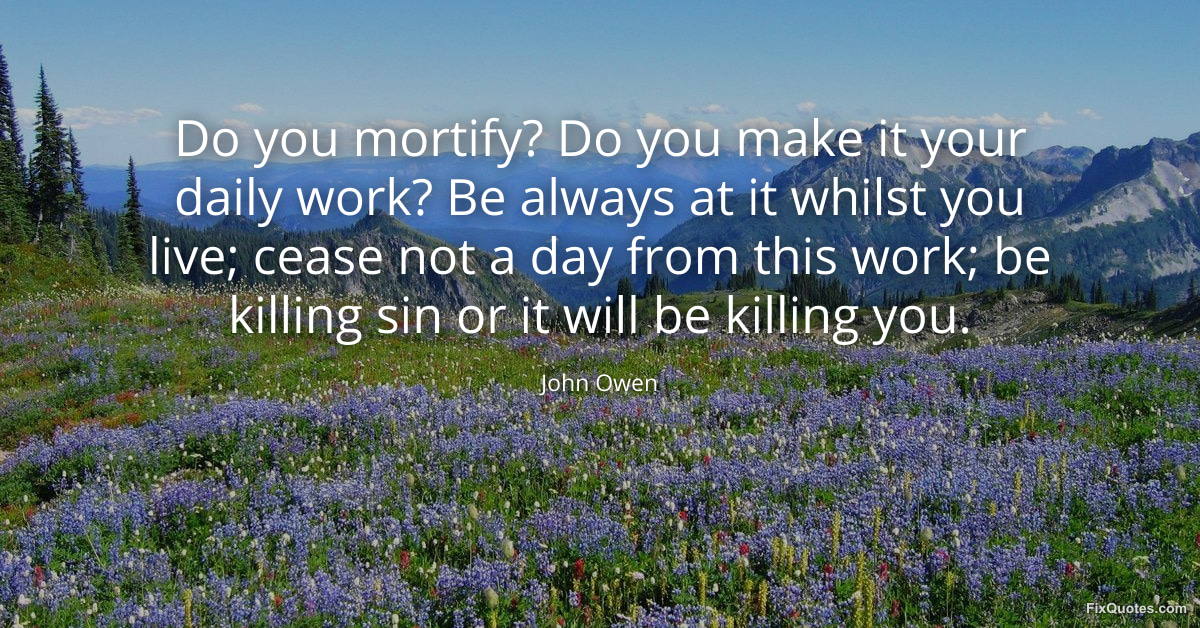
"Do you mortify? Do you make it your daily work? Be always at it whilst you live; cease not a day from this work; be killing sin or it will be killing you"
About this Quote
The intent is surgical. Owen’s “mortify” isn’t a vague call to “be better.” It’s the Puritan discipline of putting sin to death in the self - not managing it, not negotiating with it, not aestheticizing it as “flaws.” The subtext is that sin is not merely an act but an active agent, predatory and patient. His clincher, “be killing sin or it will be killing you,” gives sin a kind of grim life of its own. That personification is the engine of the line: if sin is alive, delay becomes collaboration.
Context sharpens the edge. Owen is writing in a 17th-century England saturated with religious conflict, moral scrutiny, and a theology that takes the interior life seriously enough to terrify it. This is pastoral counsel, but with the stakes framed as existential: unchecked desire doesn’t just make you messy; it hollows you out, bends your will, and eventually owns you.
What makes it work is its refusal of neutrality. Owen offers no middle category between combat and surrender, because he’s arguing that the middle category is the surrender.
Quote Details
| Topic | Self-Discipline |
|---|---|
| Source | Help us find the source |
| Cite |
Citation Formats
APA Style (7th ed.)
Owen, John. (2026, January 18). Do you mortify? Do you make it your daily work? Be always at it whilst you live; cease not a day from this work; be killing sin or it will be killing you. FixQuotes. https://fixquotes.com/quotes/do-you-mortify-do-you-make-it-your-daily-work-be-9417/
Chicago Style
Owen, John. "Do you mortify? Do you make it your daily work? Be always at it whilst you live; cease not a day from this work; be killing sin or it will be killing you." FixQuotes. January 18, 2026. https://fixquotes.com/quotes/do-you-mortify-do-you-make-it-your-daily-work-be-9417/.
MLA Style (9th ed.)
"Do you mortify? Do you make it your daily work? Be always at it whilst you live; cease not a day from this work; be killing sin or it will be killing you." FixQuotes, 18 Jan. 2026, https://fixquotes.com/quotes/do-you-mortify-do-you-make-it-your-daily-work-be-9417/. Accessed 7 Mar. 2026.