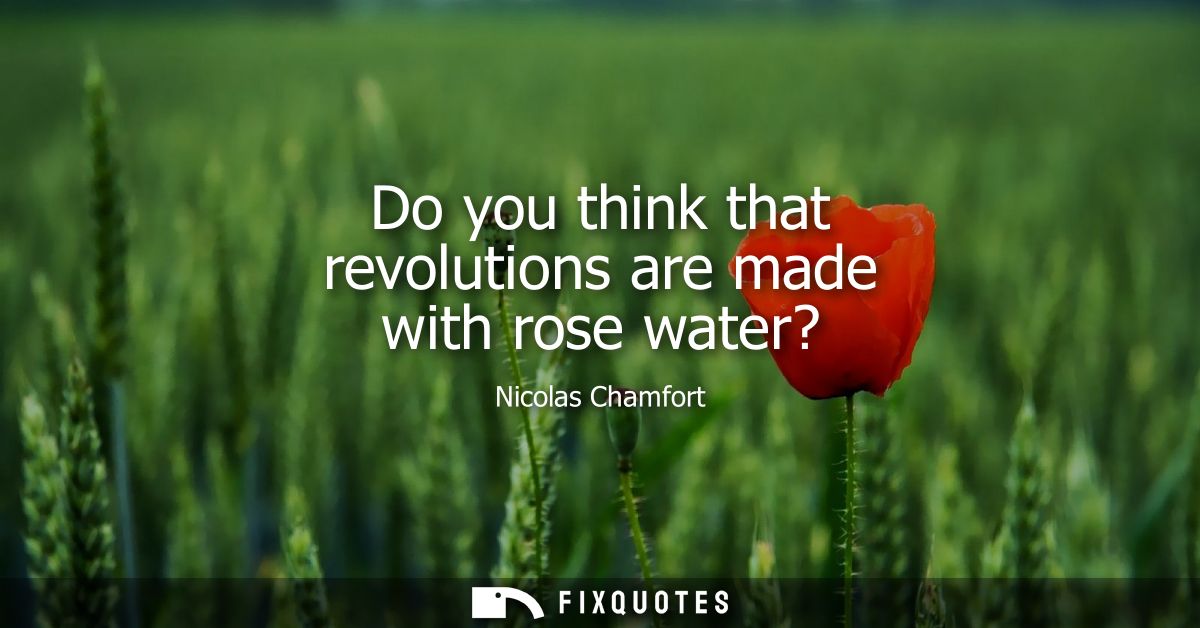
"Do you think that revolutions are made with rose water?"
About this Quote
Revolution, Chamfort sneers, is not a parlor hobby. The question lands like a slap because it targets a comforting fantasy: that political upheaval can be purified into tasteful sentiment, that history can be remade without mess, fear, or blood. “Rose water” isn’t just delicacy; it’s antiseptic perfume, the bourgeois impulse to mask rot with fragrance. Chamfort’s genius is how quickly the phrase punctures moral squeamishness while also mocking the naïveté of spectators who want radical change with none of its consequences.
The intent is double-edged. On one side, it’s a realist’s warning: revolutions are forged in pressure, not politeness. On the other, it’s a provocation, daring the fainthearted to admit what they’re actually asking for when they demand transformation but flinch at force. That’s why the form is a question, not a claim. It doesn’t argue; it corners you. If you answer “yes,” you look childish. If you answer “no,” you’ve conceded the grim logic of upheaval.
Context sharpens the bite. Chamfort, a French moralist who moved in elite salons before aligning with the Revolution and later recoiling from its brutal turns, knew both the perfume and the stench. His line reads as a dispatch from someone who watched idealists discover that liberty arrives wearing muddy boots. It’s less a celebration of violence than an indictment of genteel illusions - and a reminder that revolutions don’t only topple regimes; they also expose who was only ever in love with the idea.
The intent is double-edged. On one side, it’s a realist’s warning: revolutions are forged in pressure, not politeness. On the other, it’s a provocation, daring the fainthearted to admit what they’re actually asking for when they demand transformation but flinch at force. That’s why the form is a question, not a claim. It doesn’t argue; it corners you. If you answer “yes,” you look childish. If you answer “no,” you’ve conceded the grim logic of upheaval.
Context sharpens the bite. Chamfort, a French moralist who moved in elite salons before aligning with the Revolution and later recoiling from its brutal turns, knew both the perfume and the stench. His line reads as a dispatch from someone who watched idealists discover that liberty arrives wearing muddy boots. It’s less a celebration of violence than an indictment of genteel illusions - and a reminder that revolutions don’t only topple regimes; they also expose who was only ever in love with the idea.
Quote Details
| Topic | Freedom |
|---|---|
| Source | Help us find the source |
| Cite |
Citation Formats
APA Style (7th ed.)
Chamfort, Nicolas. (2026, January 18). Do you think that revolutions are made with rose water? FixQuotes. https://fixquotes.com/quotes/do-you-think-that-revolutions-are-made-with-rose-21332/
Chicago Style
Chamfort, Nicolas. "Do you think that revolutions are made with rose water?" FixQuotes. January 18, 2026. https://fixquotes.com/quotes/do-you-think-that-revolutions-are-made-with-rose-21332/.
MLA Style (9th ed.)
"Do you think that revolutions are made with rose water?" FixQuotes, 18 Jan. 2026, https://fixquotes.com/quotes/do-you-think-that-revolutions-are-made-with-rose-21332/. Accessed 28 Mar. 2026.
More Quotes by Nicolas
Add to List