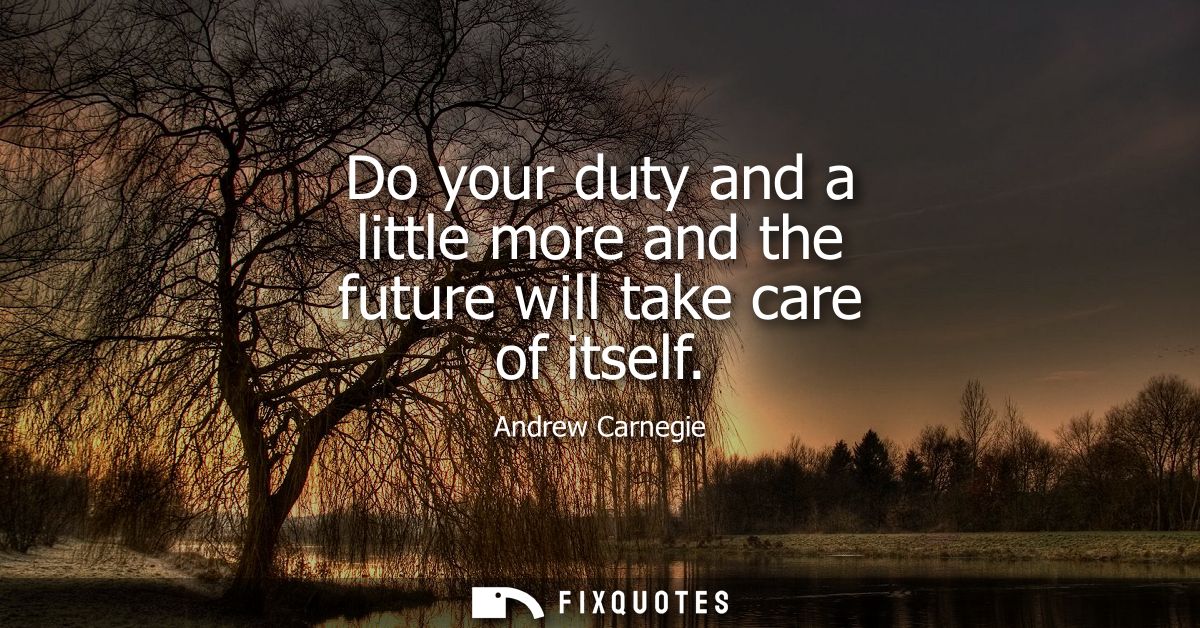
"Do your duty, and a little more, and the future will take care of itself"
About this Quote
The promise that “the future will take care of itself” is the real sales pitch. It offers psychological relief: stop fixating on outcomes, focus on inputs. For an immigrant who rose from poverty to industrial titan, that narrative flatters his biography and legitimizes his worldview. It implies that the system is ultimately just, that effort compounds like interest. Coming from a man who helped build a ruthless steel empire during an era of labor conflict and extreme inequality, the subtext cuts both ways: it’s either stoic encouragement or a conveniently moralized defense of the status quo.
Context matters: late-19th-century America ran on self-help rhetoric and the myth of meritocracy, even as unions fought for basic protections and monopolists wrote the rules. Carnegie later preached philanthropy, but this sentence keeps the moral burden on the individual worker. Do more. Wait for tomorrow. The structure of power, conveniently, can remain “taken care of” by someone else.
Quote Details
| Topic | Work Ethic |
|---|---|
| Source | Help us find the source |
| Cite |
Citation Formats
APA Style (7th ed.)
Carnegie, Andrew. (2026, February 19). Do your duty, and a little more, and the future will take care of itself. FixQuotes. https://fixquotes.com/quotes/do-your-duty-and-a-little-more-and-the-future-29794/
Chicago Style
Carnegie, Andrew. "Do your duty, and a little more, and the future will take care of itself." FixQuotes. February 19, 2026. https://fixquotes.com/quotes/do-your-duty-and-a-little-more-and-the-future-29794/.
MLA Style (9th ed.)
"Do your duty, and a little more, and the future will take care of itself." FixQuotes, 19 Feb. 2026, https://fixquotes.com/quotes/do-your-duty-and-a-little-more-and-the-future-29794/. Accessed 30 Mar. 2026.