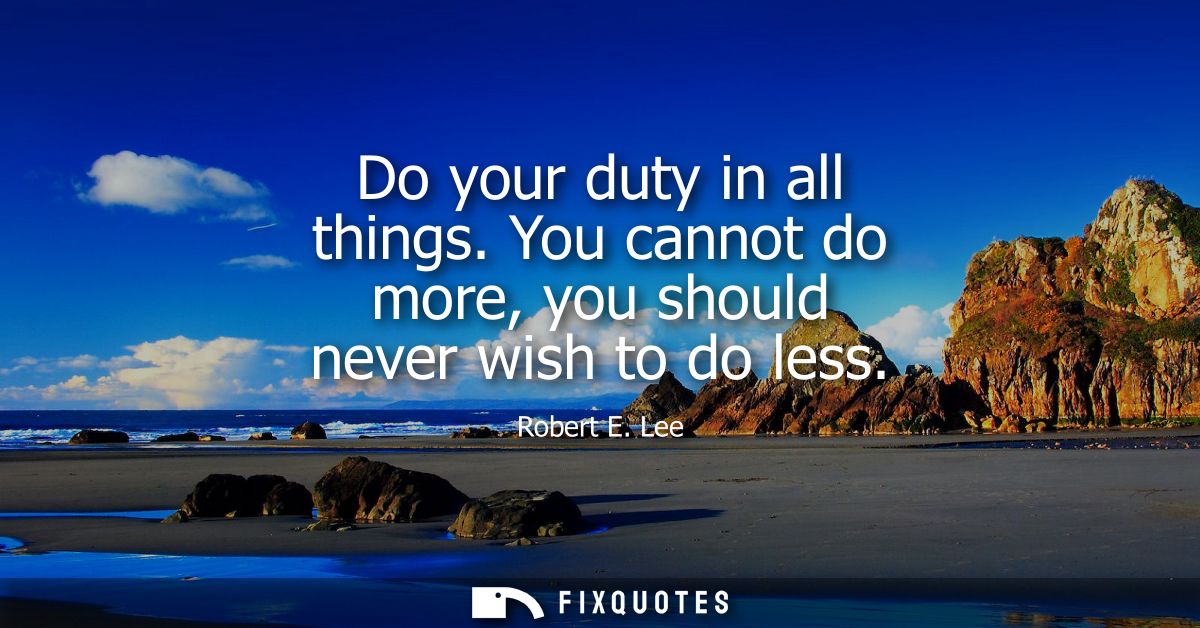
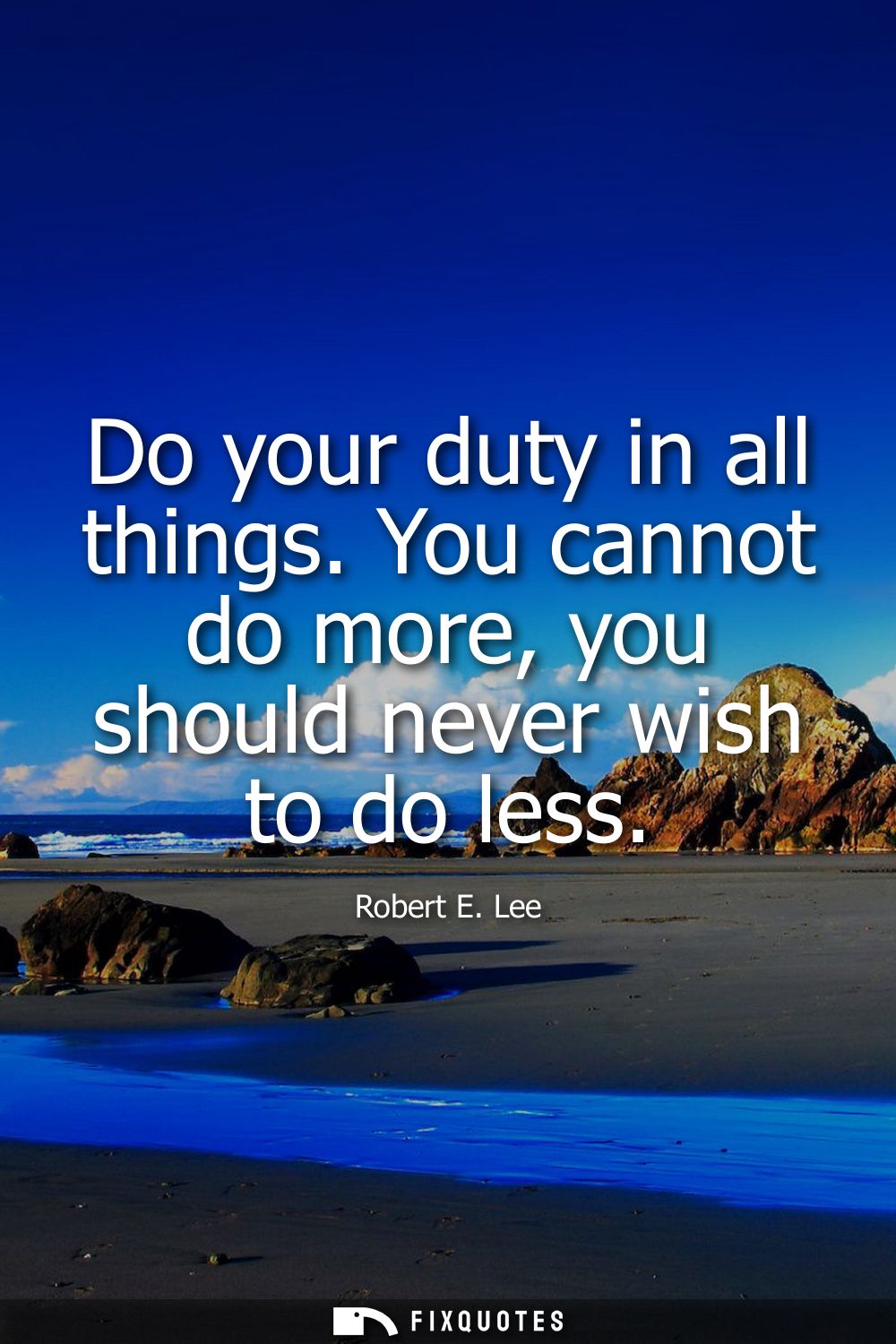
"Do your duty in all things. You cannot do more, you should never wish to do less"
About this Quote
As rhetoric, it’s almost militarily efficient. The sentence cadence marches forward, each clause narrowing the range of permissible feeling. There’s no room for moral improvisation, no invitation to weigh competing duties, no recognition that “duty” can be claimed by any cause with enough authority behind it. That omission is the subtext: duty is treated as self-evident, not contested.
Context makes the discomfort unavoidable. Lee is a general whose life and legend are bound up in the Confederacy, a state project organized around preserving slavery. Read in that shadow, the quote becomes a model of how institutions turn conscience into compliance. It isn’t that duty is inherently suspect; it’s that duty, severed from justice, becomes an elegant mechanism for distributing responsibility downward and absolution upward. The line’s power is its simplicity, and its danger is the same.
Quote Details
| Topic | Ethics & Morality |
|---|---|
| Source | Help us find the source |
| Cite |
Citation Formats
APA Style (7th ed.)
Lee, Robert E. (2026, January 15). Do your duty in all things. You cannot do more, you should never wish to do less. FixQuotes. https://fixquotes.com/quotes/do-your-duty-in-all-things-you-cannot-do-more-you-1490/
Chicago Style
Lee, Robert E. "Do your duty in all things. You cannot do more, you should never wish to do less." FixQuotes. January 15, 2026. https://fixquotes.com/quotes/do-your-duty-in-all-things-you-cannot-do-more-you-1490/.
MLA Style (9th ed.)
"Do your duty in all things. You cannot do more, you should never wish to do less." FixQuotes, 15 Jan. 2026, https://fixquotes.com/quotes/do-your-duty-in-all-things-you-cannot-do-more-you-1490/. Accessed 12 Feb. 2026.