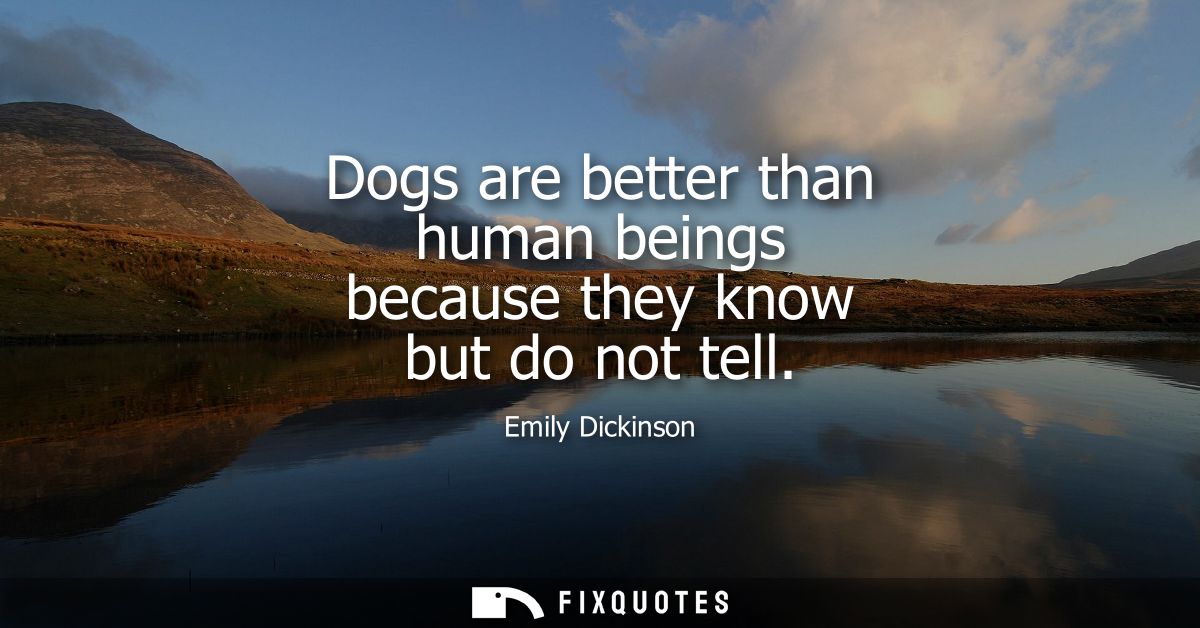
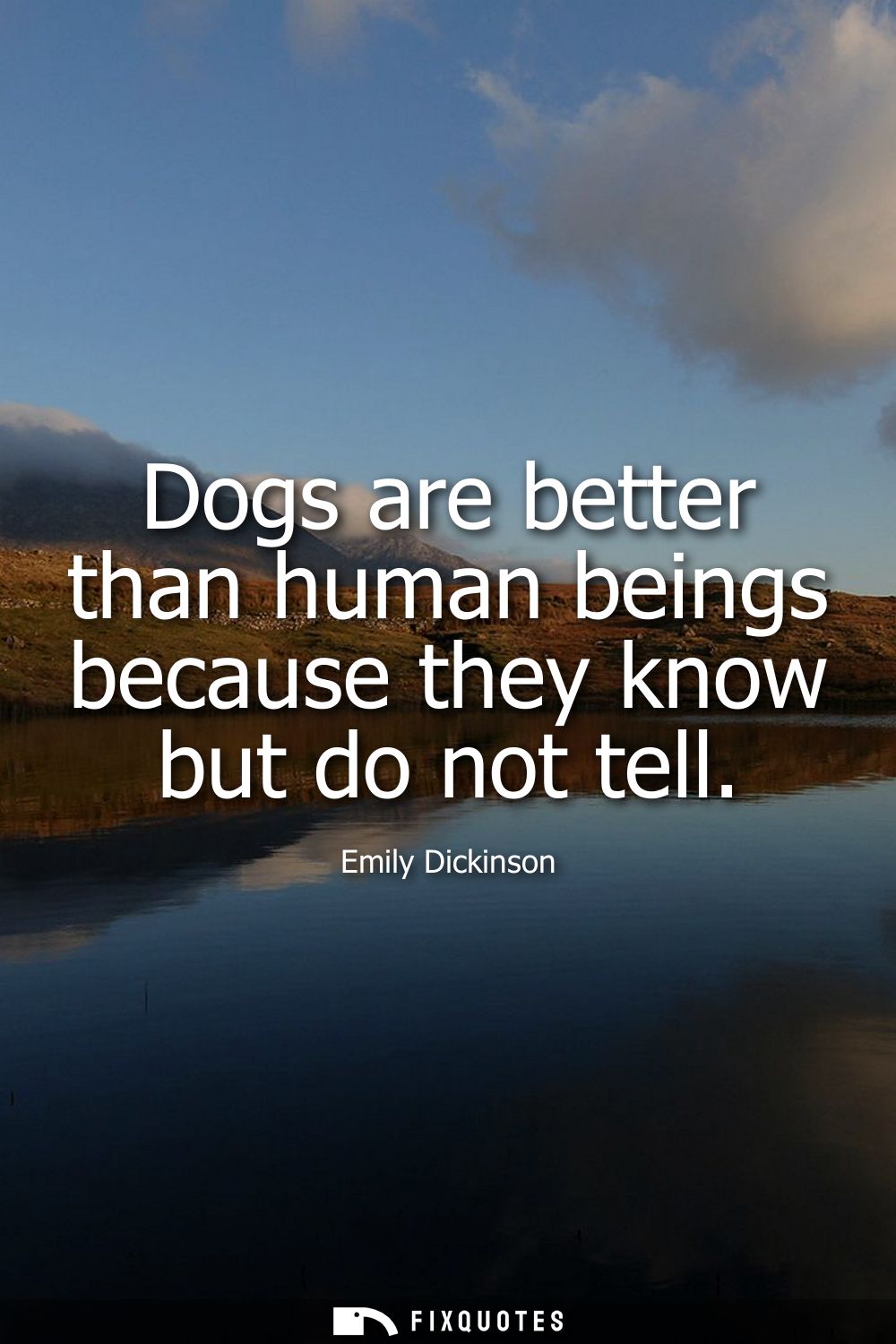
"Dogs are better than human beings because they know but do not tell"
About this Quote
Dickinson’s barb lands with the quiet force of a slammed parlor door. “Dogs are better than human beings” isn’t a sentimental valentine to pets; it’s a moral indictment of people who turn knowledge into currency. The twist is in the clause that follows: “because they know but do not tell.” She isn’t praising canine intelligence so much as elevating a particular kind of restraint. In her universe, discretion is an ethics, not a social nicety.
The line presses on a tension Dickinson lived inside: a fiercely private mind in a culture that treated reputation as communal property. Nineteenth-century New England ran on observation - who visited whom, what was said, what was implied - and the “tell” here carries the tang of gossip, confession, testimony, even publication. Humans don’t simply know; they narrate. They convert insight into leverage, intimacy into spectacle. Dogs, by contrast, are imagined as witnesses without an agenda: present, attentive, incapable of turning your vulnerabilities into a story.
There’s also a poet’s self-defense embedded in the compliment. Dickinson, who hoarded poems in drawers and practiced radical selectiveness about audience, suggests that silence can be a higher form of understanding than eloquence. The subtext is sharp: civilization congratulates itself on language, yet language is often how we betray one another. The dog becomes her clean counterexample - not innocent, exactly, but blessedly nonperformative.
The line presses on a tension Dickinson lived inside: a fiercely private mind in a culture that treated reputation as communal property. Nineteenth-century New England ran on observation - who visited whom, what was said, what was implied - and the “tell” here carries the tang of gossip, confession, testimony, even publication. Humans don’t simply know; they narrate. They convert insight into leverage, intimacy into spectacle. Dogs, by contrast, are imagined as witnesses without an agenda: present, attentive, incapable of turning your vulnerabilities into a story.
There’s also a poet’s self-defense embedded in the compliment. Dickinson, who hoarded poems in drawers and practiced radical selectiveness about audience, suggests that silence can be a higher form of understanding than eloquence. The subtext is sharp: civilization congratulates itself on language, yet language is often how we betray one another. The dog becomes her clean counterexample - not innocent, exactly, but blessedly nonperformative.
Quote Details
| Topic | Dog |
|---|---|
| Source | Later attribution: My Therapist's Dog (Diana Wells, 2004) modern compilationISBN: 9781565127890 · ID: pnZ4EAAAQBAJ
Evidence: ... Emily Dickinson wrote , in 1862 , that dogs are " better than human beings because they know , but do not tell . " Psychologists also try to know and not tell. For some. Other candidates (1) Dickinson/Higginson Correspondence: 25 April 1862 (Emily Dickinson, 1862)50.0% You ask of my Companions Hills- Sir-and the Sundown-and a Dog-large as myself, that my Father bought me-They are bett... |
| Cite |
Citation Formats
APA Style (7th ed.)
Dickinson, Emily. (2026, March 15). Dogs are better than human beings because they know but do not tell. FixQuotes. https://fixquotes.com/quotes/dogs-are-better-than-human-beings-because-they-31029/
Chicago Style
Dickinson, Emily. "Dogs are better than human beings because they know but do not tell." FixQuotes. March 15, 2026. https://fixquotes.com/quotes/dogs-are-better-than-human-beings-because-they-31029/.
MLA Style (9th ed.)
"Dogs are better than human beings because they know but do not tell." FixQuotes, 15 Mar. 2026, https://fixquotes.com/quotes/dogs-are-better-than-human-beings-because-they-31029/. Accessed 31 Mar. 2026.
More Quotes by Emily
Add to List