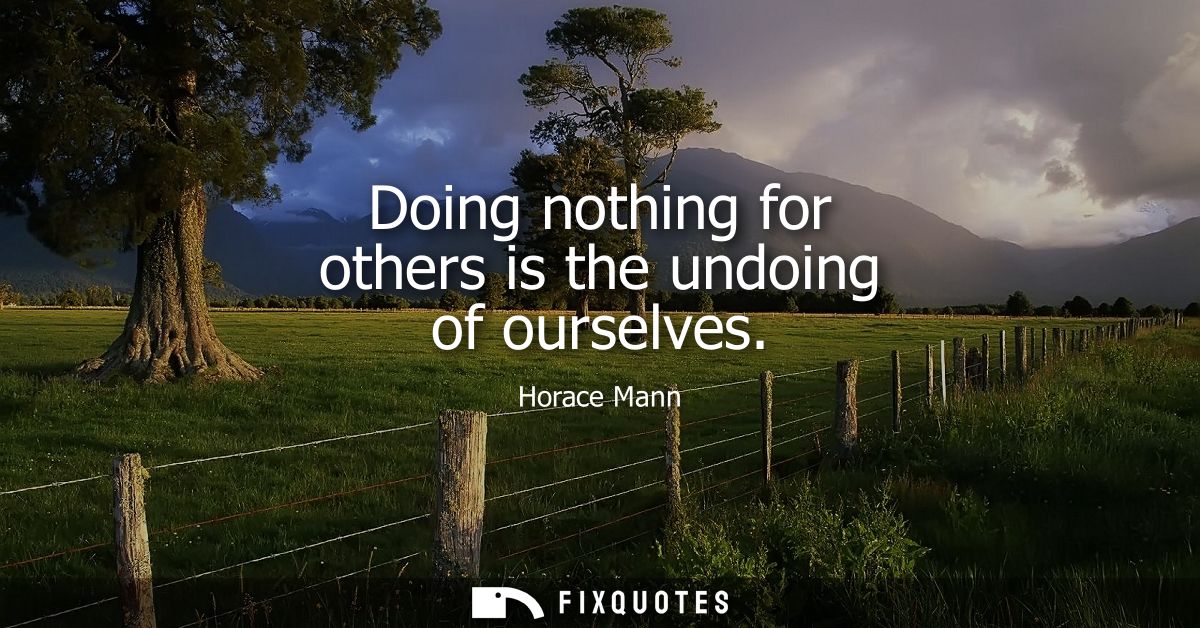
"Doing nothing for others is the undoing of ourselves"
About this Quote
Mann’s line has the snap of a moral warning disguised as practical advice: you don’t just fail other people when you withdraw from civic life; you corrode your own character. “Undoing” is the key word. It’s not mere stagnation. It suggests unmaking, a quiet unraveling that happens when a person treats society as something to consume rather than something to build.
As an educator and common-school evangelist in 19th-century America, Mann was arguing in the shadow of rapid industrialization, widening class divides, and fierce debates about who deserved education in the first place. Public schooling, to him, wasn’t charity. It was infrastructure for a democracy that could easily collapse into inherited privilege and social fracture. Read that way, “doing nothing for others” is less about private kindness than public obligation: paying taxes for schools you may not personally use, supporting institutions that lift strangers, accepting that citizenship costs something.
The subtext is also a rebuke to the era’s rising gospel of self-making. Mann doesn’t deny individual ambition; he reframes it. Selfhood isn’t a solo project. You become someone through service because service forces you into contact with limits, needs, and consequences beyond your own appetites. That collision is formative. The quote works because it flips the usual moral math: altruism isn’t self-erasure, it’s self-preservation. Ignore others long enough and you don’t protect your autonomy; you lose the very civic and moral muscles that make autonomy meaningful.
As an educator and common-school evangelist in 19th-century America, Mann was arguing in the shadow of rapid industrialization, widening class divides, and fierce debates about who deserved education in the first place. Public schooling, to him, wasn’t charity. It was infrastructure for a democracy that could easily collapse into inherited privilege and social fracture. Read that way, “doing nothing for others” is less about private kindness than public obligation: paying taxes for schools you may not personally use, supporting institutions that lift strangers, accepting that citizenship costs something.
The subtext is also a rebuke to the era’s rising gospel of self-making. Mann doesn’t deny individual ambition; he reframes it. Selfhood isn’t a solo project. You become someone through service because service forces you into contact with limits, needs, and consequences beyond your own appetites. That collision is formative. The quote works because it flips the usual moral math: altruism isn’t self-erasure, it’s self-preservation. Ignore others long enough and you don’t protect your autonomy; you lose the very civic and moral muscles that make autonomy meaningful.
Quote Details
| Topic | Kindness |
|---|---|
| Source | Help us find the source |
| Cite |
Citation Formats
APA Style (7th ed.)
Mann, Horace. (2026, January 18). Doing nothing for others is the undoing of ourselves. FixQuotes. https://fixquotes.com/quotes/doing-nothing-for-others-is-the-undoing-of-5236/
Chicago Style
Mann, Horace. "Doing nothing for others is the undoing of ourselves." FixQuotes. January 18, 2026. https://fixquotes.com/quotes/doing-nothing-for-others-is-the-undoing-of-5236/.
MLA Style (9th ed.)
"Doing nothing for others is the undoing of ourselves." FixQuotes, 18 Jan. 2026, https://fixquotes.com/quotes/doing-nothing-for-others-is-the-undoing-of-5236/. Accessed 12 Feb. 2026.
More Quotes by Horace
Add to List