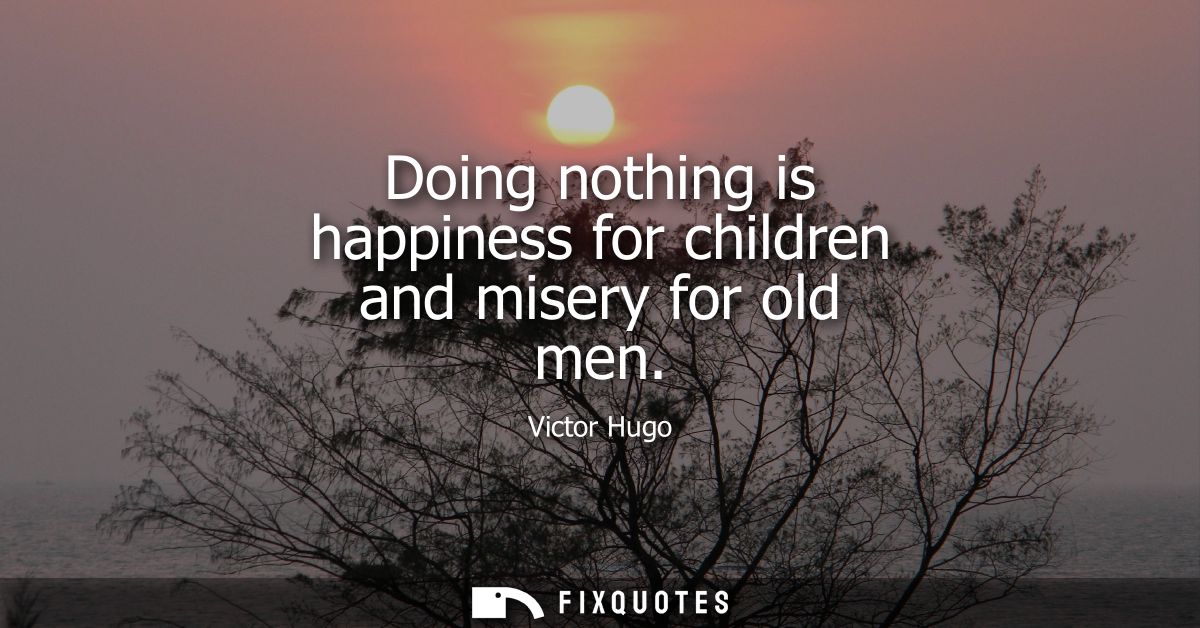
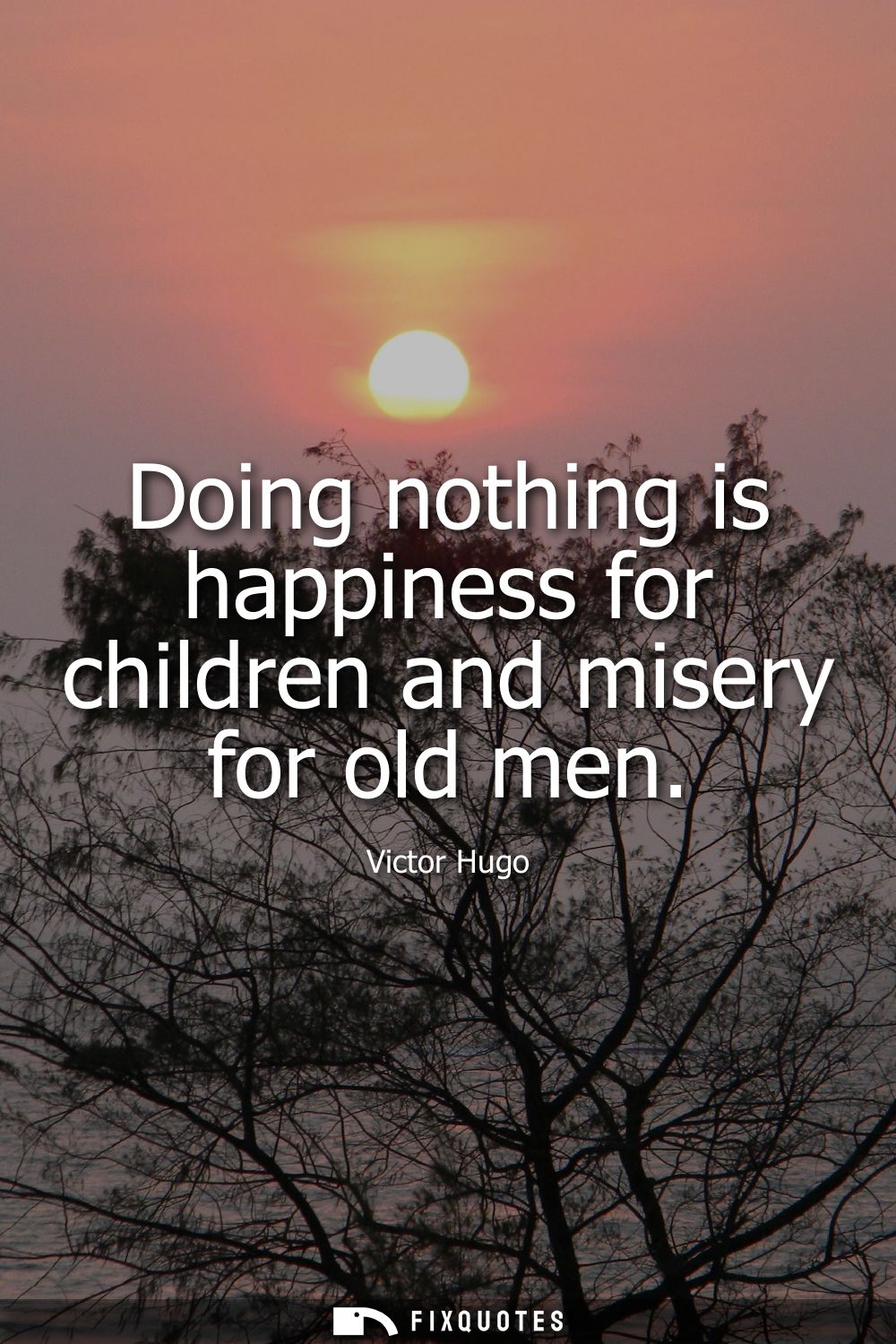
"Doing nothing is happiness for children and misery for old men"
About this Quote
Idleness flips from paradise to punishment depending on where you stand in the arc of a life. Hugo’s line works because it’s less a proverb than a little social X-ray: for children, “doing nothing” is not emptiness but permission. It’s unstructured time where imagination colonizes boredom, where the body is still new enough that rest feels like abundance. A child who does nothing is often still doing something internally - daydreaming, inventing, metabolizing the world.
For old men, the same stillness becomes a verdict. “Doing nothing” reads as erasure: no longer needed, no longer asked, no longer moving the plot. Hugo is diagnosing a culture that measures human worth in output and momentum, then pretends it’s neutral when the elderly feel discarded. Misery isn’t caused by rest itself; it’s caused by rest that arrives as enforced irrelevance.
The subtext is also brutally gendered and historical: Hugo writes in a 19th-century France where labor, masculinity, and public life are tightly braided, and where aging often meant a shrinking social role without modern safety nets or therapeutic language to soften the drop. Children are granted play because their future is assumed; old men are denied peace because their past is treated as finished.
The sentence lands because it’s symmetrical and unfair in exactly the way life can be: the same condition, “nothing,” becomes either freedom or exile depending on whether time feels like a wide horizon or a closing door.
For old men, the same stillness becomes a verdict. “Doing nothing” reads as erasure: no longer needed, no longer asked, no longer moving the plot. Hugo is diagnosing a culture that measures human worth in output and momentum, then pretends it’s neutral when the elderly feel discarded. Misery isn’t caused by rest itself; it’s caused by rest that arrives as enforced irrelevance.
The subtext is also brutally gendered and historical: Hugo writes in a 19th-century France where labor, masculinity, and public life are tightly braided, and where aging often meant a shrinking social role without modern safety nets or therapeutic language to soften the drop. Children are granted play because their future is assumed; old men are denied peace because their past is treated as finished.
The sentence lands because it’s symmetrical and unfair in exactly the way life can be: the same condition, “nothing,” becomes either freedom or exile depending on whether time feels like a wide horizon or a closing door.
Quote Details
| Topic | Aging |
|---|---|
| Source | Help us find the source |
| Cite |
Citation Formats
APA Style (7th ed.)
Hugo, Victor. (2026, January 17). Doing nothing is happiness for children and misery for old men. FixQuotes. https://fixquotes.com/quotes/doing-nothing-is-happiness-for-children-and-33473/
Chicago Style
Hugo, Victor. "Doing nothing is happiness for children and misery for old men." FixQuotes. January 17, 2026. https://fixquotes.com/quotes/doing-nothing-is-happiness-for-children-and-33473/.
MLA Style (9th ed.)
"Doing nothing is happiness for children and misery for old men." FixQuotes, 17 Jan. 2026, https://fixquotes.com/quotes/doing-nothing-is-happiness-for-children-and-33473/. Accessed 30 Mar. 2026.
More Quotes by Victor
Add to List