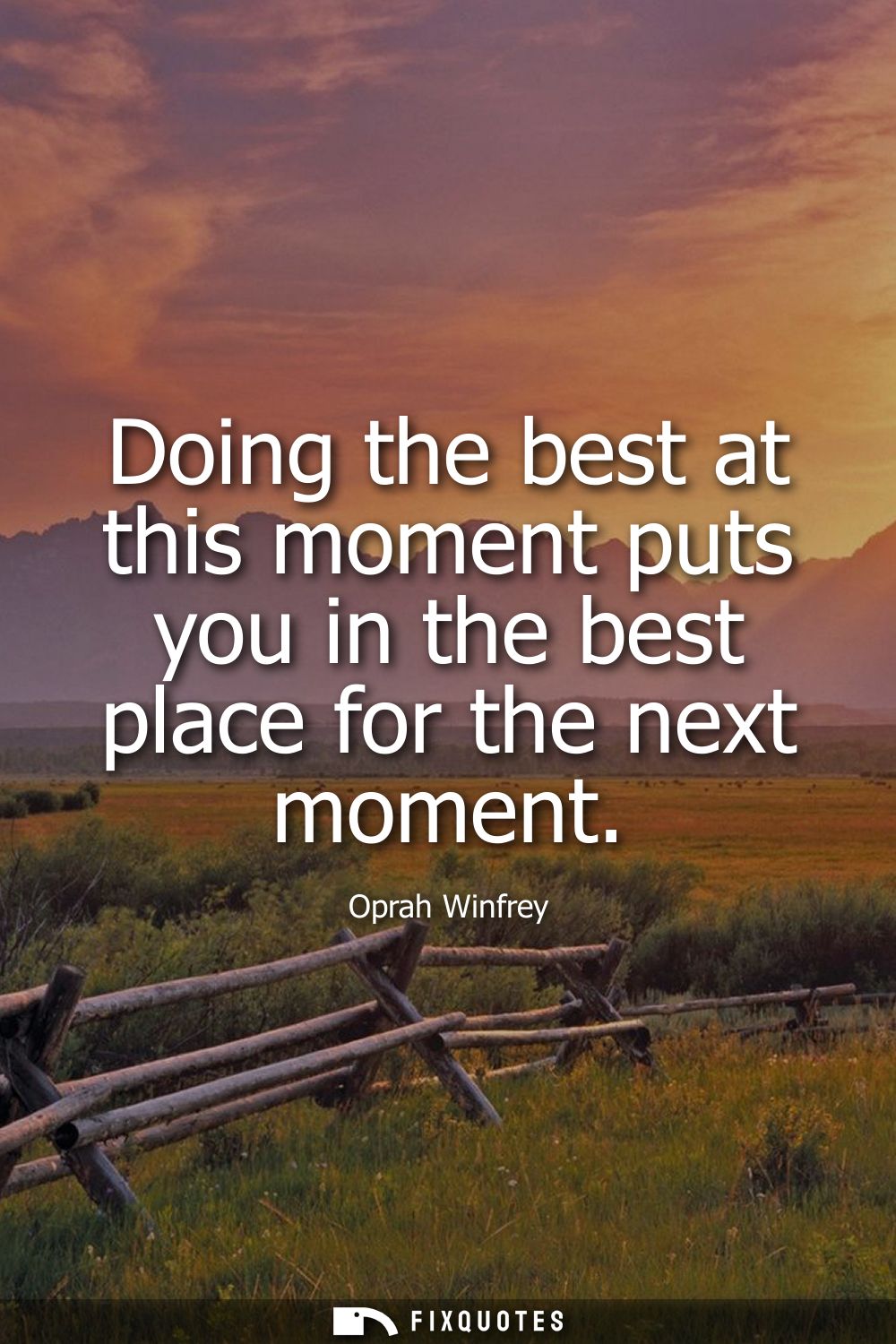
"Doing the best at this moment puts you in the best place for the next moment"
About this Quote
The subtext is classic Oprah: your life isn’t fixed, but it is responsive. Not “manifest the outcome,” not “wait for your big break,” but cultivate readiness. “Best place” isn’t just emotional wellness language; it’s strategic. It implies that effort creates positioning: skills accumulate, relationships deepen, options widen. Even when outcomes are messy, you can still improve your odds for whatever comes next.
Context matters because Oprah is an entertainer who built an empire by turning personal narrative into public instruction. She’s speaking to an audience trained by hustle culture and battered by it, people who feel behind and want a verdict. The line refuses the verdict. It offers process as salvation: you don’t need perfect clarity, just competent presence.
There’s also a quiet moral claim hiding in the pragmatism: your “best” is situational, not absolute. That makes the quote both comforting and demanding. It forgives today’s limits while insisting you keep moving.
Quote Details
| Topic | Live in the Moment |
|---|---|
| Source | Later attribution: Maxwell 2-in-1 Becoming a Person of Influence & Talent Is... (John C. Maxwell, 2009) modern compilationISBN: 9781418555399 · ID: ytIBkvRwNWgC
Evidence:
... doing the best at this moment puts you in the best place for the next moment . " -Oprah Winfrey After an awkward silence , one of the salesmen stated , “ It's those darned dogs- they just won't eat the stuff ! " If you want to be ... |
| Cite |
Citation Formats
APA Style (7th ed.)
Winfrey, Oprah. (2026, March 3). Doing the best at this moment puts you in the best place for the next moment. FixQuotes. https://fixquotes.com/quotes/doing-the-best-at-this-moment-puts-you-in-the-1126/
Chicago Style
Winfrey, Oprah. "Doing the best at this moment puts you in the best place for the next moment." FixQuotes. March 3, 2026. https://fixquotes.com/quotes/doing-the-best-at-this-moment-puts-you-in-the-1126/.
MLA Style (9th ed.)
"Doing the best at this moment puts you in the best place for the next moment." FixQuotes, 3 Mar. 2026, https://fixquotes.com/quotes/doing-the-best-at-this-moment-puts-you-in-the-1126/. Accessed 30 Mar. 2026.