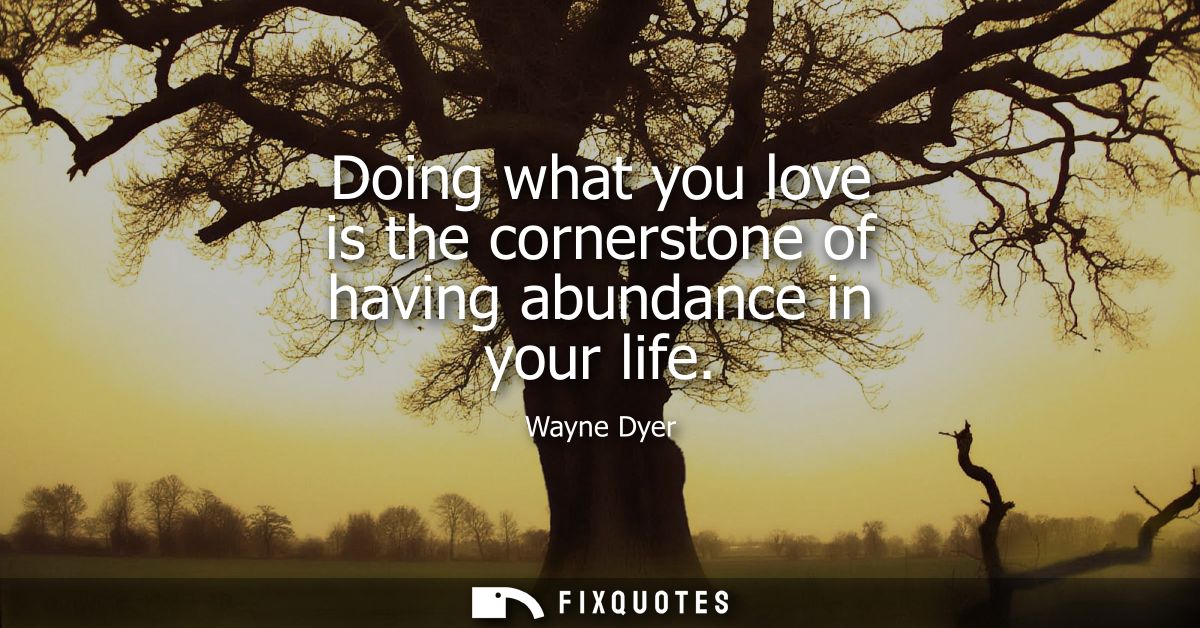
"Doing what you love is the cornerstone of having abundance in your life"
About this Quote
The line sells abundance as something less earned than unlocked, a shift in mindset rather than a shift in material conditions. Coming from Wayne Dyer - a psychologist who became one of self-help's most influential spiritual-leaning voices - it’s calibrated to feel both therapeutic and aspirational. "Cornerstone" is doing heavy rhetorical work: it frames love (as in vocation, calling, daily activity) not as a luxury you get after stability, but as the structural base that makes stability possible. That’s a reversal of the usual bargain modern life offers: grind first, fulfillment later.
The subtext is quietly anti-institutional. If abundance begins with "doing what you love", then bosses, markets, credentials, and even luck become secondary characters. You don’t need permission; you need alignment. That’s classic Dyer: internal authority over external validation, psychology braided with a near-metaphysical confidence that intention reorganizes reality.
Context matters because Dyer’s era of popularity tracked with late-20th-century American individualism and the booming self-improvement industry, where emotional vocabulary ("love", "abundance") replaced older moral language (duty, sacrifice). The quote functions like a gentle piece of consumer-friendly resistance to burnout culture, but it also risks sounding like a wellness version of meritocracy: if you’re not "abundant", maybe you didn’t love hard enough. Its persuasive power comes from that tension. It comforts by implying control, and it seduces by redefining wealth as a feeling - a psychological reframing that can be liberating, or conveniently unfalsifiable.
The subtext is quietly anti-institutional. If abundance begins with "doing what you love", then bosses, markets, credentials, and even luck become secondary characters. You don’t need permission; you need alignment. That’s classic Dyer: internal authority over external validation, psychology braided with a near-metaphysical confidence that intention reorganizes reality.
Context matters because Dyer’s era of popularity tracked with late-20th-century American individualism and the booming self-improvement industry, where emotional vocabulary ("love", "abundance") replaced older moral language (duty, sacrifice). The quote functions like a gentle piece of consumer-friendly resistance to burnout culture, but it also risks sounding like a wellness version of meritocracy: if you’re not "abundant", maybe you didn’t love hard enough. Its persuasive power comes from that tension. It comforts by implying control, and it seduces by redefining wealth as a feeling - a psychological reframing that can be liberating, or conveniently unfalsifiable.
Quote Details
| Topic | Motivational |
|---|
More Quotes by Wayne
Add to List