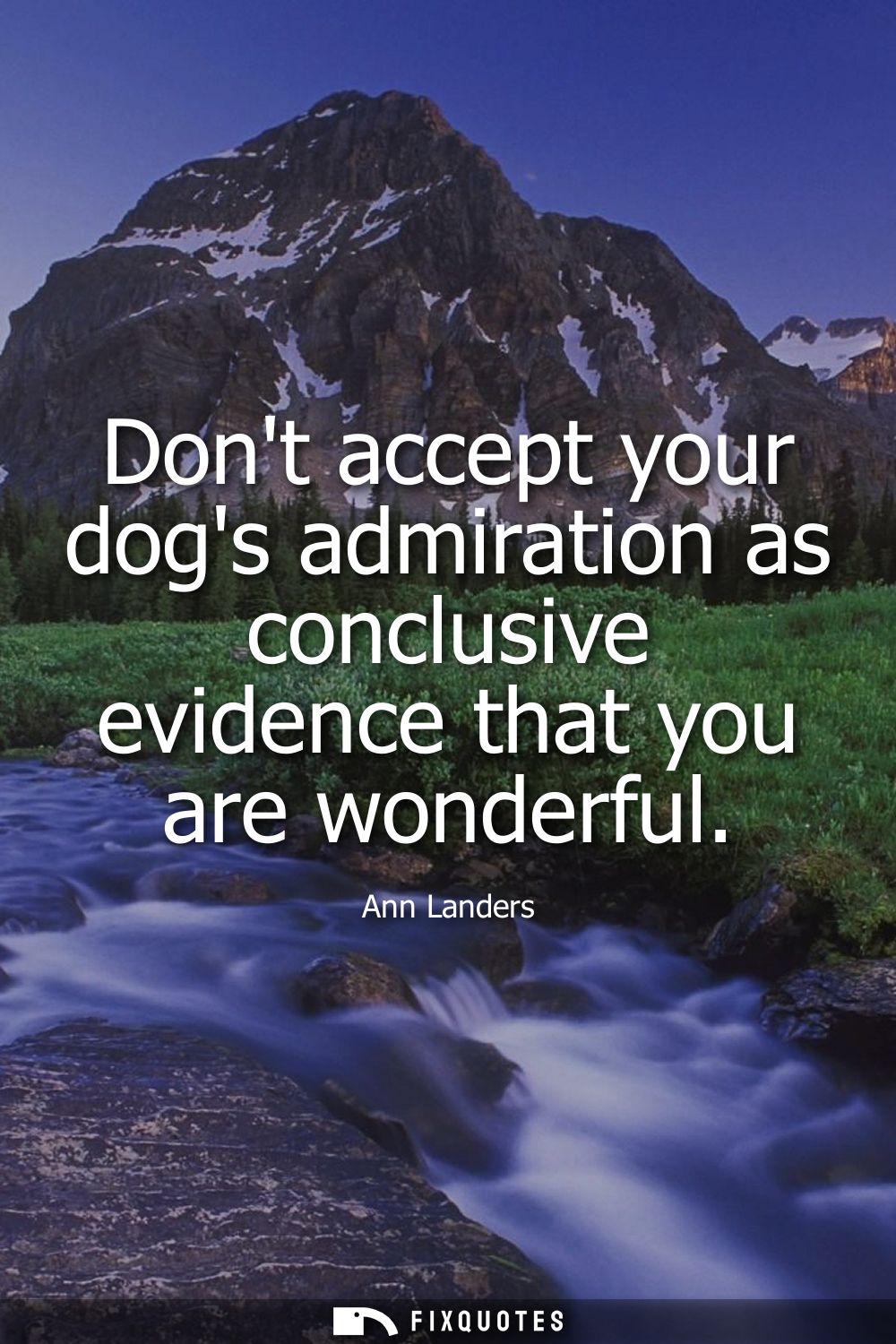
"Don't accept your dog's admiration as conclusive evidence that you are wonderful"
About this Quote
The line works because it flatters and scolds in the same breath. On the surface, its homespun warmth makes it safe enough to print next to advice about in-laws and messy divorces. Underneath, it’s a small indictment of narcissism and moral laziness: the desire to be declared “wonderful” without submitting to the friction of other people’s boundaries, feedback, or disappointment. Dogs don’t care if you’re petty, evasive, or cruel in ways that don’t threaten their food and safety. Their loyalty is real, but it’s not a character reference.
Landers wrote in an era when “self-esteem” was becoming a cultural project and domestic life was increasingly narrated through therapy language and pop psychology. Her genius was to puncture ego without sounding like a professor or a preacher. The joke is the sugar; the medicine is the reminder that admiration is not the same as accountability, and affection - especially the kind you can buy with a treat - is a terrible substitute for evidence.
Quote Details
| Topic | Witty One-Liners |
|---|---|
| Source | Help us find the source |
| Cite |
Citation Formats
APA Style (7th ed.)
Landers, Ann. (2026, January 18). Don't accept your dog's admiration as conclusive evidence that you are wonderful. FixQuotes. https://fixquotes.com/quotes/dont-accept-your-dogs-admiration-as-conclusive-14270/
Chicago Style
Landers, Ann. "Don't accept your dog's admiration as conclusive evidence that you are wonderful." FixQuotes. January 18, 2026. https://fixquotes.com/quotes/dont-accept-your-dogs-admiration-as-conclusive-14270/.
MLA Style (9th ed.)
"Don't accept your dog's admiration as conclusive evidence that you are wonderful." FixQuotes, 18 Jan. 2026, https://fixquotes.com/quotes/dont-accept-your-dogs-admiration-as-conclusive-14270/. Accessed 3 Apr. 2026.