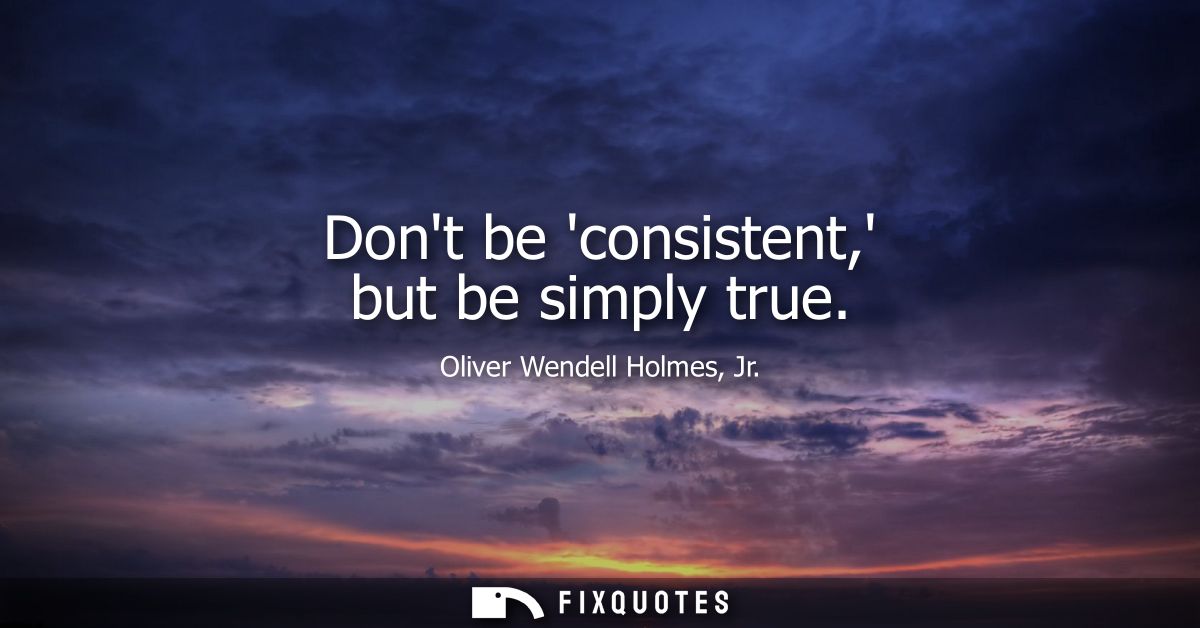
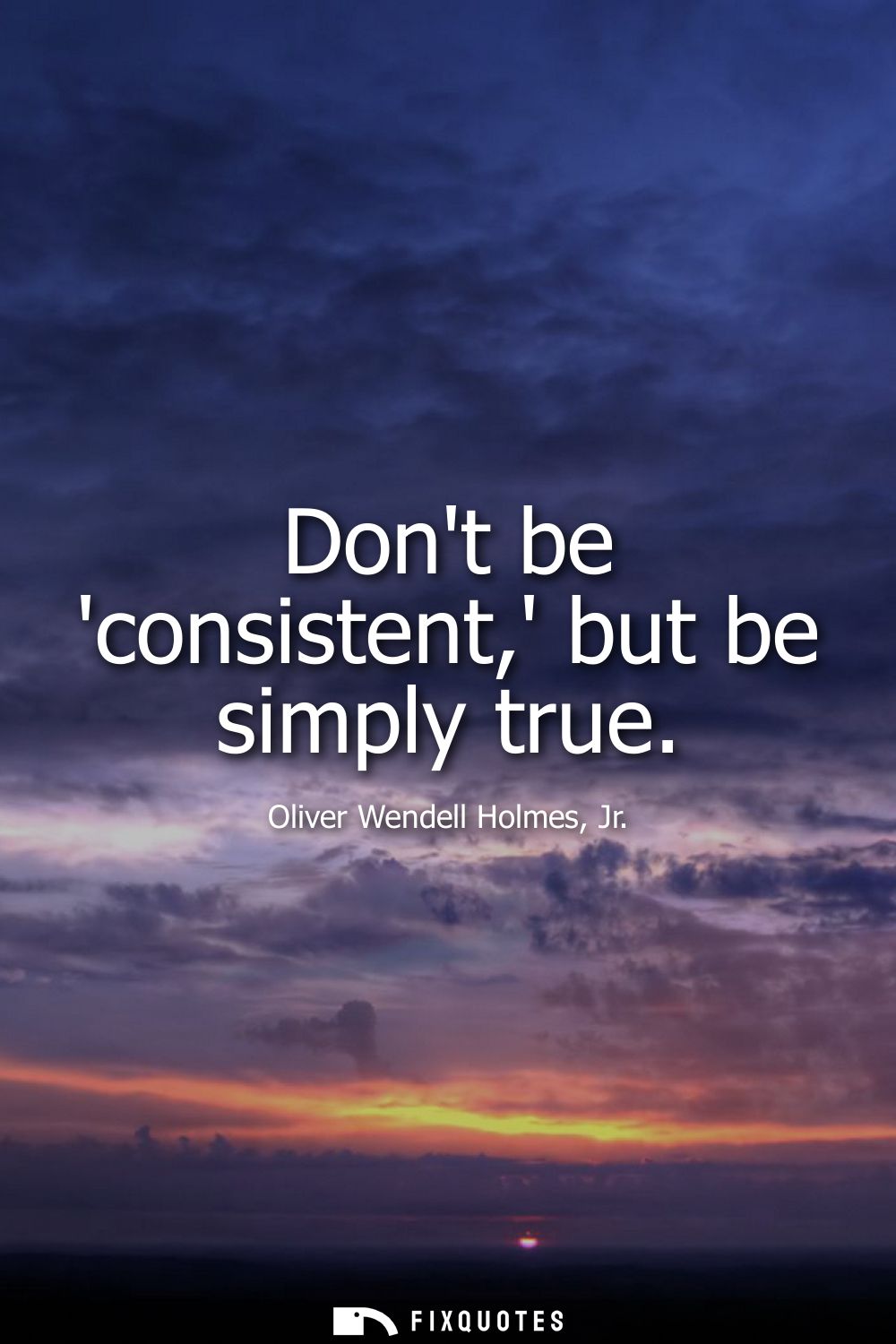
"Don't be 'consistent,' but be simply true"
About this Quote
Consistency is the virtue you brag about when you want to stop thinking. Holmes, a jurist who helped drag American law into the modern age, treats it as a kind of moral and intellectual vanity: the desire to look coherent can harden into a refusal to see what is actually in front of you. “Simply true” is his quieter, sharper standard. It doesn’t mean blithe relativism or impulsive contradiction. It means loyalty to reality over loyalty to your own prior sentences.
The line lands because it punctures a common courtroom and political instinct: if you can catch someone changing their mind, you can brand them untrustworthy. Holmes flips that. In law, clinging to past logic for its own sake becomes precedent worship, a way to make old outcomes feel inevitable. His broader philosophy (legal realism) insisted that decisions aren’t mechanically deduced from abstract principles; they’re shaped by experience, social needs, and the messy facts of human life. A judge, then, shouldn’t protect a tidy theory when new conditions expose its costs.
The subtext is ethical as much as intellectual: integrity isn’t the performance of unbroken opinions, it’s the courage to revise them. That’s especially pointed coming from Holmes, a Civil War veteran turned Supreme Court justice, steeped in the consequences of ideas treated as sacred. “Don’t be consistent” is permission to be unpopular with your past self. “Be simply true” is the demand that you earn every conclusion again, case by case, moment by moment.
The line lands because it punctures a common courtroom and political instinct: if you can catch someone changing their mind, you can brand them untrustworthy. Holmes flips that. In law, clinging to past logic for its own sake becomes precedent worship, a way to make old outcomes feel inevitable. His broader philosophy (legal realism) insisted that decisions aren’t mechanically deduced from abstract principles; they’re shaped by experience, social needs, and the messy facts of human life. A judge, then, shouldn’t protect a tidy theory when new conditions expose its costs.
The subtext is ethical as much as intellectual: integrity isn’t the performance of unbroken opinions, it’s the courage to revise them. That’s especially pointed coming from Holmes, a Civil War veteran turned Supreme Court justice, steeped in the consequences of ideas treated as sacred. “Don’t be consistent” is permission to be unpopular with your past self. “Be simply true” is the demand that you earn every conclusion again, case by case, moment by moment.
Quote Details
| Topic | Honesty & Integrity |
|---|---|
| Source | Help us find the source |
| Cite |
Citation Formats
APA Style (7th ed.)
Jr., Oliver Wendell Holmes. (2026, January 16). Don't be 'consistent,' but be simply true. FixQuotes. https://fixquotes.com/quotes/dont-be-consistent-but-be-simply-true-90100/
Chicago Style
Jr., Oliver Wendell Holmes. "Don't be 'consistent,' but be simply true." FixQuotes. January 16, 2026. https://fixquotes.com/quotes/dont-be-consistent-but-be-simply-true-90100/.
MLA Style (9th ed.)
"Don't be 'consistent,' but be simply true." FixQuotes, 16 Jan. 2026, https://fixquotes.com/quotes/dont-be-consistent-but-be-simply-true-90100/. Accessed 13 Feb. 2026.
More Quotes by Oliver
Add to List