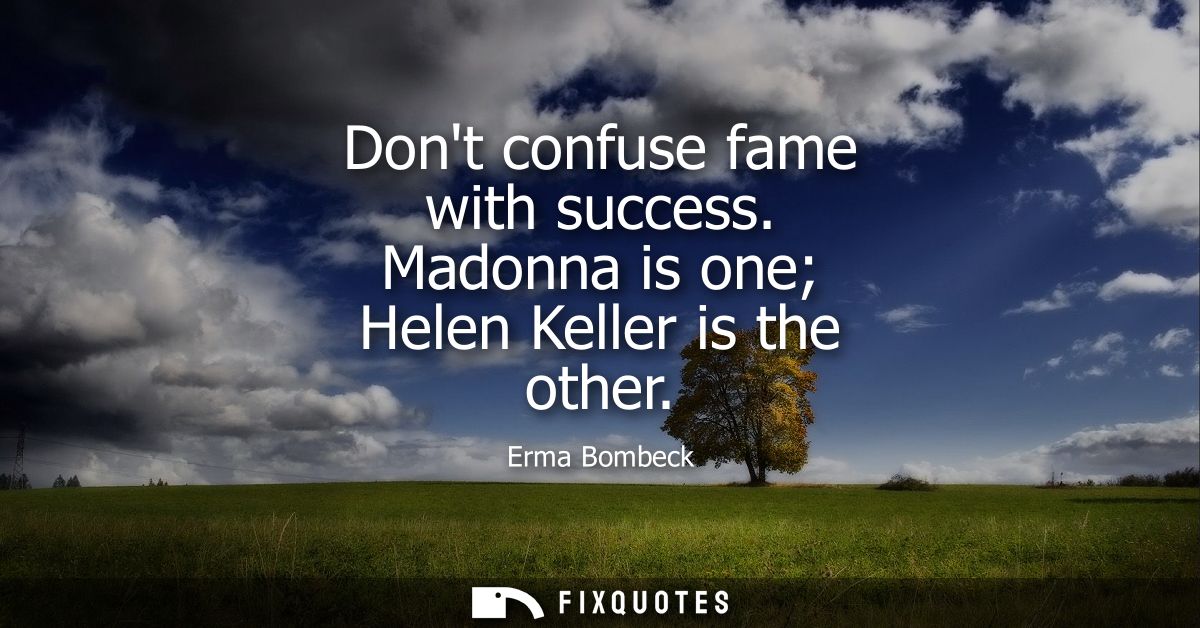
"Don't confuse fame with success. Madonna is one; Helen Keller is the other"
About this Quote
Then she drops Helen Keller like a moral anvil. Keller functions as a cultural shorthand for perseverance and public service, someone whose impact doesn’t depend on spectacle. The subtext is that success, in Bombeck’s framing, is measured by consequence and character, not by recognition. It’s a rebuke to a society that treats attention as proof of worth.
The joke works because it’s not neutral. It recruits the reader’s own hierarchy of values: you’re meant to flinch at the comparison and then nod along, relieved to be on the "right" side. In the 1980s/1990s media ecosystem Bombeck wrote for, celebrity was becoming a kind of ambient weather, and her humor often served as a pressure valve for middle-class skepticism toward that new attention economy.
It also smuggles in an uncomfortable question: if fame is so easily mistaken for success, how many Madonnas does a culture manufacture because it no longer knows how to reward its Kellers?
Quote Details
| Topic | Success |
|---|---|
| Source | Later attribution: Values That Shape Us (HB) (Manjulika Koshal, 2022) modern compilationISBN: 9781638673361 · ID: ZdNyEAAAQBAJ
Evidence:
... Don't confuse fame with success . Madonna is one ; Helen Keller is the other . " Erma Bombeck . " Success is not the result of spontaneous combustion . You must first set yourself on fire . ” Fred Shero . " Success does not consist in ... |
| Cite |
Citation Formats
APA Style (7th ed.)
Bombeck, Erma. (2026, February 11). Don't confuse fame with success. Madonna is one; Helen Keller is the other. FixQuotes. https://fixquotes.com/quotes/dont-confuse-fame-with-success-madonna-is-one-31112/
Chicago Style
Bombeck, Erma. "Don't confuse fame with success. Madonna is one; Helen Keller is the other." FixQuotes. February 11, 2026. https://fixquotes.com/quotes/dont-confuse-fame-with-success-madonna-is-one-31112/.
MLA Style (9th ed.)
"Don't confuse fame with success. Madonna is one; Helen Keller is the other." FixQuotes, 11 Feb. 2026, https://fixquotes.com/quotes/dont-confuse-fame-with-success-madonna-is-one-31112/. Accessed 7 Apr. 2026.