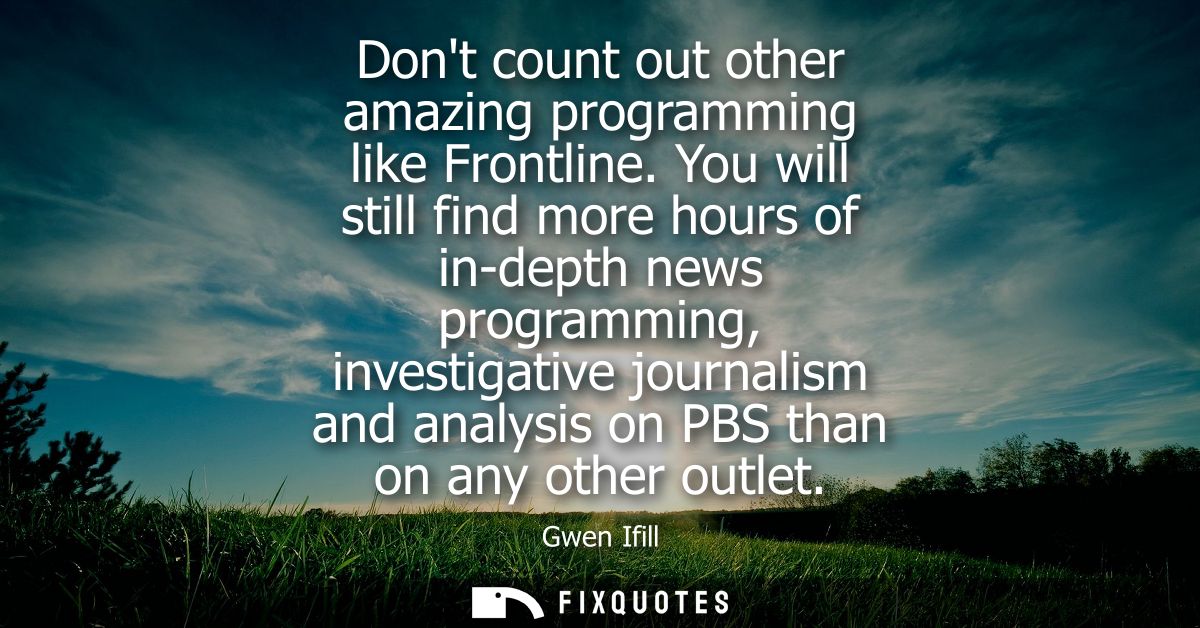
"Don't count out other amazing programming like Frontline. You will still find more hours of in-depth news programming, investigative journalism and analysis on PBS than on any other outlet"
About this Quote
Her choice of examples and categories is strategic. “Frontline” isn’t celebrity journalism; it’s painstaking reporting with the patience to follow paper trails past the breaking-news sugar rush. By stacking “in-depth,” “investigative,” and “analysis,” Ifill draws a bright line between journalism as public service and journalism as performance. The subtext is an indictment: other outlets may offer more hours of talk, but fewer hours of reporting.
The claim “than on any other outlet” is deliberately comparative, almost competitive. It reframes PBS not as an underdog but as an outlier of abundance in a scarce resource: sustained attention. Coming from Ifill - who helped steer Washington Week and co-anchored the PBS NewsHour while navigating the hyper-partisan 2000s and 2010s - the context is a newsroom veteran defending institutional muscle memory. It’s also a warning: if audiences stop valuing long-form accountability work, the market won’t replace it. PBS isn’t just programming here; it’s infrastructure for democracy, easily overlooked until it’s gone.
Quote Details
| Topic | Writing |
|---|---|
| Source | Help us find the source |
| Cite |
Citation Formats
APA Style (7th ed.)
Ifill, Gwen. (2026, January 16). Don't count out other amazing programming like Frontline. You will still find more hours of in-depth news programming, investigative journalism and analysis on PBS than on any other outlet. FixQuotes. https://fixquotes.com/quotes/dont-count-out-other-amazing-programming-like-82658/
Chicago Style
Ifill, Gwen. "Don't count out other amazing programming like Frontline. You will still find more hours of in-depth news programming, investigative journalism and analysis on PBS than on any other outlet." FixQuotes. January 16, 2026. https://fixquotes.com/quotes/dont-count-out-other-amazing-programming-like-82658/.
MLA Style (9th ed.)
"Don't count out other amazing programming like Frontline. You will still find more hours of in-depth news programming, investigative journalism and analysis on PBS than on any other outlet." FixQuotes, 16 Jan. 2026, https://fixquotes.com/quotes/dont-count-out-other-amazing-programming-like-82658/. Accessed 6 Mar. 2026.