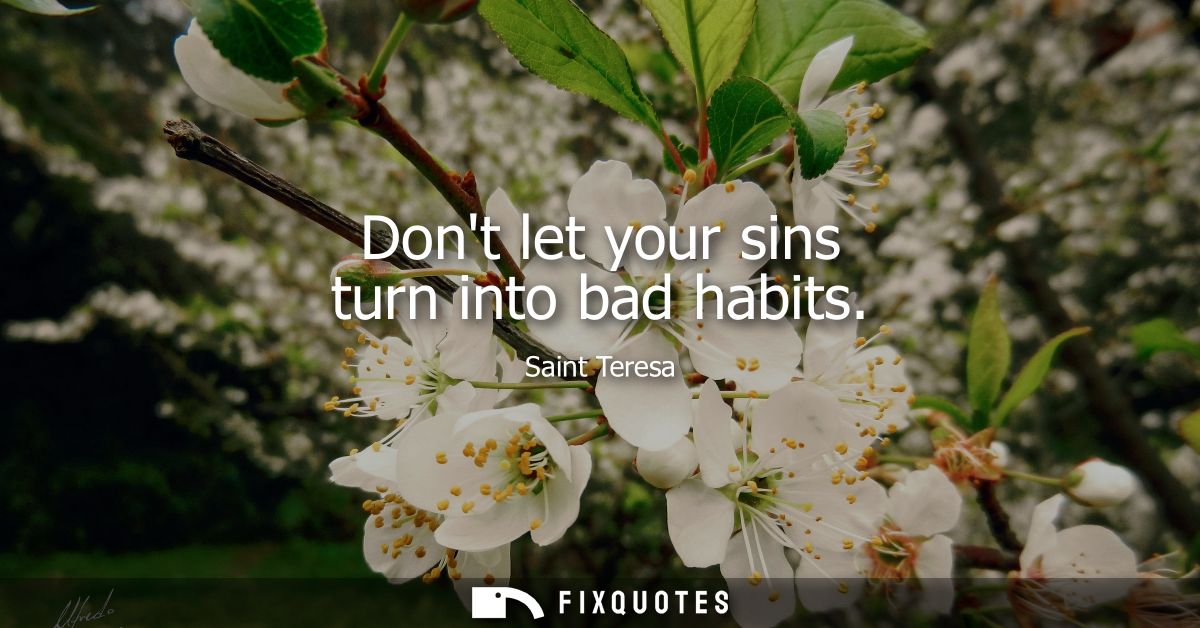
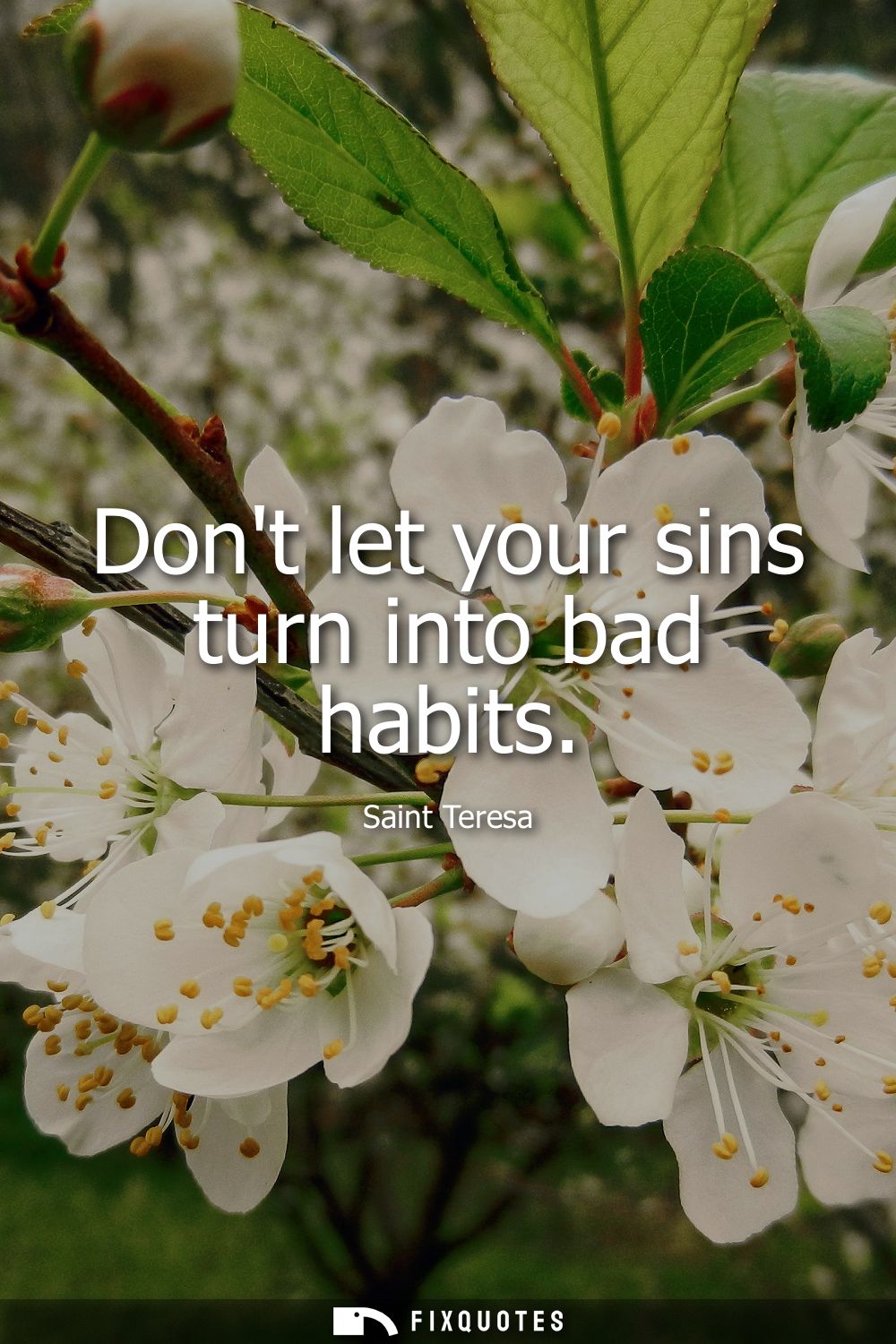
"Don't let your sins turn into bad habits"
About this Quote
A saint warning you about “bad habits” is doing something quietly radical: shrinking the cosmic drama of sin down to the scale of daily routine. Saint Teresa isn’t thundering about damnation; she’s diagnosing behavior. The line works because it treats moral failure less like a single catastrophic event and more like a feedback loop. Sin, in this framing, is not just a transgression against God but a practice that rehearses itself until it feels like personality.
The intent is preventative, almost clinical. “Don’t let” suggests you still have agency at the earliest stage, when a lapse is still pliable. Once it congeals into habit, it stops feeling like choice and starts feeling like fate. That’s the subtext: the most dangerous sins are the ones that become mundane. When wrongdoing becomes routine, conscience goes quiet, and repentance gets postponed indefinitely because there’s no longer a sharp moment to point to.
Context matters. Teresa of Avila is a central figure of Catholic reform and mystical spirituality, someone obsessed with inner discipline, attention, and the training of the will. In a convent setting, “habit” carries an extra resonance: a habit is also the religious garment, the visible sign of devotion. The line subtly implies a contest between two “habits” - the one you wear and the one you practice when nobody’s watching.
It’s also psychologically modern. It anticipates the idea that character is built by repetition, and that the battle for holiness is fought less in grand temptations than in small permissions granted again and again.
The intent is preventative, almost clinical. “Don’t let” suggests you still have agency at the earliest stage, when a lapse is still pliable. Once it congeals into habit, it stops feeling like choice and starts feeling like fate. That’s the subtext: the most dangerous sins are the ones that become mundane. When wrongdoing becomes routine, conscience goes quiet, and repentance gets postponed indefinitely because there’s no longer a sharp moment to point to.
Context matters. Teresa of Avila is a central figure of Catholic reform and mystical spirituality, someone obsessed with inner discipline, attention, and the training of the will. In a convent setting, “habit” carries an extra resonance: a habit is also the religious garment, the visible sign of devotion. The line subtly implies a contest between two “habits” - the one you wear and the one you practice when nobody’s watching.
It’s also psychologically modern. It anticipates the idea that character is built by repetition, and that the battle for holiness is fought less in grand temptations than in small permissions granted again and again.
Quote Details
| Topic | Habits |
|---|---|
| Source | Help us find the source |
| Cite |
Citation Formats
APA Style (7th ed.)
Teresa, Saint. (2026, January 15). Don't let your sins turn into bad habits. FixQuotes. https://fixquotes.com/quotes/dont-let-your-sins-turn-into-bad-habits-6715/
Chicago Style
Teresa, Saint. "Don't let your sins turn into bad habits." FixQuotes. January 15, 2026. https://fixquotes.com/quotes/dont-let-your-sins-turn-into-bad-habits-6715/.
MLA Style (9th ed.)
"Don't let your sins turn into bad habits." FixQuotes, 15 Jan. 2026, https://fixquotes.com/quotes/dont-let-your-sins-turn-into-bad-habits-6715/. Accessed 12 Feb. 2026.
More Quotes by Saint
Add to List