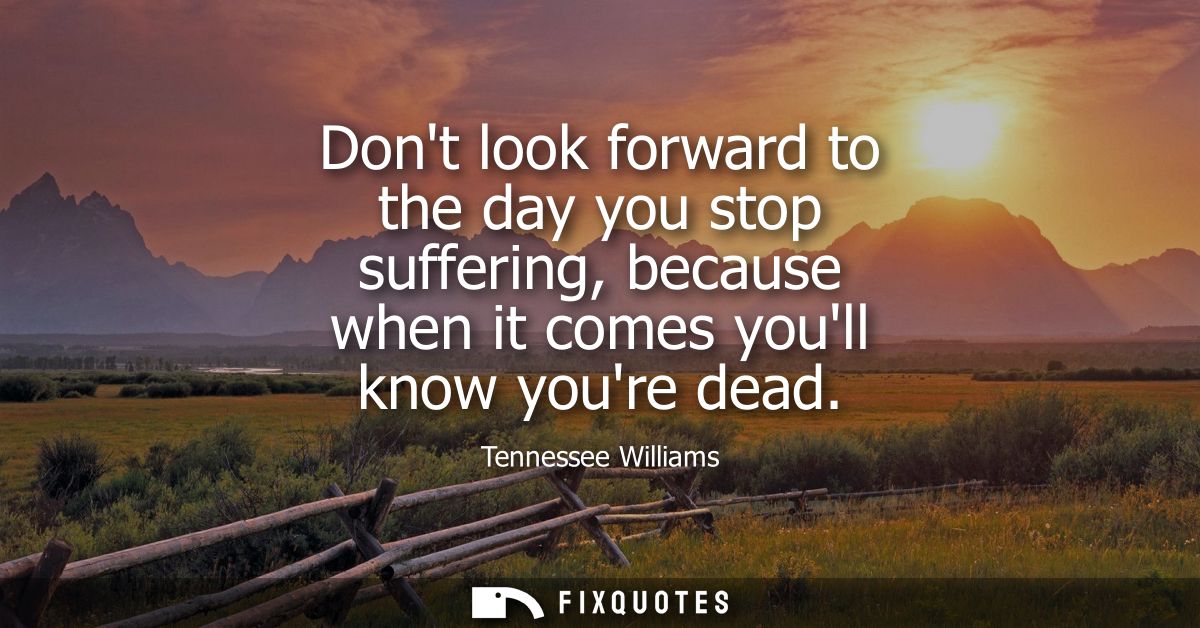
"Don't look forward to the day you stop suffering, because when it comes you'll know you're dead"
About this Quote
The subtext is theatrical and personal. His characters - Blanche, Brick, Amanda - aren’t destroyed by suffering itself so much as by their attempts to anesthetize it: alcohol, fantasy, performance, control. “Don’t look forward” is a warning against postponing life until the pain stops, because that posture turns living into a waiting room. It’s also a jab at the American optimism he so often skewered: the idea that hardship is merely a plot obstacle on the way to a clean resolution. Williams insists the mess is the plot.
Context matters: a dramatist writing through mid-century moral policing, family trauma, addiction, and the pressure of being a gay man in public success and private peril. In that light, the line reads less like nihilism than like brutal craft advice: suffering is the engine; if you remove it, you remove motion. The bleakness isn’t decorative. It’s an artistic ethic - stay awake, stay raw, don’t confuse numbness with peace.
Quote Details
| Topic | Mortality |
|---|---|
| Source | Later attribution: Beyond the Mask (Kathleen A. Burt, 2012) modern compilationISBN: 9781926975085 · ID: e5d2DwAAQBAJ
Evidence:
... Tennessee Williams , “ All of us are guinea pigs in the laboratory of God . Humanity is just a work in progress . " Playwright . " Don't look forward to the day you stop suffering , because when it comes you'll know you're dead ... |
| Cite |
Citation Formats
APA Style (7th ed.)
Williams, Tennessee. (2026, February 12). Don't look forward to the day you stop suffering, because when it comes you'll know you're dead. FixQuotes. https://fixquotes.com/quotes/dont-look-forward-to-the-day-you-stop-suffering-1979/
Chicago Style
Williams, Tennessee. "Don't look forward to the day you stop suffering, because when it comes you'll know you're dead." FixQuotes. February 12, 2026. https://fixquotes.com/quotes/dont-look-forward-to-the-day-you-stop-suffering-1979/.
MLA Style (9th ed.)
"Don't look forward to the day you stop suffering, because when it comes you'll know you're dead." FixQuotes, 12 Feb. 2026, https://fixquotes.com/quotes/dont-look-forward-to-the-day-you-stop-suffering-1979/. Accessed 12 Feb. 2026.