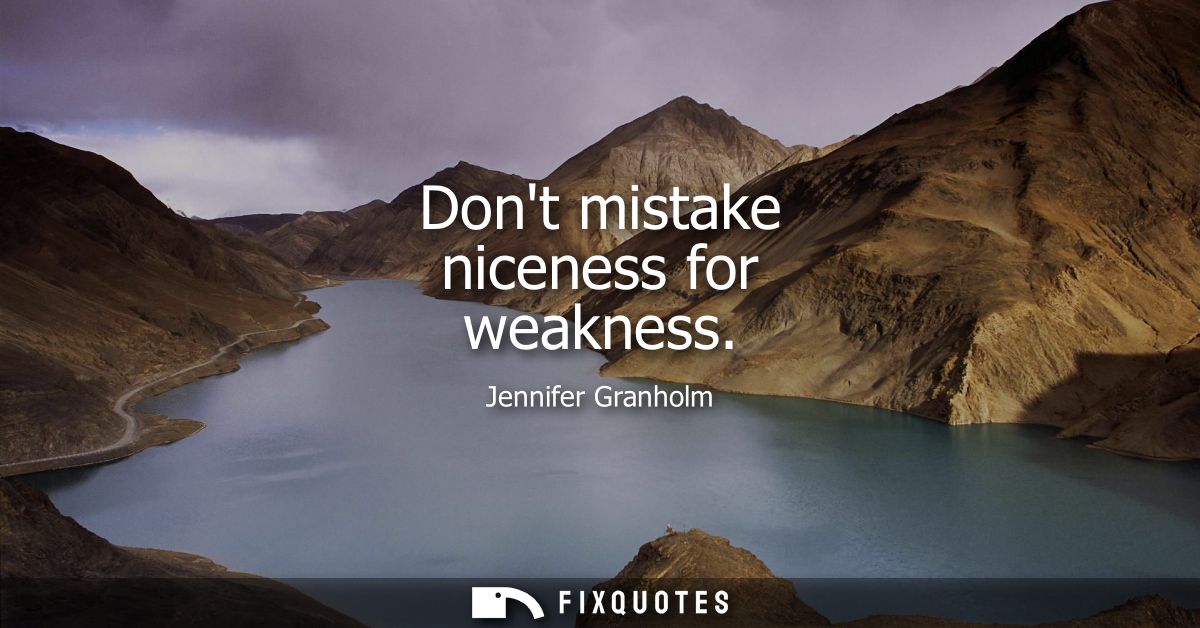
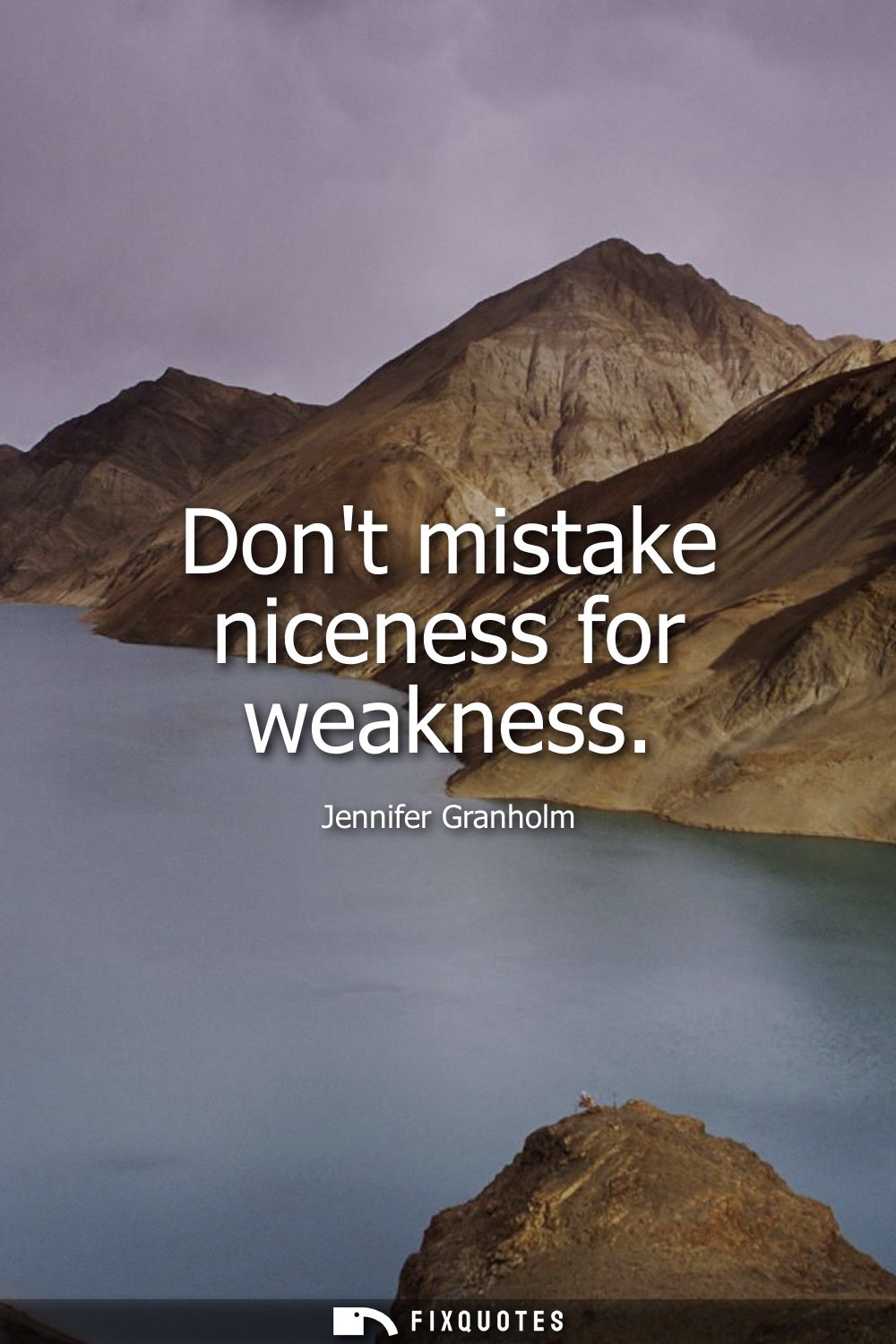
"Don't mistake niceness for weakness"
About this Quote
"Don't mistake niceness for weakness" is the kind of warning that lands hardest in rooms where power is negotiated through tone: committee hearings, union halls, donor meetings, the cable-news greenroom. Coming from Jennifer Granholm, a politician who built a public-facing brand on approachable competence, the line functions as both self-defense and quiet threat. It reassures allies that civility is a strategy, not a surrender. It warns opponents that politeness is not permission.
The genius is in the verb "mistake". Granholm isn’t pleading to be taken seriously; she’s diagnosing a perception error in the listener. That flips the burden. If you read her warmth as softness, that’s your miscalculation, and miscalculations in politics get punished. "Niceness" is also a deliberately domestic, gender-coded word: a trait women are expected to perform and then derided for when they do. The quote pushes back against the trap where a woman leader gets labeled either "likable" or "strong" as if the two can’t coexist.
Context matters here: modern American politics rewards aggression, while still demanding "civility" as a performative ritual. Granholm’s line threads that needle. It argues for a form of power that doesn’t need constant theatrics, a reminder that some of the most consequential actors work in calm voices while moving leverage behind the scenes. It’s an assertion that decency can be armor, not ornament.
The genius is in the verb "mistake". Granholm isn’t pleading to be taken seriously; she’s diagnosing a perception error in the listener. That flips the burden. If you read her warmth as softness, that’s your miscalculation, and miscalculations in politics get punished. "Niceness" is also a deliberately domestic, gender-coded word: a trait women are expected to perform and then derided for when they do. The quote pushes back against the trap where a woman leader gets labeled either "likable" or "strong" as if the two can’t coexist.
Context matters here: modern American politics rewards aggression, while still demanding "civility" as a performative ritual. Granholm’s line threads that needle. It argues for a form of power that doesn’t need constant theatrics, a reminder that some of the most consequential actors work in calm voices while moving leverage behind the scenes. It’s an assertion that decency can be armor, not ornament.
Quote Details
| Topic | Confidence |
|---|---|
| Source | Help us find the source |
| Cite |
Citation Formats
APA Style (7th ed.)
Granholm, Jennifer. (2026, January 15). Don't mistake niceness for weakness. FixQuotes. https://fixquotes.com/quotes/dont-mistake-niceness-for-weakness-142899/
Chicago Style
Granholm, Jennifer. "Don't mistake niceness for weakness." FixQuotes. January 15, 2026. https://fixquotes.com/quotes/dont-mistake-niceness-for-weakness-142899/.
MLA Style (9th ed.)
"Don't mistake niceness for weakness." FixQuotes, 15 Jan. 2026, https://fixquotes.com/quotes/dont-mistake-niceness-for-weakness-142899/. Accessed 28 Mar. 2026.
More Quotes by Jennifer
Add to List