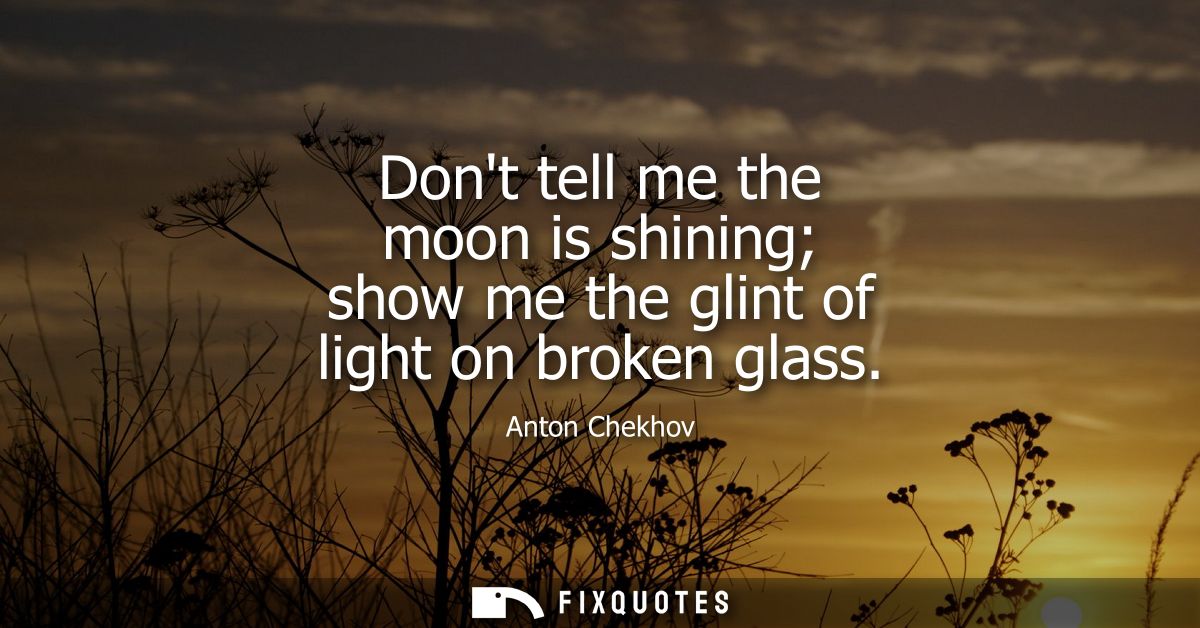
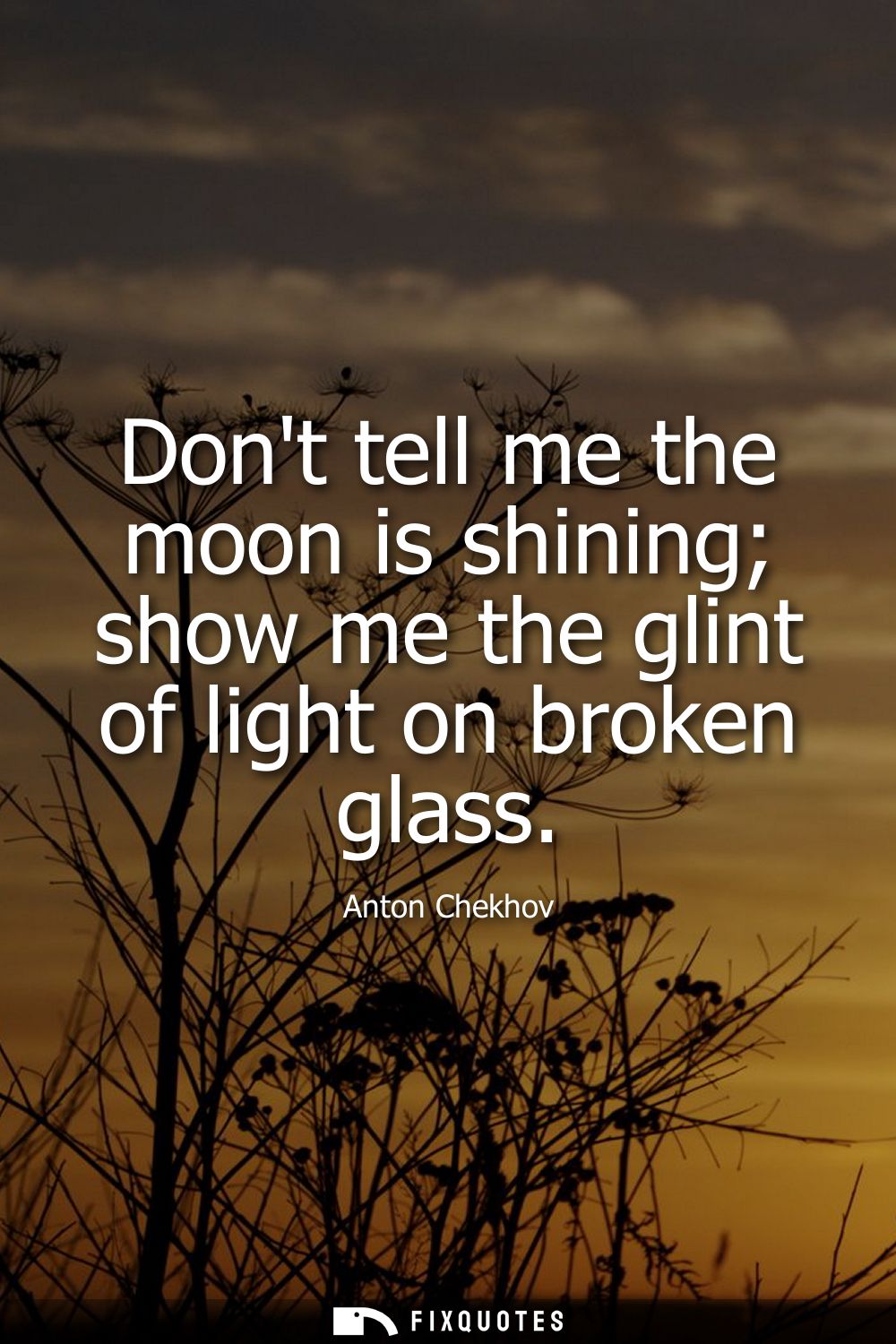
"Don't tell me the moon is shining; show me the glint of light on broken glass"
About this Quote
The intent is aesthetic, but also moral. Chekhov is often read as gentle; this is him being exacting. He distrusts grand declarations because they’re too easy to fake. Anyone can announce beauty. The real writer proves it by noticing what most people step around. Broken glass is doing double duty: it’s sensory (a sharp flash in the dark) and social (a hint of poverty, violence, disorder, or a party that went wrong). One image quietly supplies narrative pressure.
Context matters. As a dramatist and doctor, Chekhov worked in a culture thick with melodrama and moralizing. His plays and stories push against that tradition by making meaning accumulate through implication, not proclamation. This line crystallizes the “show, don’t tell” principle, but in Chekhov’s hands it’s less a workshop rule than a worldview: reality arrives as fragments, and the writer’s job is to make us feel the whole by letting one precise fragment cut.
Quote Details
| Topic | Writing |
|---|---|
| Source | Help us find the source |
| Cite |
Citation Formats
APA Style (7th ed.)
Chekhov, Anton. (2026, January 17). Don't tell me the moon is shining; show me the glint of light on broken glass. FixQuotes. https://fixquotes.com/quotes/dont-tell-me-the-moon-is-shining-show-me-the-38637/
Chicago Style
Chekhov, Anton. "Don't tell me the moon is shining; show me the glint of light on broken glass." FixQuotes. January 17, 2026. https://fixquotes.com/quotes/dont-tell-me-the-moon-is-shining-show-me-the-38637/.
MLA Style (9th ed.)
"Don't tell me the moon is shining; show me the glint of light on broken glass." FixQuotes, 17 Jan. 2026, https://fixquotes.com/quotes/dont-tell-me-the-moon-is-shining-show-me-the-38637/. Accessed 1 Apr. 2026.