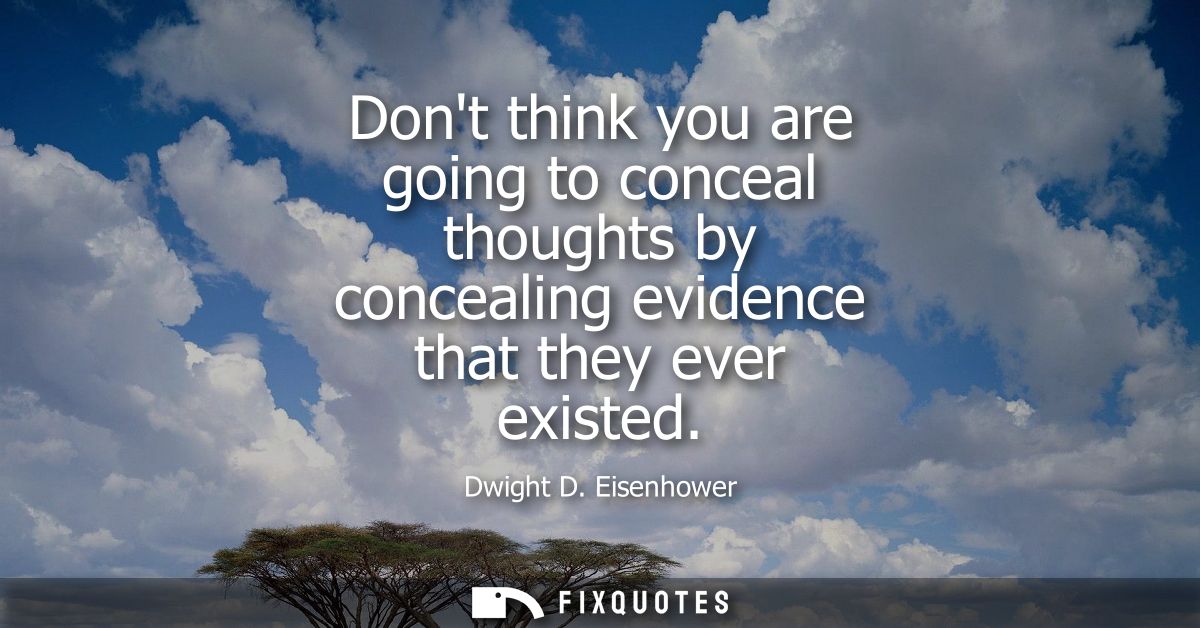
"Don't think you are going to conceal thoughts by concealing evidence that they ever existed"
About this Quote
Eisenhower speaks with the authority of someone who ran vast systems where documentation is oxygen: wartime command, NATO logistics, the modern presidency. That matters. He isn’t moralizing from a pulpit; he’s diagnosing how institutions actually work. Memory is distributed. Paper circulates. People talk. Bureaucracies, like battlefields, produce traces. The quote implies a second audience beyond the would-be cover-up artist: subordinates and witnesses. It nudges them toward skepticism about secrecy and toward the idea that truth has redundancies.
The subtext is also reputational: leaders who try to bury evidence don’t just risk exposure; they reveal they had something worth hiding in the first place. Eisenhower, famous for a calm managerial persona, uses a clipped, almost parental reprimand to assert a hard reality: history isn’t fooled by missing pages. It’s often most interested in the pages someone tried to tear out.
Quote Details
| Topic | Honesty & Integrity |
|---|---|
| Source | Help us find the source |
| Cite |
Citation Formats
APA Style (7th ed.)
Eisenhower, Dwight D. (2026, January 17). Don't think you are going to conceal thoughts by concealing evidence that they ever existed. FixQuotes. https://fixquotes.com/quotes/dont-think-you-are-going-to-conceal-thoughts-by-30919/
Chicago Style
Eisenhower, Dwight D. "Don't think you are going to conceal thoughts by concealing evidence that they ever existed." FixQuotes. January 17, 2026. https://fixquotes.com/quotes/dont-think-you-are-going-to-conceal-thoughts-by-30919/.
MLA Style (9th ed.)
"Don't think you are going to conceal thoughts by concealing evidence that they ever existed." FixQuotes, 17 Jan. 2026, https://fixquotes.com/quotes/dont-think-you-are-going-to-conceal-thoughts-by-30919/. Accessed 22 Mar. 2026.